Tennessee purple coneflower
Echinacea tennesseensis · Accepted scientific name
Scientific literature: Very Sparse (8 studies) · ★☆☆☆☆
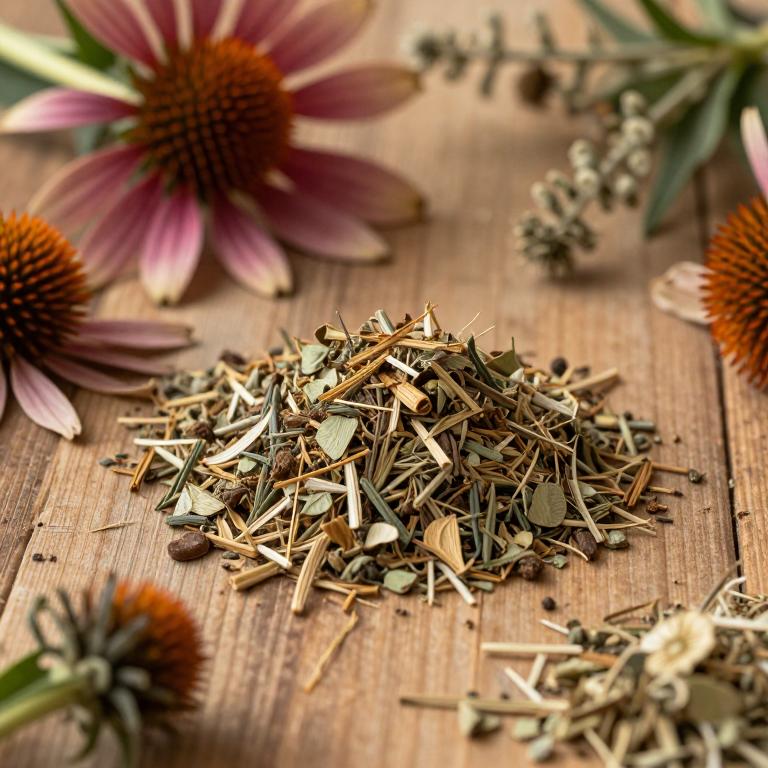
Tennessee purple coneflower, scientifically known as Echinacea tennesseensis, is a rare perennial herb endemic to specific limestone outcrops in the Southeastern United States. Renowned for its vibrant blooms, this species shares the medicinal heritage of its relatives, traditionally valued for supporting immune health and providing potent antioxidant properties.
- Family
- Asteraceae
- Native range
- Northern America
- Parts used
- Flower · Leaf
- Common names
- Tennessee Purple-Coneflower · Tennessee Coneflower
- Scientific synonyms
- Echinacea Pallida Var. Tennesseensis · Echinacea Angustifolia Var. Tennesseensis · 1 more
Names and Synonyms
Common Names
- Tennessee purple-coneflower
- Tennessee coneflower
Scientific Names
Accepted name
Echinacea tennesseensisSynonyms
- Echinacea pallida var. tennesseensis
- Echinacea angustifolia var. tennesseensis
- Brauneria tennesseensis
Sources: Wikidata, Catalogue of Life
Taxonomical Classification
This plant, Echinacea tennesseensis, belongs to the kingdom Plantae and the phylum Streptophyta. Within the class Equisetopsida and subclass Magnoliidae, it is classified under the order Asterales. Finally, it is a member of the family Asteraceae and is specifically categorized under the genus Echinacea.
| Rank | Classification |
|---|---|
| Kingdom | Plantae |
| Phylum | Streptophyta |
| Class | Equisetopsida |
| Subclass | Magnoliidae |
| Order | Asterales |
| Family | Asteraceae |
| Genus | Echinacea |
Sources: The World Checklist of Vascular Plants (WCVP)
Distribution
This plant is characterized by a very specific and limited geographical range. It is found exclusively within the Southeastern United States. More precisely, its natural habitat is restricted to the state of Tennessee. Because of this narrow distribution, it is considered a localized species. This specific location defines the primary area where the plant can be discovered in the wild.
| Region | Area |
|---|---|
| Southeastern U.S.A. | Tennessee |
Sources: The World Checklist of Vascular Plants (WCVP)
Botanical Identification
Life history
The life history of Echinacea tennesseensis is characterized by its nature as a perennial plant, meaning it completes its life cycle over multiple years rather than dying after a single growing season. As a perennial, the species establishes a robust root system that allows it to survive dormant periods during unfavorable environmental conditions, such as extreme cold or drought, before re-emerging to continue its growth cycle. This long-term survival strategy enables the plant to accumulate resources over time, supporting the development of its characteristic flowering structures in successive seasons. By persisting through multiple years, the plant can participate in long-term reproductive cycles, contributing to the stability of its population within its native habitats.
- Lifecycle :
- perennial
Morphology
The morphology of Echinacea tennesseensis is characterized by its growth form as a non-woody herb, specifically categorized as a forb. It functions as an independent organism, lacking any parasitic or epiphytic tendencies, as it maintains a strictly terrestrial lifestyle rather than being aquatic, semiaquatic, or epiphytic. The plant is entirely self-supporting, showing no tendencies to act as a climber, liana, or vine, and relies on its herbaceous structure for stability.
- Aquatic :
- terrestrial
- Climber :
- self-supporting
- Epiphyte :
- terrestrial
- Growth form :
- herb
- Growth form :
- forb
- Parasite :
- independent
- Woodiness :
- non-woody
Sources: Global Inventory of Floras and Traits (GIFT)
Plant Parts
Echinacea tennesseensis has 4 reported plant parts identified across 4 scientific publications and several other databases that are studied for medicinal purposes. The most consistently reported plant part include flower, leaf, root, stem.
| Plant part | Supporting sources | Consensus |
|---|---|---|
| Flower | 1 supporting sources | ★☆☆☆☆ |
| Leaf | 1 supporting sources | ★☆☆☆☆ |
| Root | 1 supporting sources | ★☆☆☆☆ |
| Stem | 1 supporting sources | ★☆☆☆☆ |
Flower
- Cytokine
Leaf
- Cytokine
Root
- Cytokine
Stem
- Cytokine
Chemicals
Echinacea tennesseensis has 2 reported phytochemicals identified across 4 scientific publications and several other databases. The most consistently reported chemicals include IL 10, TNF alpha.
| Chemical | Supporting sources | Consensus |
|---|---|---|
| IL 10 | 1 supporting sources | ★☆☆☆☆ |
| TNF alpha | 1 supporting sources | ★☆☆☆☆ |
IL 10
- Cytokine
TNF alpha
- Cytokine
Conditions
Echinacea tennesseensis has 2 reported investigations on conditions identified across 4 scientific publications and several other databases. The most consistently reported conditions include influenza, upper respiratory infections.
| Condition | Supporting sources | Consensus |
|---|---|---|
| Influenza | 1 supporting sources | ★☆☆☆☆ |
| Upper respiratory infections | 1 supporting sources | ★☆☆☆☆ |
Influenza
- Cytokine
Upper respiratory infections
- Cytokine
Preparations
Echinacea tennesseensis has 1 reported preparations identified across 4 scientific publications and several other databases. The most consistently reported preparations include ethanol tinctures.
| Preparation | Supporting sources | Consensus |
|---|---|---|
| Ethanol tinctures | 1 supporting sources | ★☆☆☆☆ |
Ethanol tinctures
- Cytokine