sanguine purple-coneflower
Echinacea sanguinea · Accepted scientific name
Scientific literature: Very Sparse (1 studies) · ★☆☆☆☆
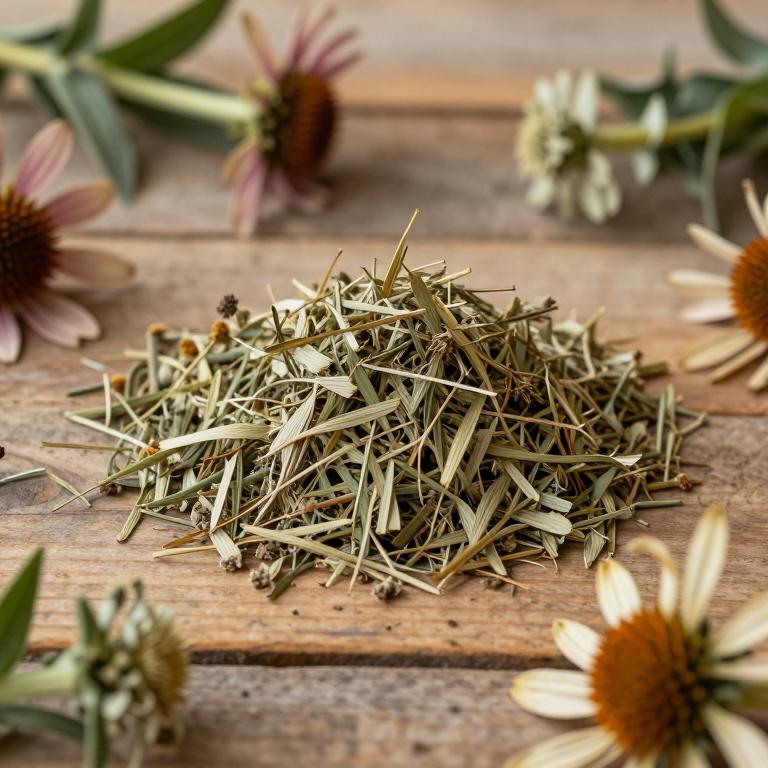
Sanguine purple-coneflower, scientifically known as Echinacea sanguinea, is a striking perennial native to specific regions of North America. Renowned for its deep, blood-red hues, this medicinal plant is celebrated in herbalism for its potent immune-boosting properties and its ability to support the body's natural defenses against various ailments.
- Family
- Asteraceae
- Native range
- Northern America
- Parts used
- Not available
- Common names
- Sanguine Purple-Coneflower
- Scientific synonyms
- Echinacea Pallida Var. Sanguinea
Names and Synonyms
Common Names
- sanguine purple-coneflower
Scientific Names
Accepted name
Echinacea sanguineaSynonyms
- Echinacea pallida var. sanguinea
Sources: Wikidata, Catalogue of Life
Taxonomical Classification
This plant belongs to the kingdom Plantae and the phylum Streptophyta, falling under the class Equisetopsida and subclass Magnoliidae. Within the order Asterales, it is classified under the family Asteraceae. Finally, its taxonomic identity is defined by the genus Echinacea.
| Rank | Classification |
|---|---|
| Kingdom | Plantae |
| Phylum | Streptophyta |
| Class | Equisetopsida |
| Subclass | Magnoliidae |
| Order | Asterales |
| Family | Asteraceae |
| Genus | Echinacea |
Sources: The World Checklist of Vascular Plants (WCVP)
Distribution
This plant exhibits a specific range across several regions of the United States. In the North-Central U.S.A., its presence is noted in Oklahoma. Moving toward the South-Central U.S.A., the species can also be found in Texas. The distribution extends into the Southeastern U.S.A., where it inhabits Arkansas. Finally, it is also documented within the state of Louisiana.
| Region | Area |
|---|---|
| North-Central U.S.A. | Oklahoma |
| South-Central U.S.A. | Texas |
| Southeastern U.S.A. | Arkansas |
| Southeastern U.S.A. | Louisiana |
Sources: The World Checklist of Vascular Plants (WCVP)
Botanical Identification
Life history
The life history of Echinacea sanguinea is characterized by its status as a perennial, meaning it completes its life cycle over multiple years through a continuous cycle of growth, flowering, and dormancy. As a perennial, the plant establishes a robust root system that allows it to survive through various seasonal changes, re-emerging from the soil to initiate new vegetative growth each spring. This life strategy enables the plant to invest significant energy into long-term survival and structural development rather than focusing solely on a single reproductive event. Throughout its lifespan, it undergoes distinct phenological stages, including the development of foliage, the emergence of its characteristic blooms, and the subsequent production of seeds for sexual reproduction, ensuring both individual longevity and the continued propagation of the species within its habitat.
- Lifecycle :
- perennial
Morphology
The morphology of Echinacea sanguinea is characterized by its growth form as a non-woody herb, specifically classified as a forb. The plant is strictly terrestrial in its habitat, functioning as an independent organism that does not exhibit parasitic or epiphytic behaviors. Structurally, it is a self-supporting species rather than a climber, meaning it lacks the liana or vine characteristics necessary for obligatory or facultative climbing, maintaining a stable, upright stature through its own herbaceous stem structure.
- Aquatic :
- terrestrial
- Climber :
- self-supporting
- Epiphyte :
- terrestrial
- Growth form :
- herb
- Growth form :
- forb
- Parasite :
- independent
- Woodiness :
- non-woody
Sources: Global Inventory of Floras and Traits (GIFT)
Activities
Echinacea sanguinea has 1 reported activities identified across 0 scientific publications and several other databases. The most consistently reported activities include Antiinflammatory.
| Activity | Supporting sources | Consensus |
|---|---|---|
| Antiinflammatory | 1 supporting sources | ★☆☆☆☆ |
Antiinflammatory
- The American journal of clinical nutrition
Preparations
Echinacea sanguinea has 1 reported preparations identified across 0 scientific publications and several other databases. The most consistently reported preparations include Echinacea sanguinea ethanol extracts.
| Preparation | Supporting sources | Consensus |
|---|---|---|
| Echinacea sanguinea ethanol extracts | 1 supporting sources | ★☆☆☆☆ |
Echinacea sanguinea ethanol extracts
- Planta medica