fragrant cliff fern
Dryopteris fragrans · Accepted scientific name
Scientific literature: Very Sparse (46 studies) · ★☆☆☆☆
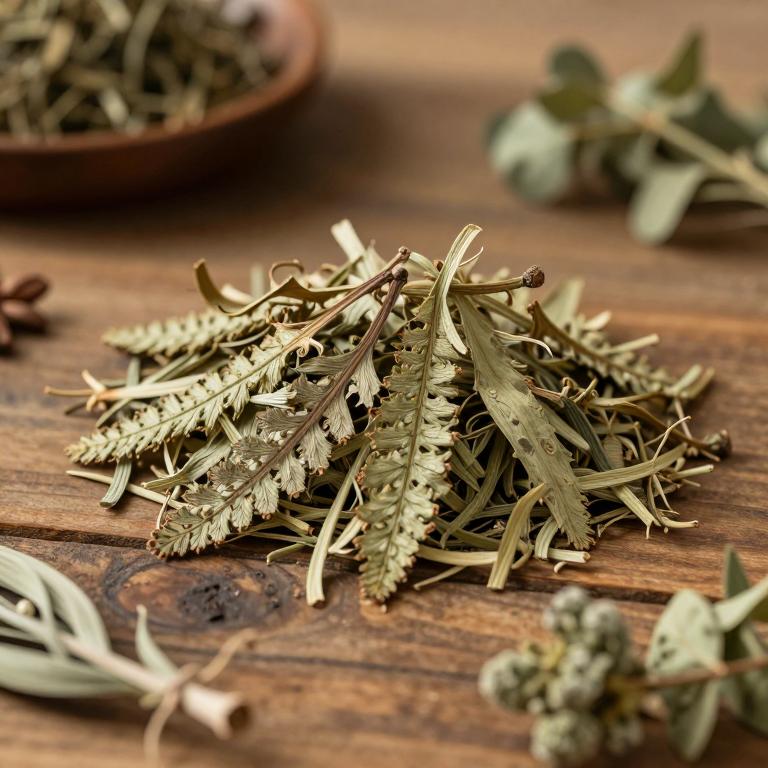
Fragrant cliff fern, scientifically known as Dryopteris fragrans, is a captivating perennial celebrated for its aromatic foliage. Thriving in shaded, rocky crevices, this fern offers both ornamental beauty and traditional medicinal potential. Its unique scent and resilient nature make it a distinctive addition to any botanical collection or garden.
Names and Synonyms
Common Names
- fragrant cliff fern
- fragrant cliff wood fern
- fragrant fern
- fragrant shield fern
- fragrant wood fern
- fragrant-cliff fern
Scientific Names
Accepted name
Dryopteris fragransSynonyms
- Aspidium fragrans
- Dryopteris aquilonaris
- Dryopteris fragrans f. aquilonaris
- Dryopteris fragrans var. remotiuscula
- Filix aquilonaris
- Filix fragrans
- Filix-mas fragrans
- Lastrea fragrans
- Nephrodium fragrans var. remotiusculum
- Nephrodium fragrans f. aquilonare
- Nephrodium fragrans var. aquilonare
- Polystichum fragrans
- Woodsia xanthosporangia
- Nephrodium fragrans
- Filix-mas fragrans var. hookeriana
- Thelypteris fragrans
- Thelypteris fragrans var. hookeriana
- Dryopteris fragrans var. hookeriana
Regional and Traditional Names
French:
- dryoptère fragrante
- dryoptère odorante
- dryoptéride odorante
Sources: Wikidata, Catalogue of Life
Taxonomical Classification
This plant belongs to the kingdom Plantae and the phylum Streptophyta, placing it within the class Equisetopsida. It is further classified under the subclass Polypodiinae and the order Polypodiales, falling into the family Polypodiaceae. Finally, it is identified by the genus Dryopteris.
| Rank | Classification |
|---|---|
| Kingdom | Plantae |
| Phylum | Streptophyta |
| Class | Equisetopsida |
| Subclass | Polypodiinae |
| Order | Polypodiales |
| Family | Polypodiaceae |
| Genus | Dryopteris |
Sources: The World Checklist of Vascular Plants (WCVP)
Distribution
This plant exhibits a wide geographical distribution across several distinct regions of the northern hemisphere. In Northern Europe, its presence is specifically noted within the borders of Finland. Moving toward Eastern Europe, the species can be found throughout North European Russia. Its range extends significantly into Siberia, where it inhabits the Altay region. Furthermore, the plant is documented in the Siberian territories of both Buryatiya and Chitа.
| Region | Area |
|---|---|
| Northern Europe | Finland |
| Eastern Europe | North European Russia |
| Siberia | Altay |
| Siberia | Buryatiya |
| Siberia | Chita |
| Siberia | Irkutsk |
| Siberia | Krasnoyarsk |
| Siberia | Tuva |
| Siberia | West Siberia |
| Siberia | Yakutiya |
Sources: The World Checklist of Vascular Plants (WCVP)
Botanical Identification
Ecology
The ecology of Dryopteris fragrans is defined by its preference for specific microhabitats characterized by structural complexity and moisture retention. This species is primarily found colonizing crevices in rocks and specialized niches within planters, where the substrate provides the necessary stability and mineral composition for its rhizomatous growth. By occupying these rocky and container-based environments, the plant utilizes the unique drainage properties and moisture-holding capacities of these sites to support its physiological needs. The ability to thrive in such localized environments suggests a specialized ecological strategy centered on utilizing rocky interfaces and sheltered niches that offer protection from excessive environmental fluctuations.
- Habitat :
- placers and rocks
Life history
The life history of Dryopteris fragrans is characterized by its status as a perennial plant, meaning it lives for more than two years and undergoes consistent growth cycles through multiple seasons. As a perennial fern, it survives unfavorable environmental conditions by maintaining underground structures, such as rhizomes, which store nutrients and allow the plant to regrow during favorable periods. Its developmental cycle involves the emergence of fronds from these rhizomes, followed by the maturation of spore-producing structures on the underside of the leaves. Unlike annuals or biennials, this species establishes long-term presence in its habitat, continuously replenishing its biomass and participating in reproductive cycles through the dispersal of spores over many years.
- Lifecycle :
- perennial
Morphology
The morphology of Dryopteris fragrans is characterized by its growth form as a non-woody herb and specifically a forb. It is a self-supporting plant that does not exhibit climbing behavior, functioning as an independent organism rather than a parasite or epiphyte, with a primarily terrestrial habitat. The plant is relatively small in stature, maintaining a height that ranges from a minimum of 0.05 m to a maximum of 0.3 m.
- Aquatic :
- terrestrial
- Climber :
- self-supporting
- Epiphyte :
- terrestrial
- Growth form :
- herb
- Growth form :
- forb
- Parasite :
- independent
- Plant height max:
- 0.3 m
- Plant height min:
- 0.05 m
- Woodiness :
- non-woody
Reproduction
The reproduction of Dryopteris fragrans follows the characteristic lifecycle of ferns, involving an alternation of generations rather than the production of traditional flowers. Instead of blooming, the plant produces specialized structures called sporangia, typically located on the underside of its fertile fronds, which release microscopic spores into the environment. Based on the seasonal cycles of its reproductive development, the period associated with its reproductive activity begins in July and reaches its conclusion in August. These spores, when dispersed under favorable moisture conditions, germinate into a small, heart-shaped gametophyte, which eventually facilitates the fertilization process required to produce new sporophytes.
- Flowering time :
- Jul
- Flowering time :
- Aug
Sources: Global Inventory of Floras and Traits (GIFT)
Plant Parts
Dryopteris fragrans has 1 reported plant parts identified across 1 scientific publications and several other databases that are studied for medicinal purposes. The most consistently reported plant part include root.
| Plant part | Supporting sources | Consensus |
|---|---|---|
| Root | 1 supporting sources | ★☆☆☆☆ |
Root
- International journal of molecular sciences
Chemicals
Dryopteris fragrans has 31 reported phytochemicals identified across 1 scientific publications and several other databases. The most consistently reported chemicals include Albicanol, triterpenoids, 1,4,8-TRIHYDROXYANTHRAQUINONE, 1,8-dihydroxy-anthraquinone, Aspidin BB.
| Chemical | Supporting sources | Consensus |
|---|---|---|
| Albicanol | 2 supporting sources | ★☆☆☆☆ |
| triterpenoids | 2 supporting sources | ★☆☆☆☆ |
| 1,4,8-TRIHYDROXYANTHRAQUINONE | 1 supporting sources | ★☆☆☆☆ |
| 1,8-dihydroxy-anthraquinone | 1 supporting sources | ★☆☆☆☆ |
| Aspidin BB | 1 supporting sources | ★☆☆☆☆ |
| Aspidin PB | 1 supporting sources | ★☆☆☆☆ |
| Aspidinol | 1 supporting sources | ★☆☆☆☆ |
| BETA-SITOSTEROL | 1 supporting sources | ★☆☆☆☆ |
| Chrysophanol | 1 supporting sources | ★☆☆☆☆ |
| Cryptotanshinone | 1 supporting sources | ★☆☆☆☆ |
Albicanol
- Food & function
- Zhong yao cai = Zhongyaocai = Journal of Chinese medicinal materials
triterpenoids
- Pharmaceuticals (Basel, Switzerland)
- Protein expression and purification
1,4,8-TRIHYDROXYANTHRAQUINONE
- Pharmaceuticals (Basel, Switzerland)
1,8-dihydroxy-anthraquinone
- Pharmaceuticals (Basel, Switzerland)
Aspidin BB
- Zhong yao cai = Zhongyaocai = Journal of Chinese medicinal materials
Aspidin PB
- Zhong yao cai = Zhongyaocai = Journal of Chinese medicinal materials
Aspidinol
- Zhong yao cai = Zhongyaocai = Journal of Chinese medicinal materials
BETA-SITOSTEROL
- Zhong yao cai = Zhongyaocai = Journal of Chinese medicinal materials
Chrysophanol
- Pharmaceuticals (Basel, Switzerland)
Cryptotanshinone
- Pharmaceuticals (Basel, Switzerland)
Activities
Dryopteris fragrans has 2 reported activities identified across 1 scientific publications and several other databases. The most consistently reported activities include Anticancer, Antioxidant.
| Activity | Supporting sources | Consensus |
|---|---|---|
| Anticancer | 1 supporting sources | ★☆☆☆☆ |
| Antioxidant | 1 supporting sources | ★☆☆☆☆ |
Anticancer
- Molecules (Basel, Switzerland)
Antioxidant
- Food & function
Conditions
Dryopteris fragrans has 5 reported investigations on conditions identified across 1 scientific publications and several other databases. The most consistently reported conditions include antioxidant activity, breast cancer, cancer, gastric cancer, lung cancer.
| Condition | Supporting sources | Consensus |
|---|---|---|
| Antioxidant activity | 1 supporting sources | ★☆☆☆☆ |
| Breast cancer | 1 supporting sources | ★☆☆☆☆ |
| Cancer | 1 supporting sources | ★☆☆☆☆ |
| Gastric cancer | 1 supporting sources | ★☆☆☆☆ |
| Lung cancer | 1 supporting sources | ★☆☆☆☆ |
Antioxidant activity
- Food & function
Breast cancer
- Molecules (Basel, Switzerland)
Cancer
- Molecules (Basel, Switzerland)
Gastric cancer
- Molecules (Basel, Switzerland)
Lung cancer
- Molecules (Basel, Switzerland)
Preparations
Dryopteris fragrans has 2 reported preparations identified across 1 scientific publications and several other databases. The most consistently reported preparations include alcohol extract, sesquiterpenoid.
| Preparation | Supporting sources | Consensus |
|---|---|---|
| Alcohol extract | 1 supporting sources | ★☆☆☆☆ |
| Sesquiterpenoid | 1 supporting sources | ★☆☆☆☆ |
Alcohol extract
- Zhong yao cai = Zhongyaocai = Journal of Chinese medicinal materials
Sesquiterpenoid
- Food & function