Madagascar Sundew
Drosera madagascariensis · Accepted scientific name
Scientific literature: Very Sparse (1 studies) · ★☆☆☆☆
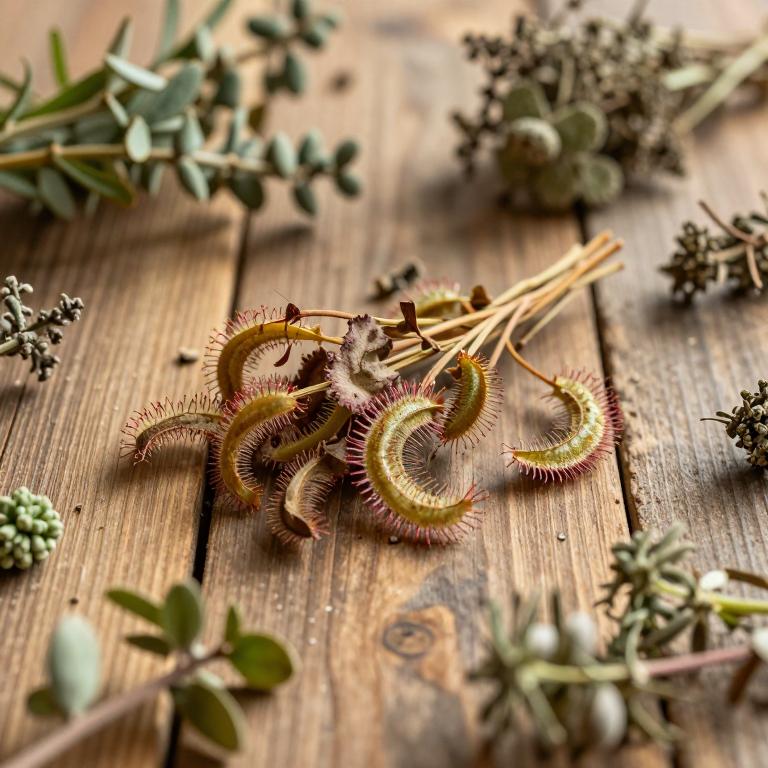
Madagascar Sundew, scientifically known as Drosera madagascariensis, is a captivating carnivorous plant endemic to the unique ecosystems of Madagascar. Renowned for its glistening, mucilaginous tentacles, it expertly traps insects to supplement nutrient-poor soils. Beyond its botanical beauty, this species holds significant interest in traditional medicinal practices and ecological studies.
- Family
- Droseraceae
- Native range
- Africa
- Parts used
- Not available
- Common names
- Madagascar Sundew
- Scientific synonyms
- Drosera Congolana
Names and Synonyms
Common Names
- Madagascar Sundew
Scientific Names
Accepted name
Drosera madagascariensisSynonyms
- Drosera congolana
Sources: Wikidata, Catalogue of Life
Taxonomical Classification
This plant, Drosera madagascariensis, belongs to the kingdom Plantae and the phylum Streptophyta. Within the class Equisetopsida and subclass Magnoliidae, it is classified under the order Caryophyllales. Finally, it is a member of the family Droseraceae and falls under the genus Drosera.
| Rank | Classification |
|---|---|
| Kingdom | Plantae |
| Phylum | Streptophyta |
| Class | Equisetopsida |
| Subclass | Magnoliidae |
| Order | Caryophyllales |
| Family | Droseraceae |
| Genus | Drosera |
Sources: The World Checklist of Vascular Plants (WCVP)
Distribution
This plant exhibits a specific geographical distribution across several nations in West Tropical Africa. It can be found growing within the borders of Benin and Guinea. Additionally, its presence extends into the territory of Mali. The species is also documented to inhabit parts of Nigeria. Finally, its range includes the country of Niger.
| Region | Area |
|---|---|
| West Tropical Africa | Benin |
| West Tropical Africa | Guinea |
| West Tropical Africa | Mali |
| West Tropical Africa | Nigeria |
| West Tropical Africa | Niger |
| West-Central Tropical Africa | Burundi |
| West-Central Tropical Africa | Central African Republic |
| West-Central Tropical Africa | Cameroon |
| West-Central Tropical Africa | Congo |
| West-Central Tropical Africa | Gabon |
Sources: The World Checklist of Vascular Plants (WCVP)
Botanical Identification
Ecology
The ecology of Drosera madagascariensis is characterized by its preference for specialized niches within swampy savannah environments. This species thrives in these waterlogged, nutrient-poor habitats, where its specialized survival strategies are adapted to the specific hydrological conditions of the savannah ecosystem. Its distribution occurs across a notable altitudinal gradient, spanning from low-lying areas at an elevation of 45 m AMSL to higher reaches reaching a maximum of 1550 m AMSL.
- Elevational range max:
- 1550 m AMSL
- Elevational range min:
- 45 m AMSL
- Habitat :
- in swampy savannah
Life history
The life history of Drosera madagascariensis is characterized by a perennial lifecycle, allowing the plant to persist through multiple growing seasons. In terms of its structural growth strategy, it exhibits a dual classification of life forms, functioning as both a chamaephyte and a hemicryptophyte. As a chamaephyte, its perennating buds are located close to the soil surface, often just above it, which helps in surviving varying environmental conditions. Simultaneously, its classification as a hemicryptophyte indicates that its overwintering buds are situated at the soil surface or slightly below it, protected by leaf litter or substrate, ensuring its continued survival and regeneration within its specific ecological niche.
- Life form :
- chamaephyte
- Life form :
- hemicryptophyte
- Lifecycle :
- perennial
Morphology
The morphology of Drosera madagascariensis is characterized by its growth form as a non-woody herb, existing primarily as a small, self-supporting forb. The plant exhibits a low stature, with a height ranging from a minimum of 0.2 m to a maximum of 0.25 m. In terms of its ecological positioning and habitat preference, it is classified as a terrestrial species, though it can inhabit semiaquatic or aquatic environments. It functions as an independent organism rather than a parasite and does not exhibit epiphytic behavior, remaining grounded in its terrestrial or semiaquatic niche. Lacking any climbing mechanisms, the plant is entirely self-supporting and does not develop into a liana or vine.
- Aquatic :
- terrestrial
- Climber :
- self-supporting
- Epiphyte :
- terrestrial
- Growth form :
- herb
- Parasite :
- independent
- Plant height max:
- 0.25 m
- Plant height min:
- 0.2 m
- Woodiness :
- non-woody
Physiology
The physiology of Drosera madagascariensis is characterized by a complex interplay between autotrophic carbon fixation and heterotrophic nutrient acquisition. As a carnivorous plant adapted to nutrient-poor environments, it utilizes a C3 photosynthetic pathway to convert light energy and atmospheric carbon dioxide into chemical energy, a process that is highly efficient under the specific light and temperature regimes of its native habitat. To supplement the nitrogen and phosphorus deficiencies inherent in its substrate, the plant employs specialized glandular trichomes on its leaf surfaces. These glands secrete a viscous, enzyme-rich mucilage that serves a dual physiological purpose: it acts as a sticky trap for macro-invertebrates and functions as a digestive organ. Once prey is captured, the plant initiates a physiological response involving the secretion of proteases, phosphatases, and nucleases to break down organic matter, followed by the active transport of absorbed nutrients across the leaf membrane to support metabolic functions and growth.
- Photosynthetic pathway :
- C3
Sources: Global Inventory of Floras and Traits (GIFT)
Chemicals
Drosera madagascariensis has 1 reported phytochemicals identified across 0 scientific publications and several other databases. The most consistently reported chemicals include Myricetin 3-O-galactoside.
| Chemical | Supporting sources | Consensus |
|---|---|---|
| Myricetin 3-O-galactoside | 1 supporting sources | ★☆☆☆☆ |
Myricetin 3-O-galactoside
- Die Pharmazie