Dionaea muscipula
Dionaea muscipula · Accepted scientific name
Scientific literature: Very Sparse (43 studies) · ★☆☆☆☆
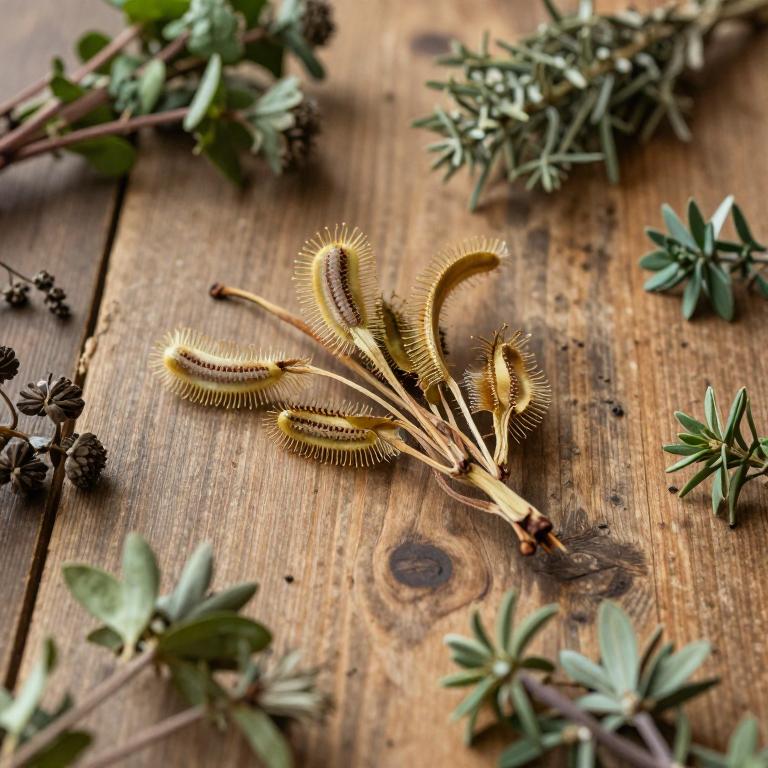
, scientifically known as Dionaea muscipula, is the captivating Venus flytrap, a carnivorous plant native to the wetlands of North and South Carolina. Renowned for its rapid, snap-trap mechanism, it captures insects to supplement nutrient-poor soil, representing one of nature's most extraordinary evolutionary adaptations and botanical marvels.
- Family
- Not available
- Native range
- Northern America
- Parts used
- Not available
- Common names
- Not available
- Scientific synonyms
- Not available
Names and Synonyms
Scientific Names
Accepted name
Dionaea muscipulaDistribution
This plant, known as Dionaea muscipula, exhibits a specific and varied distribution across different regions of the United States. In the Northwestern U.S.A., it can be found as far west as Washington. Moving toward the Northeastern U.S.A., its presence is noted in both New Jersey and Pennsylvania. The species also extends to the Southwestern U.S.A., specifically within the state of California. Finally, its range reaches the Southeastern U.S.A. in Alabama.
| Region | Area |
|---|---|
| Northwestern U.S.A. | Washington |
| Northeastern U.S.A. | New Jersey |
| Northeastern U.S.A. | Pennsylvania |
| Southwestern U.S.A. | California |
| Southeastern U.S.A. | Alabama |
| Southeastern U.S.A. | Florida |
| Southeastern U.S.A. | North Carolina |
| Southeastern U.S.A. | South Carolina |
| Southeastern U.S.A. | Virginia |
| Caribbean | Jamaica |
Sources: The World Checklist of Vascular Plants (WCVP)
Botanical Identification
Life history
The life history of Dionaea muscipula is characterized by its status as a perennial plant, allowing it to persist through multiple growing seasons rather than completing its cycle within a single year. Functioning as a hemicryptophyte, the species maintains its perennating buds at or just below the soil surface, protected by the leaf litter or substrate during unfavorable conditions. This life form, specifically categorized under the hemicryptophyte classification, enables the plant to survive seasonal fluctuations and regrow from its underground structures once environmental conditions become suitable for its specialized physiological processes.
- Life form :
- hemicryptophyte
- Lifecycle :
- perennial
Morphology
The morphology of Dionaea muscipula is characterized by a growth form classified as both a herb and a forb, exhibiting a non-woody structure throughout its vegetative parts. It is a self-supporting plant, functioning as a non-climber without the need for liana or vine-like support. In terms of its ecological positioning and substrate preference, the plant is strictly terrestrial rather than aquatic, semiaquatic, or epiphytic. Furthermore, it is an independent organism that does not exhibit parasitic behavior, maintaining its own physiological processes without relying on a host.
- Aquatic :
- terrestrial
- Climber :
- self-supporting
- Epiphyte :
- terrestrial
- Growth form :
- herb
- Growth form :
- forb
- Parasite :
- independent
- Woodiness :
- non-woody
Sources: Global Inventory of Floras and Traits (GIFT)
Chemicals
Dionaea muscipula has 3 reported phytochemicals identified across 0 scientific publications and several other databases. The most consistently reported chemicals include 3-Chloroplumbagin, Droserone, Plumbagin.
| Chemical | Supporting sources | Consensus |
|---|---|---|
| 3-Chloroplumbagin | 1 supporting sources | ★☆☆☆☆ |
| Droserone | 1 supporting sources | ★☆☆☆☆ |
| Plumbagin | 1 supporting sources | ★☆☆☆☆ |
3-Chloroplumbagin
- Dr. Duke
Droserone
- Dr. Duke
Plumbagin
- Dr. Duke
Activities
Dionaea muscipula has 40 reported activities identified across 0 scientific publications and several other databases. The most consistently reported activities include Abortifacient, Allelochemic, Antialopecic, Antibacterial, Anticoagulant.
| Activity | Supporting sources | Consensus |
|---|---|---|
| Abortifacient | 1 supporting sources | ★☆☆☆☆ |
| Allelochemic | 1 supporting sources | ★☆☆☆☆ |
| Antialopecic | 1 supporting sources | ★☆☆☆☆ |
| Antibacterial | 1 supporting sources | ★☆☆☆☆ |
| Anticoagulant | 1 supporting sources | ★☆☆☆☆ |
| Antifeedant | 1 supporting sources | ★☆☆☆☆ |
| Antifertility | 1 supporting sources | ★☆☆☆☆ |
| Antiflu | 1 supporting sources | ★☆☆☆☆ |
| Antihistoplasmotic | 1 supporting sources | ★☆☆☆☆ |
| Antiimplantation | 1 supporting sources | ★☆☆☆☆ |
Abortifacient
- Dr. Duke
Allelochemic
- Dr. Duke
Antialopecic
- Dr. Duke
Antibacterial
- Dr. Duke
Anticoagulant
- Dr. Duke
Antifeedant
- Dr. Duke
Antifertility
- Dr. Duke
Antiflu
- Dr. Duke
Antihistoplasmotic
- Dr. Duke
Antiimplantation
- Dr. Duke