Grassveld Karmedik
Dicoma anomala · Accepted scientific name
Scientific literature: Very Sparse (21 studies) · ★☆☆☆☆
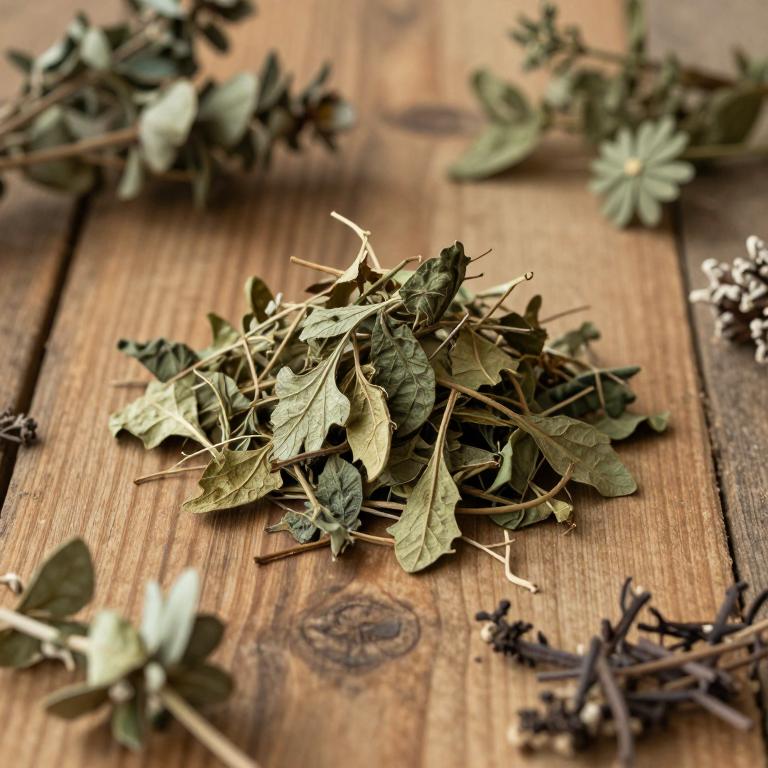
Grassveld Karmedik, scientifically known as Dicoma anomala, is a resilient medicinal herb native to various African regions. Often found in grassland ecosystems, this plant is valued in traditional medicine for its diverse therapeutic properties. Understanding its botanical characteristics and ecological role is essential for exploring its potential pharmacological benefits.
- Family
- Asteraceae
- Native range
- Africa
- Parts used
- Root · Leaf
- Common names
- Grassveld Karmedik · Stomach Bush
- Scientific synonyms
- Not available
Names and Synonyms
Common Names
- Grassveld Karmedik
- Stomach bush
Scientific Names
Accepted name
Dicoma anomalaSources: Wikidata, Catalogue of Life
Taxonomical Classification
This plant belongs to the kingdom Plantae and the phylum Streptophyta, falling under the class Equisetopsida and subclass Magnoliidae. Within the order Asterales, it is classified under the family Asteraceae and the genus Dicoma. As a member of the Dicoma genus, Dicoma anomaloma represents a specific medicinal species within this diverse botanical group.
| Rank | Classification |
|---|---|
| Kingdom | Plantae |
| Phylum | Streptophyta |
| Class | Equisetopsida |
| Subclass | Magnoliidae |
| Order | Asterales |
| Family | Asteraceae |
| Genus | Dicoma |
Sources: The World Checklist of Vascular Plants (WCVP)
Distribution
This plant is geographically distributed across several key regions within the African continent. In West-Central Tropical Africa, its presence is noted in Burundi, Rwanda, and the Democratic Republic of the Congo. Moving toward the southern part of the continent, its range extends into South Tropical Africa. Specifically, it can be found growing within the borders of Angola. Additionally, the distribution includes the country of Mozambique, completing its regional footprint.
| Region | Area |
|---|---|
| West-Central Tropical Africa | Burundi |
| West-Central Tropical Africa | Rwanda |
| West-Central Tropical Africa | DR Congo |
| South Tropical Africa | Angola |
| South Tropical Africa | Mozambique |
| South Tropical Africa | Zambia |
| South Tropical Africa | Zimbabwe |
| Southern Africa | Botswana |
| Southern Africa | Cape Provinces |
| Southern Africa | Lesotho |
Sources: The World Checklist of Vascular Plants (WCVP)
Botanical Identification
Ecology
The ecology of Dicoma anomala is characterized by its ability to inhabit diverse topographical landscapes, demonstrating a broad adaptability to varying altitudinal gradients. This species is found across a significant vertical span, thriving in environments ranging from low-lying areas at an elevation of 152 m AMSL to high-altitude habitats reaching up to a maximum of 2336 m AMSL. This expansive elevational range suggests that the plant can tolerate a wide spectrum of climatic conditions, including fluctuations in temperature, atmospheric pressure, and moisture availability associated with moving from lowland to montane ecosystems.
- Elevational range max:
- 2336 m AMSL
- Elevational range min:
- 152 m AMSL
Life history
The life history of Dicoma anomala is characterized by its status as a perennial species, allowing it to persist in its environment over multiple growing seasons. In terms of its structural growth strategy, the plant is classified as a chamaephyte, a life form where the terminal buds are located close to the soil surface, often protected by leaf litter or the substrate itself. This specific life form, consistent across its classification as both a chamaephyte and a secondary chamaephyte designation, enables the plant to withstand various environmental stresses while maintaining a low-growing profile.
- Life form :
- chamaephyte
- Lifecycle :
- perennial
Morphology
The morphology of Dicoma anomala is characterized by its growth form as a non-woody herb. It is a terrestrial, self-supporting plant that does not function as a climber, liana, or vine, nor does it exhibit parasitic or epiphytic behavior, growing instead as an independent organism. In terms of stature, the plant maintains a relatively low profile, with a height that typically ranges from a minimum of 0.1 m to a maximum of 0.4 m, resulting in an average plant height of approximately 0.5 m.
- Aquatic :
- terrestrial
- Climber :
- self-supporting
- Epiphyte :
- terrestrial
- Growth form :
- herb
- Parasite :
- independent
- Plant height max:
- 0.4 m
- Plant height mean:
- 0.5 m
- Plant height min:
- 0.1 m
- Woodiness :
- non-woody
Physiology
The physiology of Dicoma anomala is characterized by its specialized metabolic processes and nutrient acquisition strategies within its native ecosystems. Regarding its relationship with soil nutrients, the plant does not function as a nitrogen fixer; it lacks the symbiotic relationship with nitrogen-fixing bacteria, such as Rhizobium, required to convert atmospheric nitrogen into a usable form, meaning it must rely on the uptake of available nitrates and ammonium from the soil. Its physiological performance is heavily influenced by its ability to manage water stress and adapt to the specific chemical compositions of its substrate. The metabolic pathways of the plant are geared toward survival in potentially nutrient-limited or arid environments, where efficient resource partitioning and carbon assimilation are critical for maintaining cellular homeostasis and supporting its growth cycles.
- Nitrogen fixer :
- no
Reproduction
The reproduction of Dicoma anomala is characterized by specific seed morphology and diverse dispersal mechanisms. The plant produces seeds with a highly uniform mass, where both the minimum, mean, and maximum recorded values are consistently 0.00306 g. In terms of propagation strategy, the species primarily exhibits an anemochorous dispersal syndrome, utilizing wind to transport its seeds. However, its reproductive ecology is multifaceted, as it also possesses traits associated with zoochorous, autochorous, hydrochorous, and unspecialized dispersal modes, suggesting a complex interaction with various environmental vectors for seed distribution.
- Dispersal syndrome :
- anemochorous
- Seed mass mean:
- 0.00306 g
Sources: Global Inventory of Floras and Traits (GIFT)
Plant Parts
Dicoma anomala has 2 reported plant parts identified across 4 scientific publications and several other databases that are studied for medicinal purposes. The most consistently reported plant part include root, leaf.
| Plant part | Supporting sources | Consensus |
|---|---|---|
| Root | 3 supporting sources | ★★☆☆☆ |
| Leaf | 1 supporting sources | ★☆☆☆☆ |
Root
- Photodiagnosis and photodynamic therapy
- International journal of microbiology
- Biomedicine & pharmacotherapy = Biomedecine & pharmacotherapie
Leaf
- International journal of systematic and evolutionary microbiology
Chemicals
Dicoma anomala has 2 reported phytochemicals identified across 4 scientific publications and several other databases. The most consistently reported chemicals include Pheophorbide a, Silver nanoparticles.
| Chemical | Supporting sources | Consensus |
|---|---|---|
| Pheophorbide a | 1 supporting sources | ★☆☆☆☆ |
| Silver nanoparticles | 1 supporting sources | ★☆☆☆☆ |
Pheophorbide a
- Biomedicine & pharmacotherapy = Biomedecine & pharmacotherapie
Silver nanoparticles
- Biomedicine & pharmacotherapy = Biomedecine & pharmacotherapie
Activities
Dicoma anomala has 1 reported activities identified across 4 scientific publications and several other databases. The most consistently reported activities include Anticancer.
| Activity | Supporting sources | Consensus |
|---|---|---|
| Anticancer | 1 supporting sources | ★☆☆☆☆ |
Anticancer
- Biomedicine & pharmacotherapy = Biomedecine & pharmacotherapie
Conditions
Dicoma anomala has 9 reported investigations on conditions identified across 4 scientific publications and several other databases. The most consistently reported conditions include cancer, fever, ulcers, cold, cough.
| Condition | Supporting sources | Consensus |
|---|---|---|
| Cancer | 2 supporting sources | ★☆☆☆☆ |
| Fever | 2 supporting sources | ★☆☆☆☆ |
| Ulcers | 2 supporting sources | ★☆☆☆☆ |
| Cold | 1 supporting sources | ★☆☆☆☆ |
| Cough | 1 supporting sources | ★☆☆☆☆ |
| Coughs | 1 supporting sources | ★☆☆☆☆ |
| Dysentery | 1 supporting sources | ★☆☆☆☆ |
| Lung cancer | 1 supporting sources | ★☆☆☆☆ |
| Malaria | 1 supporting sources | ★☆☆☆☆ |
Cancer
- Molecules (Basel, Switzerland)
- Biomedicine & pharmacotherapy = Biomedecine & pharmacotherapie
Fever
- Molecules (Basel, Switzerland)
- Data in brief
Ulcers
- Molecules (Basel, Switzerland)
- Data in brief
Cold
- Molecules (Basel, Switzerland)
Cough
- Molecules (Basel, Switzerland)
Coughs
- Data in brief
Dysentery
- Data in brief
Lung cancer
- Biomedicine & pharmacotherapy = Biomedecine & pharmacotherapie
Malaria
- Molecules (Basel, Switzerland)
Preparations
Dicoma anomala has 3 reported preparations identified across 4 scientific publications and several other databases. The most consistently reported preparations include MeOH root extract, methanol root extract, root methanol (MeOH) extract.
| Preparation | Supporting sources | Consensus |
|---|---|---|
| Meoh root extract | 1 supporting sources | ★☆☆☆☆ |
| Methanol root extract | 1 supporting sources | ★☆☆☆☆ |
| Root methanol (meoh) extract | 1 supporting sources | ★☆☆☆☆ |
Meoh root extract
- Biomedicine & pharmacotherapy = Biomedecine & pharmacotherapie
Methanol root extract
- Photodiagnosis and photodynamic therapy
Root methanol (meoh) extract
- Biomedicine & pharmacotherapy = Biomedecine & pharmacotherapie