larkspur
Delphinium · Accepted scientific name
Scientific literature: Very Sparse (19 studies) · ★☆☆☆☆
Larkspur, scientifically known as Delphinium, is a striking perennial celebrated for its tall, spire-like blooms in vibrant blues and purples. While admired in gardens for their architectural beauty, these plants contain potent alkaloids, requiring careful handling as they possess significant medicinal properties and potential toxicity if ingested improperly.
- Family
- Ranunculaceae
- Native range
- Europe
- Parts used
- Root
- Common names
- Larkspur · Larkspurs
- Scientific synonyms
- Pseudodelphinium · Aconitella · 7 more
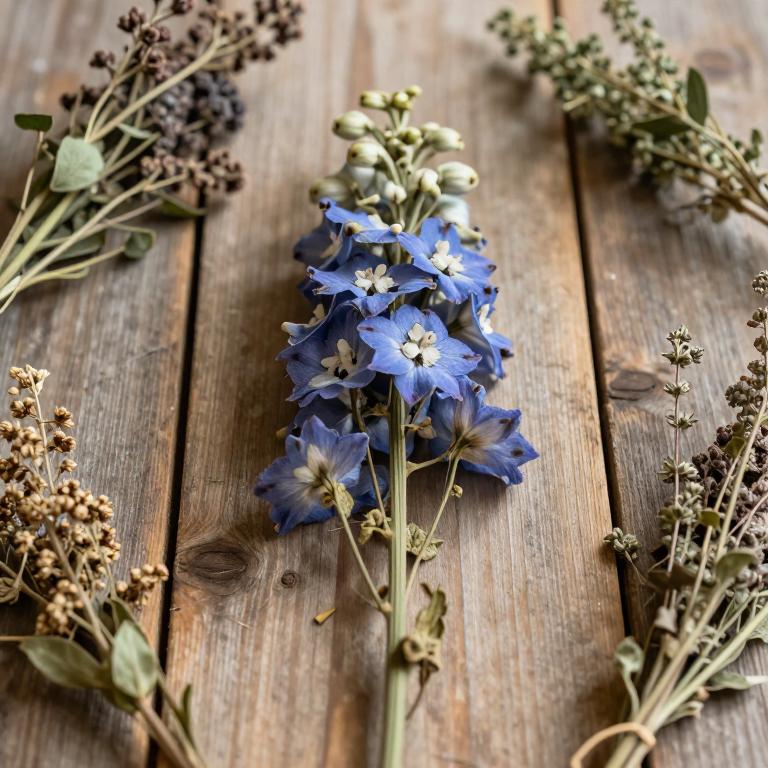
Names and Synonyms
Common Names
- larkspur
- larkspurs
Scientific Names
Accepted name
DelphiniumSynonyms
- Pseudodelphinium
- Aconitella
- Delphinastrum
- Diedropetala
- Chienia
- Phtirium
- Plectrornis
- Phledinium
- Aconitopsis
Regional and Traditional Names
German:
- Rittersporne
- Rittersporne
French:
- Dauphinelle
- Pied d'alouette
- Pied-d'alouette
- Dauphinelles et pieds-d'alouette
Sources: Wikidata, Catalogue of Life
Taxonomical Classification
This plant belongs to the kingdom Plantae and the phylum Streptophyta, falling under the class Equisetopsida and subclass Magnoliidae. Within the order Ranunculales and the family Ranunculaceae, it is classified under the genus Delphinium.
| Rank | Classification |
|---|---|
| Kingdom | Plantae |
| Phylum | Streptophyta |
| Class | Equisetopsida |
| Subclass | Magnoliidae |
| Order | Ranunculales |
| Family | Ranunculaceae |
| Genus | Delphinium |
Sources: The World Checklist of Vascular Plants (WCVP)
Distribution
This plant exhibits a specific distribution pattern across several regions of Northern Europe. It can be found growing in the natural landscapes of Denmark. Additionally, its presence extends to the northern territories of Finland. The species is also widely documented throughout Great Britain and Ireland. Finally, its geographical range includes the rugged terrains of Norway.
| Region | Area |
|---|---|
| Northern Europe | Denmark |
| Northern Europe | Finland |
| Northern Europe | Great Britain |
| Northern Europe | Ireland |
| Northern Europe | Norway |
| Northern Europe | Sweden |
| Middle Europe | Austria |
| Middle Europe | Belgium |
| Middle Europe | Czechia-Slovakia |
| Middle Europe | Germany |
Sources: The World Checklist of Vascular Plants (WCVP)
Plant Parts
Delphinium has 1 reported plant parts identified across 1 scientific publications and several other databases that are studied for medicinal purposes. The most consistently reported plant part include root.
| Plant part | Supporting sources | Consensus |
|---|---|---|
| Root | 1 supporting sources | ★☆☆☆☆ |
Root
- JNMA; journal of the Nepal Medical Association
Chemicals
Delphinium has 8 reported phytochemicals identified across 1 scientific publications and several other databases. The most consistently reported chemicals include Delcosine, Delpheline, HETISINE, Kobusine, Pseudokobusine.
| Chemical | Supporting sources | Consensus |
|---|---|---|
| Delcosine | 2 supporting sources | ★☆☆☆☆ |
| Delpheline | 1 supporting sources | ★☆☆☆☆ |
| HETISINE | 1 supporting sources | ★☆☆☆☆ |
| Kobusine | 1 supporting sources | ★☆☆☆☆ |
| Pseudokobusine | 1 supporting sources | ★☆☆☆☆ |
| Venulol | 1 supporting sources | ★☆☆☆☆ |
| aconitine | 1 supporting sources | ★☆☆☆☆ |
| lappaconitine | 1 supporting sources | ★☆☆☆☆ |
Delcosine
- Journal of natural medicines
- Molecules (Basel, Switzerland)
Delpheline
- Molecules (Basel, Switzerland)
HETISINE
- Phytotherapy research : PTR
Kobusine
- Molecules (Basel, Switzerland)
Pseudokobusine
- Molecules (Basel, Switzerland)
Venulol
- Phytotherapy research : PTR
aconitine
- Scientific reports
lappaconitine
- Molecules (Basel, Switzerland)
Activities
Delphinium has 1 reported activities identified across 1 scientific publications and several other databases. The most consistently reported activities include Antiproliferative.
| Activity | Supporting sources | Consensus |
|---|---|---|
| Antiproliferative | 1 supporting sources | ★☆☆☆☆ |
Antiproliferative
- Journal of natural medicines
Conditions
Delphinium has 8 reported investigations on conditions identified across 1 scientific publications and several other databases. The most consistently reported conditions include epilepsy, headache, mania, pain, paralysis.
| Condition | Supporting sources | Consensus |
|---|---|---|
| Epilepsy | 1 supporting sources | ★☆☆☆☆ |
| Headache | 1 supporting sources | ★☆☆☆☆ |
| Mania | 1 supporting sources | ★☆☆☆☆ |
| Pain | 1 supporting sources | ★☆☆☆☆ |
| Paralysis | 1 supporting sources | ★☆☆☆☆ |
| Rheumatism | 1 supporting sources | ★☆☆☆☆ |
| Toothache | 1 supporting sources | ★☆☆☆☆ |
| Triple-negative breast cancer | 1 supporting sources | ★☆☆☆☆ |
Epilepsy
- JNMA; journal of the Nepal Medical Association
Headache
- JNMA; journal of the Nepal Medical Association
Mania
- JNMA; journal of the Nepal Medical Association
Pain
- Molecules (Basel, Switzerland)
Paralysis
- JNMA; journal of the Nepal Medical Association
Rheumatism
- JNMA; journal of the Nepal Medical Association
Toothache
- JNMA; journal of the Nepal Medical Association
Triple-negative breast cancer
- Molecules (Basel, Switzerland)
Preparations
Delphinium has 1 reported preparations identified across 1 scientific publications and several other databases. The most consistently reported preparations include lappaconitine.
| Preparation | Supporting sources | Consensus |
|---|---|---|
| Lappaconitine | 1 supporting sources | ★☆☆☆☆ |
Lappaconitine
- Molecules (Basel, Switzerland)