African blackwood
Dalbergia melanoxylon · Accepted scientific name
Scientific literature: Very Sparse (6 studies) · ★☆☆☆☆
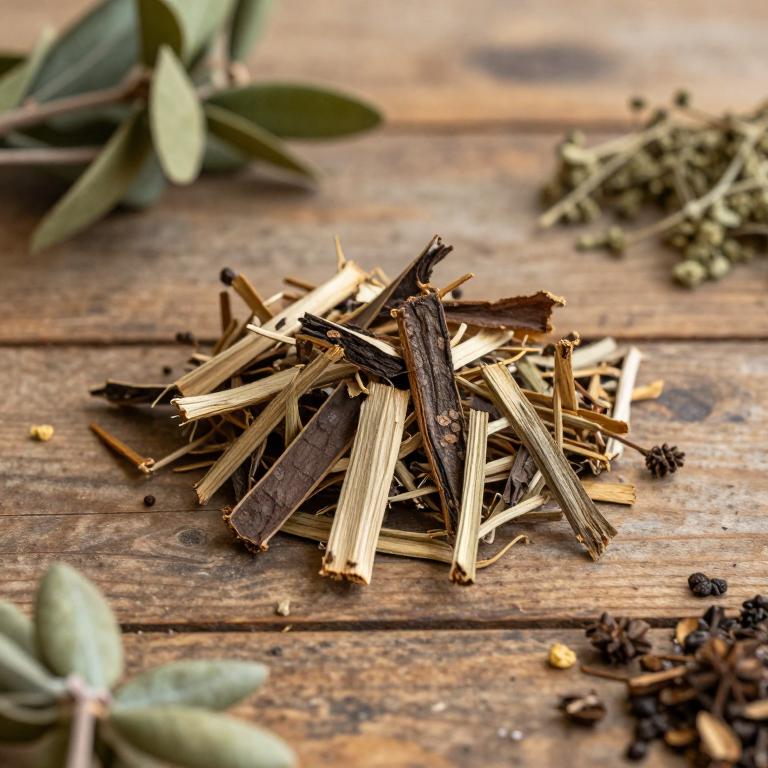
African blackwood, scientifically known as Dalbergia melanoxylon, is a highly prized timber tree found across eastern and southern Africa. Beyond its legendary use in musical instrument crafting, various parts of the plant hold significant medicinal value, traditionally utilized in folk remedies to treat ailments ranging from skin conditions to inflammation.
Names and Synonyms
Common Names
- african-blackwood
- African Blackwood
- African Ebony
- Mozambique Ebony
- African-ebony
- Chinese blackwood
- Mozambique-ebony
- Senaar-ebony
- Senegal-ebony
- Sudan-ebony
- poyi
- Blackwood Dalbergia
- Ebony Dalbergia
- Grenadille Wood
- Rhodesian Bird-Cherry
- Senegal Ebony
- Ungoro Ebony
- Zebrawood Flatbean
Scientific Names
Accepted name
Dalbergia melanoxylonSynonyms
- Amerimnon stocksii
- Dalbergia stocksii
- Amerimnon melanoxylon
Regional and Traditional Names
Spanish:
- ébano de Mozambique
German:
- Grenadill
- Zebraholz
- Afrikanischer Grenadilla
French:
- ébène du Mozambique
- grenadille du Mozambique
- ébène du Sénégal
- grenadille d'Afrique
- Ébène du Mozambique
Sources: Wikidata, Catalogue of Life
Taxonomical Classification
This plant belongs to the kingdom Plantae and the phylum Streptophyta, falling under the class Equisetopsida and subclass Magnoliidae. Within the order Fabales, it is a member of the family Fabaceae and is classified under the genus Dalbergia.
| Rank | Classification |
|---|---|
| Kingdom | Plantae |
| Phylum | Streptophyta |
| Class | Equisetopsida |
| Subclass | Magnoliidae |
| Order | Fabales |
| Family | Fabaceae |
| Genus | Dalbergia |
Sources: The World Checklist of Vascular Plants (WCVP)
Distribution
This plant, known as Dalbergia melanoxylon, exhibits a specific distribution across the West Tropical Africa region. It can be found growing within the borders of Burkina. Additionally, its natural habitat extends into the territory of Guinea. The species is also documented to occur in the Ivory Coast. Finally, its geographical range includes parts of Mali and Mauritania.
| Region | Area |
|---|---|
| West Tropical Africa | Burkina |
| West Tropical Africa | Guinea |
| West Tropical Africa | Ivory Coast |
| West Tropical Africa | Mali |
| West Tropical Africa | Mauritania |
| West Tropical Africa | Nigeria |
| West Tropical Africa | Senegal |
| West Tropical Africa | Togo |
| West-Central Tropical Africa | Central African Republic |
| West-Central Tropical Africa | Cameroon |
Sources: The World Checklist of Vascular Plants (WCVP)
Botanical Identification
Ecology
The ecology of Dalbergia melanoxylon is characterized by its ability to thrive within diverse landscape types, primarily inhabiting deciduous woodland or bushland and wooded grassland. It demonstrates significant adaptability to specific soil conditions, frequently establishing itself on rocky sites as well as on black cotton soil. In terms of altitudinal distribution, the species occupies a broad vertical range, occurring at elevations starting from a minimum of 60 m AMSL up to a maximum of 1320 m AMSL.
- Elevational range max:
- 1320 m AMSL
- Elevational range min:
- 60 m AMSL
- Habitat :
- deciduous woodland or bushland, wooded grassland, often on rocky sites, also on black cotton soil
Life history
The life history of Dalbergia melanoxylon is characterized by its existence as a perennial organism, allowing it to persist through multiple growing seasons. As a phanerophyte, the plant maintains its photosynthetic organs on elevated woody stems, a life form that ensures its survival and structural dominance within its ecological niche. Its physiological cycle is marked by being deciduous, meaning it undergoes a seasonal shedding of its foliage, typically in response to environmental changes or seasonal transitions. This combination of a long-lived perennial lifecycle, a phanerophyte growth habit, and deciduous leaf behavior defines its fundamental biological strategy and temporal pattern of development.
- Deciduousness :
- deciduous
- Life form :
- phanerophyte
- Lifecycle :
- perennial
Morphology
The morphology of Dalbergia melanoxylon is characterized by its growth form as a woody tree. It is a self-supporting plant that functions independently, without behaving as a parasite or an epiphyte, and it thrives in terrestrial environments rather than aquatic or semiaquatic habitats. In terms of stature, the plant typically reaches a mean height of 6 meters, though its size can vary significantly, ranging from a minimum of 5 meters to a maximum height of 12 meters.
- Aquatic :
- terrestrial
- Climber :
- self-supporting
- Epiphyte :
- terrestrial
- Growth form :
- tree
- Parasite :
- independent
- Plant height max:
- 12 m
- Plant height mean:
- 6 m
- Plant height min:
- 5 m
- Woodiness :
- woody
Physiology
The physiology of Dalbergia melanoxylon is characterized by its efficient metabolic processes and nutrient acquisition strategies. As a plant utilizing the C3 photosynthetic pathway, it undergoes carbon fixation through the Calvin cycle, where atmospheric carbon dioxide is directly converted into organic compounds via the enzyme RuBisCO. This metabolic route is typical for many woody dicotyledonous species inhabiting temperate to subtropical environments. Furthermore, the plant functions as a nitrogen fixer, establishing symbiotic relationships with diazotrophic bacteria (typically within root nodules) to convert atmospheric nitrogen into bioavailable forms. This biological nitrogen fixation provides a critical nutrient source that supports its growth and protein synthesis, enhancing its ability to thrive in diverse soil conditions.
- Nitrogen fixer :
- yes
- Photosynthetic pathway :
- C3
Reproduction
The reproduction of Dalbergia melanoxylon is characterized by a biotic pollination syndrome, primarily driven by insects, with bees playing a significant role in the transfer of pollen. The plant does not exhibit self-fertilization, relying instead on these external agents to facilitate genetic exchange. Following successful pollination, the plant produces fruit classified as an achene. These fruits are indehiscent, meaning they do not split open at maturity to release their contents. The seeds produced within the fruit exhibit varying dimensions, with a minimum seed mass of 0.025 g and a maximum of 0.16129 g, resulting in an average seed mass of approximately 0.08593 g.
- Dehiscence :
- indehiscent
- Fruit type :
- achene
- Pollination syndrome :
- insect
- Pollination syndrome :
- bee
- Pollination syndrome :
- biotic
- Seed mass max:
- 0.16129 g
- Seed mass mean:
- 0.08593 g
- Seed mass min:
- 0.025 g
- Self fertilization :
- absent
Sources: Global Inventory of Floras and Traits (GIFT)
Plant Parts
Dalbergia melanoxylon has 1 reported plant parts identified across 1 scientific publications and several other databases that are studied for medicinal purposes. The most consistently reported plant part include leaf.
| Plant part | Supporting sources | Consensus |
|---|---|---|
| Leaf | 1 supporting sources | ★☆☆☆☆ |
Leaf
- Molecules (Basel, Switzerland)
Activities
Dalbergia melanoxylon has 3 reported activities identified across 1 scientific publications and several other databases. The most consistently reported activities include Antibacterial, Antifungal, Antimicrobial.
| Activity | Supporting sources | Consensus |
|---|---|---|
| Antibacterial | 1 supporting sources | ★☆☆☆☆ |
| Antifungal | 1 supporting sources | ★☆☆☆☆ |
| Antimicrobial | 1 supporting sources | ★☆☆☆☆ |
Antibacterial
- Journal of ethnopharmacology
Antifungal
- Journal of ethnopharmacology
Antimicrobial
- Journal of ethnopharmacology
Conditions
Dalbergia melanoxylon has 1 reported investigations on conditions identified across 1 scientific publications and several other databases. The most consistently reported conditions include snakebites.
| Condition | Supporting sources | Consensus |
|---|---|---|
| Snakebites | 1 supporting sources | ★☆☆☆☆ |
Snakebites
- Pharmaceutical biology
Preparations
Dalbergia melanoxylon has 6 reported preparations identified across 1 scientific publications and several other databases. The most consistently reported preparations include aqueous extract, citric acid extract, dichloromethane extract, methanol and distilled water extracts, methanol extract.
| Preparation | Supporting sources | Consensus |
|---|---|---|
| Aqueous extract | 1 supporting sources | ★☆☆☆☆ |
| Citric acid extract | 1 supporting sources | ★☆☆☆☆ |
| Dichloromethane extract | 1 supporting sources | ★☆☆☆☆ |
| Methanol and distilled water extracts | 1 supporting sources | ★☆☆☆☆ |
| Methanol extract | 1 supporting sources | ★☆☆☆☆ |
| Petroleum ether extract | 1 supporting sources | ★☆☆☆☆ |
Aqueous extract
- Journal of ethnopharmacology
Citric acid extract
- Journal of ethnopharmacology
Dichloromethane extract
- Journal of ethnopharmacology
Methanol and distilled water extracts
- Molecules (Basel, Switzerland)
Methanol extract
- Journal of ethnopharmacology
Petroleum ether extract
- Journal of ethnopharmacology