Garden Dahlia
Dahlia pinnata · Accepted scientific name
Scientific literature: Very Sparse (6 studies) · ★☆☆☆☆
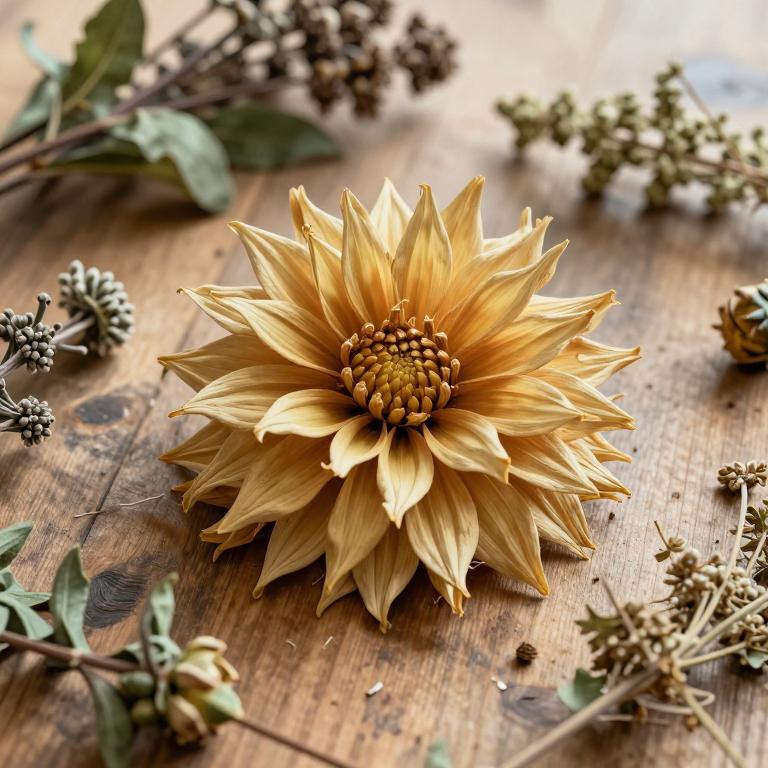
Garden Dahlia, scientifically known as Dahlia pinnata, is a breathtaking perennial celebrated for its vibrant, multi-layered blooms. Beyond its ornamental charm, this species holds significant medicinal potential, traditionally utilized in various cultures for its anti-inflammatory and antimicrobial properties. It remains a fascinating bridge between exquisite beauty and therapeutic utility.
- Family
- Asteraceae
- Native range
- Europe
- Parts used
- Not available
- Common names
- Not available
- Scientific synonyms
- Coreopsis Georgina · Dahlia Purpurea Var. Pallida · 28 more
Names and Synonyms
Scientific Names
Accepted name
Dahlia pinnataSynonyms
- Coreopsis georgina
- Dahlia purpurea var. pallida
- Dahlia mexicana
- Dahlia nana
- Georgina superflua var. flavescens
- Georgina superflua var. lilacina
- Dahlia pusilla
- Georgina superflua var. pallida
- Dahlia rosea
- Georgina superflua var. rubra
- Dahlia sambucifolia
- Georgina variabilis var. lilacina
- Dahlia sphondyliifolia
- Dahlia superflua
- Georgina variabilis var. purpurea
- Dahlia variabilis
- Georgina asepinae
- Georgina astrantiiflora
- Georgina superflua
- Georgina rosea
- Georgina superflua var. purpurea
- Georgina variabilis var. pallida
- Dahlia pinnata var. variabilis
- Dahlia purpurea var. flavescens
- Georgia rosea
- Dahlia purpurea var. rubra
- Dahlia purpurea var. lilacina
- Dahlia pinnata var. nana
- Dahlia royleana
- Bidens variabilis
Regional and Traditional Names
German:
- Großfiedrige Dahlie
French:
- Dahlia commun
Sources: Wikidata
Taxonomical Classification
This plant belongs to the kingdom Plantae within the phylum Streptophyta and the class Equisetopsida. Under the subclass Magnoliidae and order Asterales, it is classified in the family Asteraceae. Finally, it is identified by the genus Dahlia, specifically as the species Dahlia pinnata.
| Rank | Classification |
|---|---|
| Kingdom | Plantae |
| Phylum | Streptophyta |
| Class | Equisetopsida |
| Subclass | Magnoliidae |
| Order | Asterales |
| Family | Asteraceae |
| Genus | Dahlia |
Sources: The World Checklist of Vascular Plants (WCVP)
Distribution
This plant exhibits a diverse geographical distribution across several regions of the European continent. In Northern Europe, it can be found growing in Great Britain and Ireland. Its presence extends even further north into the country of Norway. Moving into Middle Europe, the species is well-established within Germany. Finally, its range reaches into Hungary, completing its distribution across these specific territories.
| Region | Area |
|---|---|
| Northern Europe | Great Britain |
| Northern Europe | Ireland |
| Northern Europe | Norway |
| Middle Europe | Germany |
| Middle Europe | Hungary |
| Southwestern Europe | Baleares |
| Southwestern Europe | France |
| Southwestern Europe | Portugal |
| Southwestern Europe | Spain |
| Southeastern Europe | Bulgaria |
Sources: The World Checklist of Vascular Plants (WCVP)
Botanical Identification
Ecology
The ecology of Dahlia pinnata is characterized by its ability to thrive across a significant altitudinal gradient, typically occupying an elevational range between 1000 m and 2800 m AMSL. While it maintains a specific niche within these mountainous or highland parameters, the species has demonstrated remarkable adaptability to human-altered environments; for instance, it has been widely cultivated throughout the USSR as one of the most popular ornamental plants. This transition from natural highland habitats to widespread cultivation highlights its versatility in various ecological settings, provided the elevation requirements are met.
- Elevational range max:
- 2800 m AMSL
- Elevational range min:
- 1000 m AMSL
- Habitat :
- cultivated throughout the USSR as one of the most popular ornamental plants
Life history
The life history of Dahlia pinnata is characterized by its status as a perennial plant, allowing it to persist through multiple growing seasons via its underground tuberous roots. During its developmental cycle, the plant emerges from these storage organs in the spring, establishing a robust root system and producing lush foliage to support rapid vegetative growth. As the plant matures, it transitions into its reproductive phase, producing distinctive inflorescences that facilitate sexual reproduction through seed production, while the tubers ensure asexual survival and regeneration during dormancy. While its growth patterns can be variable depending on environmental conditions and soil stability, its fundamental biological strategy relies on this perennial nature to survive seasonal shifts, retreating into dormancy during unfavorable periods before re-emerging to repeat its life cycle.
- Lifecycle :
- perennial
Morphology
The morphology of Dahlia pinnata is characterized by its growth form as a non-woody herb and specifically a forb. It is a terrestrial species that grows as an independent plant, meaning it does not function as a parasite or an epiphyte. As a self-supporting organism rather than a climber, vine, or liana, it maintains a structural uprightness. The plant typically reaches a height ranging from a minimum of 1.5 m to a maximum of 2 m, with a mean plant height of approximately 1 m.
- Aquatic :
- terrestrial
- Climber :
- self-supporting
- Epiphyte :
- terrestrial
- Growth form :
- herb
- Growth form :
- forb
- Parasite :
- independent
- Plant height max:
- 2 m
- Plant height mean:
- 1 m
- Plant height min:
- 1.5 m
- Woodiness :
- non-woody
Physiology
The physiology of Dahlia pinnata is characterized by a C3 photosynthetic pathway, meaning it utilizes the Calvin cycle for carbon fixation without the specialized adaptations found in C4 or CAM plants. The plant does not exhibit succulence, lacking the specialized fleshy tissues required for significant water storage within its vegetative structures. Additionally, it is not a nitrogen fixer, as it does not possess the symbiotic relationship with nitrogen-fixing bacteria necessary to convert atmospheric nitrogen into usable forms, relying instead on organic nitrogen uptake from the soil.
- Nitrogen fixer :
- no
- Photosynthetic pathway :
- C3
- Succulence :
- no
Reproduction
The reproduction of Dahlia pinnata is driven by biotic pollination processes, specifically utilizing an insect-based pollination syndrome to facilitate fertilization. The flowering period typically commences in July and extends through August, though the timing can be variable. Following successful pollination, the plant develops fruits that exhibit specific dimensional characteristics, with an average length of 1.05 cm (ranging from a minimum of 0.9 cm to a maximum of 1.2 cm) and an average width of 0.35 cm (ranging from a minimum of 0.3 cm to a maximum of 0.4 cm). The seeds produced within these fruits are quite small, possessing a mean mass of 0.009115 g, with individual seed masses ranging from a minimum of 0.0088 g to a maximum of 0.00943 g. Once mature, the dispersal of the seeds is characterized by an anemochorous syndrome, meaning they are primarily dispersed by the wind.
- Dispersal syndrome :
- anemochorous
- Flowering time :
- Jul
- Flowering time :
- Aug
- Fruit length max:
- 1.2 cm
- Fruit length mean:
- 1.05 cm
- Fruit length min:
- 0.9 cm
- Fruit width max:
- 0.4 cm
- Fruit width mean:
- 0.35 cm
- Fruit width min:
- 0.3 cm
- Pollination syndrome :
- insect
- Pollination syndrome :
- biotic
- Seed mass max:
- 0.00943 g
- Seed mass mean:
- 0.009115 g
- Seed mass min:
- 0.0088 g
Sources: Global Inventory of Floras and Traits (GIFT)
Chemicals
Dahlia pinnata has 6 reported phytochemicals identified across 0 scientific publications and several other databases. The most consistently reported chemicals include Flavonoids, IL 10, IL-6, Kaempferol-3-rutinoside, RUTIN.
| Chemical | Supporting sources | Consensus |
|---|---|---|
| Flavonoids | 1 supporting sources | ★☆☆☆☆ |
| IL 10 | 1 supporting sources | ★☆☆☆☆ |
| IL-6 | 1 supporting sources | ★☆☆☆☆ |
| Kaempferol-3-rutinoside | 1 supporting sources | ★☆☆☆☆ |
| RUTIN | 1 supporting sources | ★☆☆☆☆ |
| Sugars | 1 supporting sources | ★☆☆☆☆ |
Flavonoids
- Phytochemical analysis : PCA
IL 10
- International journal of molecular sciences
IL-6
- International journal of molecular sciences
Kaempferol-3-rutinoside
- Phytochemical analysis : PCA
RUTIN
- Phytochemical analysis : PCA
Sugars
- Phytochemical analysis : PCA