Cypripedium calceolus
Cypripedium calceolus · Accepted scientific name
Scientific literature: Very Sparse (0 studies) · ★☆☆☆☆
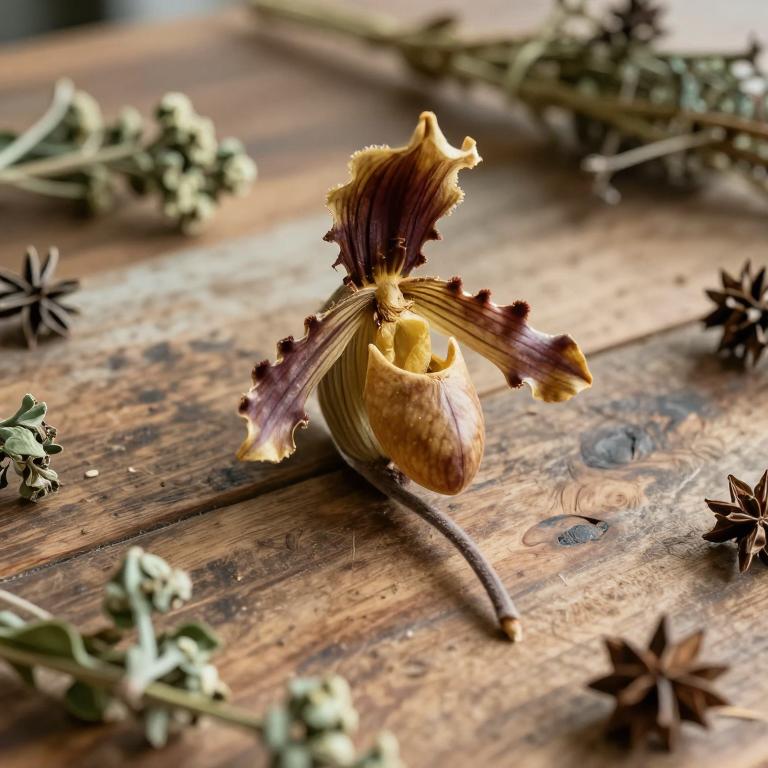
Cypripedium calceolus, commonly known as the Lady's Slipper orchid, is a striking perennial celebrated for its unique, pouch-shaped flowers. This species relies on its tiny, dust-like seeds to propagate and spread throughout its natural woodland habitats. When handling these botanical elements, one must focus on the specific preparations of the seeds to ensure successful germination. Understanding the delicate nature of the seed is essential for anyone interested in the cultivation of this rare orchid. By mastering the care of these seeds, enthusiasts can help preserve the legacy of this enchanting plant.
- Synonyms
- Cypripedilon Marianus · Cypripedium Microsaccos · 10 more
- Common names
- Not available
- Family
- Orchidaceae
- Distribution
- Southern America
- Plant Parts
- Seed
Classification
Common Names
Cypripedium calceolus is a remarkable orchid known by several distinct regional names. In various parts of Europe, it is frequently referred to as the Europäischer Frauenschuh or simply the Frauenschuh. Some local dialects even use the specific term Fruesko to describe this striking wildflower. Because of its vibrant hue, it is also commonly called the Gelber Frauenschuh to highlight its yellow petals. Finally, it can be found under the common name Esgid Fair in certain botanical circles.
Sources: Catalogue of Life (COL)
Synonyms
Cypripedium calceolus is a complex species that has been classified under several different botanical names throughout history. Taxonomists have previously identified this plant using synonyms such as Calceolus alternifolius and Calceolus marianus. Further variations in its nomenclature include the designations Cypripedilon marianus and Cypripedium atsmori. Additionally, the specific form known as Cypripedium calceolus f. grandifolium is recognized within its botanical lineage. Understanding these various synonyms is essential for accurately tracking the plant's diverse scientific identity.
Sources: The World Checklist of Vascular Plants (WCVP)
Taxonomy
Cypripedium calceolus is a fascinating botanical specimen belonging to the kingdom Plantae. Within this vast biological realm, it is specifically classified under the class Equisetopsida. This plant falls under the order Asparagales, showcasing its unique evolutionary lineage. Further refinement of its identity places it within the diverse family Orchidaceae. Finally, it is distinguished by its membership in the genus Cypripedium, marking it as a true lady's slipper orchid.
| Rank | Classification |
|---|---|
| Kingdom | Plantae |
| Phylum | Streptophyta |
| Class | Equisetopsida |
| Subclass | Magnoliidae |
| Order | Asparagales |
| Family | Orchidaceae |
| Genus | Cypripedium |
Sources: The World Checklist of Vascular Plants (WCVP)
Distribution
Geographic Regions
Cypripedium calceolus exhibits a remarkably wide geographical distribution that spans across multiple continents. In the African region, this species can be found specifically within Northern Africa and Algeria. Its presence extends significantly into the Asia-Temperate zone, where it thrives in parts of China such as Inner Mongolia and Manchuria. Furthermore, the plant is well-established throughout Eastern Asia, inhabiting the diverse landscapes of both Japan and Korea. This broad range highlights the plant's ability to adapt to various temperate environments across the globe.
Sources: The World Checklist of Vascular Plants (WCVP)
Identification
Morphology
Cypripedium calceolus is a delicate herb characterized by its self-supporting growth form. This plant maintains a relatively modest stature, typically reaching a maximum height of 0.6 m. Depending on environmental conditions, its vertical reach often fluctuates between a minimum of 0.25 m and 0.325 m. Such compact dimensions allow it to thrive gracefully within its natural habitat. Understanding these specific physical traits is essential for identifying this unique botanical species.
Sources: Global Inventory of Floras and Traits (GIFT)
Biological Activities
Compounds
Conditions
Cypripedium calceolus was subjected to short-term cryopreservation by being kept frozen for a period of three days. Following this process, the seeds were planted on three distinct media types consisting of ½ MS, MS with 10% coconut milk, and BM1. The results showed that 24.98% of seeds formed protocorms on the ½ MS medium, while the other media yielded 10.02% and 15.02% respectively. Despite the initial formation of these protocorms, all of them died after a duration of 2.5 months. Consequently, it has been determined that the current protocol for the cryopreservation of these seeds requires further improvement.
Preparations
Cypripedium calceolus is prepared as seeds for the purpose of cryopreservation and conservation research. These seeds of the endangered ornamental species were collected and kept frozen for a period of three days. To test their viability after thawing, the seeds were planted on three distinct media types, including ½ MS, MS with 10% coconut milk, and BM1. While some seeds successfully formed protocorms on these media, all of the resulting protocorms eventually died after 2.5 months. Consequently, the current protocol used to prepare and preserve these seeds requires further improvement to ensure successful growth.
Parts used
Cypripedium calceolus is an endangered ornamental species that requires specialized preservation techniques to ensure its long-term survival. During recent research, the seeds of this plant were collected and subjected to a three-day cryopreservation period in liquid nitrogen. To test their viability, the seeds were planted on three distinct media types: ½ MS, MS with 10% coconut milk, and BM1. While a portion of the seeds successfully formed protocorms on these media, all of them ultimately died after two and a half months. Consequently, the study suggests that the current cryopreservation protocol for the seeds of C. calceolus must be improved to be effective.