Cymbopogon khasianus ex
Cymbopogon khasianus · Accepted scientific name
Scientific literature: Very Sparse (5 studies) · ★☆☆☆☆
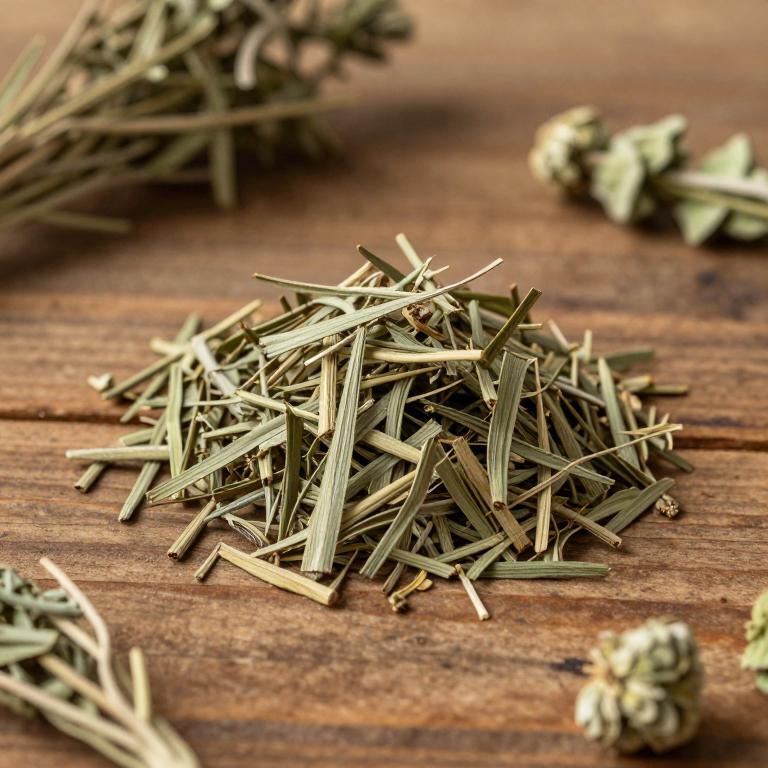
Cymbopogon khasianus ex, scientifically known as Cymbopogon khasianus, is a perennial grass native to the northeastern regions of India. Renowned for its aromatic properties, this medicinal plant is rich in essential oils. It is traditionally utilized in folk medicine for its antimicrobial, anti-inflammatory, and soothing therapeutic qualities.
- Family
- Poaceae
- Native range
- Asia-Temperate
- Parts used
- Not available
- Common names
- Not available
- Scientific synonyms
- Andropogon Nardus Subsp. Khasianus · Cymbopogon Auritus
Names and Synonyms
Scientific Names
Accepted name
Cymbopogon khasianusSynonyms
- Andropogon nardus subsp. khasianus
- Cymbopogon auritus
Sources: Wikidata
Taxonomical Classification
This plant, Cymbopogon khasianus, belongs to the kingdom Plantae and the phylum Streptophyta. Within the class Equisetopsida and subclass Magnoliidae, it is classified under the order Poales and the family Poaceae. Finally, it is placed within the genus Cymbopogon.
| Rank | Classification |
|---|---|
| Kingdom | Plantae |
| Phylum | Streptophyta |
| Class | Equisetopsida |
| Subclass | Magnoliidae |
| Order | Poales |
| Family | Poaceae |
| Genus | Cymbopogon |
Sources: The World Checklist of Vascular Plants (WCVP)
Distribution
This plant exhibits a diverse geographical distribution across several key regions in Asia. Within China, it can be found specifically in the South-Central and Southeast areas. Its presence extends into the Indian Subcontinent, where it is documented in Assam and Bangladesh. Furthermore, the species is well-established in the East Himalaya region. Together, these locations highlight the broad ecological range of Cymbopogon khasianus.
| Region | Area |
|---|---|
| China | China South-Central |
| China | China Southeast |
| Indian Subcontinent | Assam |
| Indian Subcontinent | Bangladesh |
| Indian Subcontinent | East Himalaya |
| Indian Subcontinent | West Himalaya |
| Indo-China | Myanmar |
| Indo-China | Thailand |
Sources: The World Checklist of Vascular Plants (WCVP)
Botanical Identification
Ecology
The ecology of Cymbopogon khasianus is characterized by its specific distribution across diverse altitudinal gradients within its native habitat. This species thrives across a broad vertical range, typically occupying montane and sub-montane environments. Its elevational distribution begins at a minimum altitude of 800 m AMSL and extends up to a maximum of 2800 m AMSL. On average, the plant is most commonly found at a mean elevation of 1400 m AMSL, suggesting a preference for mid-altitude ecological niches where specific temperature and moisture regimes are maintained.
- Elevational range max:
- 2800 m AMSL
- Elevational range mean:
- 1400 m AMSL
- Elevational range min:
- 800 m AMSL
Life history
The life history of Cymbopogon khasianus is characterized by its status as a perennial organism, allowing it to persist through multiple growing seasons. In terms of its biological structure and survival strategy, the plant is classified as a hemicryptophyte, meaning its perennial buds are located at or just below the soil surface, protected by leaf litter or surface debris during unfavorable conditions. This life form, categorized both as a hemicryptophyte and a hemi-crypto-phyte within botanical frameworks, ensures its long-term establishment and ability to regenerate following seasonal changes.
- Life form :
- hemicryptophyte
- Lifecycle :
- perennial
Morphology
The morphology of Cymbopogon khasianus is characterized by its growth form as a non-woody herb, specifically categorized as a graminoid. It functions as a self-supporting plant, exhibiting neither climbing nor liana-like tendencies, as it lacks the structural requirements of vines or obligatory climbers. This species is an independent organism, showing no parasitic behavior, and it is strictly terrestrial rather than being an epiphyte or an aquatic/semiaquatic plant. Its structure is entirely non-woody, maintaining a herbaceous habit throughout its lifecycle.
- Aquatic :
- terrestrial
- Climber :
- self-supporting
- Epiphyte :
- terrestrial
- Growth form :
- herb
- Parasite :
- independent
- Woodiness :
- non-woody
Sources: Global Inventory of Floras and Traits (GIFT)
Chemicals
Cymbopogon khasianus has 1 reported phytochemicals identified across 0 scientific publications and several other databases. The most consistently reported chemicals include Methyl eugenol.
| Chemical | Supporting sources | Consensus |
|---|---|---|
| Methyl eugenol | 1 supporting sources | ★☆☆☆☆ |
Methyl eugenol
- Current pharmaceutical biotechnology
Activities
Cymbopogon khasianus has 2 reported activities identified across 0 scientific publications and several other databases. The most consistently reported activities include Antimicrobial, Antioxidant.
| Activity | Supporting sources | Consensus |
|---|---|---|
| Antimicrobial | 1 supporting sources | ★☆☆☆☆ |
| Antioxidant | 1 supporting sources | ★☆☆☆☆ |
Antimicrobial
- Current pharmaceutical biotechnology
Antioxidant
- Current pharmaceutical biotechnology
Conditions
Cymbopogon khasianus has 1 reported investigations on conditions identified across 0 scientific publications and several other databases. The most consistently reported conditions include antioxidant.
| Condition | Supporting sources | Consensus |
|---|---|---|
| Antioxidant | 1 supporting sources | ★☆☆☆☆ |
Antioxidant
- Current pharmaceutical biotechnology