Common Honeybush-tea
Cyclopia genistoides · Accepted scientific name
Scientific literature: Very Sparse (5 studies) · ★☆☆☆☆
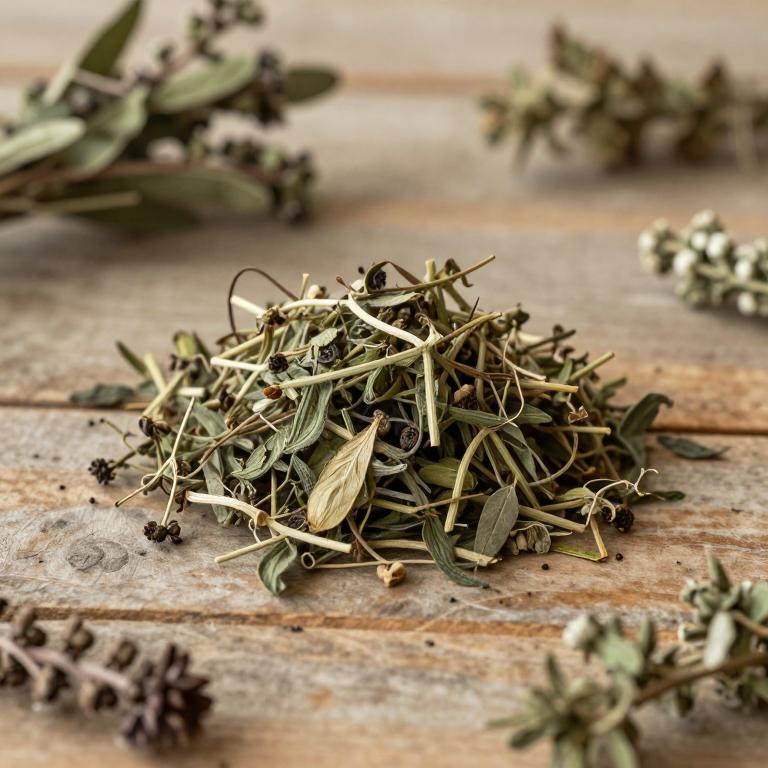
Common Honeybush-tea, scientifically known as Cyclopia genistoiides, is a fragrant, amber-colored herbal infusion native to South Africa's Fynbos biome. Renowned for its naturally sweet flavor and low caffeine content, this medicinal plant offers potent antioxidant properties, supporting digestive health and providing a soothing, wellness-boosting ritual for tea enthusiasts.
Names and Synonyms
Common Names
- Common Honeybush Tea
- Honeybush Tea
- Coastal Honeybush
- Common Honeybush
- Needleleaf Honeybush
- Sandveld Honeybush
Scientific Names
Accepted name
Cyclopia genistoidesSynonyms
- Virgilia genistoides
- Galega genistoides
- Ibbetsonia genistoides
- Cyclopia genistoides var. teretifolia
- Cyclopia teretifolia
- Sophora genistoides
- Cyclopia genistoides var. heterophylla
- Cyclopia heterophylla
Sources: Wikidata, Catalogue of Life
Taxonomical Classification
This plant belongs to the kingdom Plantae and is classified within the phylum Streptophyta and the class Equisetopsida. It is further categorized under the subclass Magnoliidae and the order Fabales, falling within the family Fabaceae. Finally, its specific taxonomic placement is within the genus Cyclopia.
| Rank | Classification |
|---|---|
| Kingdom | Plantae |
| Phylum | Streptophyta |
| Class | Equisetopsida |
| Subclass | Magnoliidae |
| Order | Fabales |
| Family | Fabaceae |
| Genus | Cyclopia |
Sources: The World Checklist of Vascular Plants (WCVP)
Distribution
This plant is native to the southern region of the African continent. Its specific geographical distribution is concentrated within the Cape Provinces. Within this area, it thrives in the unique environmental conditions of the Fynbos biome. Because of this limited range, it is considered an endemic species to these coastal and inland provinces. Consequently, the plant's natural habitat is strictly tied to the diverse landscapes of Southern Africa.
| Region | Area |
|---|---|
| Southern Africa | Cape Provinces |
Sources: The World Checklist of Vascular Plants (WCVP)
Botanical Identification
Ecology
The ecology of Cyclopia geniostoides is defined by its broad adaptability across diverse altitudinal gradients, allowing it to occupy a wide variety of habitats. This species demonstrates significant vertical distribution, thriving in environments ranging from low-lying coastal or valley regions at an elevation of 15 m AMSL to much higher montane settings reaching up to 1830 m AMSL. This extensive elevational range suggests that the plant can tolerate diverse climatic conditions, varying temperature regimes, and differing moisture levels found throughout these stratified ecological zones.
- Elevational range max:
- 1830 m AMSL
- Elevational range min:
- 15 m AMSL
Life history
The life history of Cyclopia genistoides is characterized by its status as a perennial species, allowing it to persist in its natural habitat over multiple growing seasons. As a long-lived plant, it undergoes cyclical stages of vegetative growth and reproductive development, often adapted to the specific seasonal rhythms of its environment. Throughout its life, the plant establishes a stable presence, periodically investing energy into flowering and seed production to ensure the continuity of its population. This perennial nature enables it to endure varying environmental conditions, building resilience through successive years of growth.
- Lifecycle :
- perennial
Morphology
The morphology of Cyclopia genistoides is characterized by its growth form as a woody shrub, functioning as a self-supporting plant that does not require climbing structures. It is a terrestrial species, existing independently of any parasitic relationships, and does not exhibit epiphytic behavior. The plant reaches a maximum height of approximately 1.79 m, maintaining a sturdy, woody structure typical of its shrub classification.
- Aquatic :
- terrestrial
- Climber :
- self-supporting
- Epiphyte :
- terrestrial
- Growth form :
- shrub
- Parasite :
- independent
- Plant height max:
- 1.79 m
- Woodiness :
- woody
Sources: Global Inventory of Floras and Traits (GIFT)
Chemicals
Cyclopia genistoides has 4 reported phytochemicals identified across 0 scientific publications and several other databases. The most consistently reported chemicals include BENZOPHENONE, Dihydrochalcone, FLAVONE, XANTHONE.
| Chemical | Supporting sources | Consensus |
|---|---|---|
| BENZOPHENONE | 1 supporting sources | ★☆☆☆☆ |
| Dihydrochalcone | 1 supporting sources | ★☆☆☆☆ |
| FLAVONE | 1 supporting sources | ★☆☆☆☆ |
| XANTHONE | 1 supporting sources | ★☆☆☆☆ |
BENZOPHENONE
- Molecules (Basel, Switzerland)
Dihydrochalcone
- Molecules (Basel, Switzerland)
FLAVONE
- Molecules (Basel, Switzerland)
XANTHONE
- Molecules (Basel, Switzerland)
Conditions
Cyclopia genistoides has 1 reported investigations on conditions identified across 0 scientific publications and several other databases. The most consistently reported conditions include anti-allergic.
| Condition | Supporting sources | Consensus |
|---|---|---|
| Anti-allergic | 1 supporting sources | ★☆☆☆☆ |
Anti-allergic
- Planta medica
Preparations
Cyclopia genistoides has 1 reported preparations identified across 0 scientific publications and several other databases. The most consistently reported preparations include unfermented and fermented sample extracts.
| Preparation | Supporting sources | Consensus |
|---|---|---|
| Unfermented and fermented sample extracts | 1 supporting sources | ★☆☆☆☆ |
Unfermented and fermented sample extracts
- Molecules (Basel, Switzerland)