Sowbreads
Cyclamen · Accepted scientific name
Scientific literature: Very Sparse (15 studies) · ★☆☆☆☆
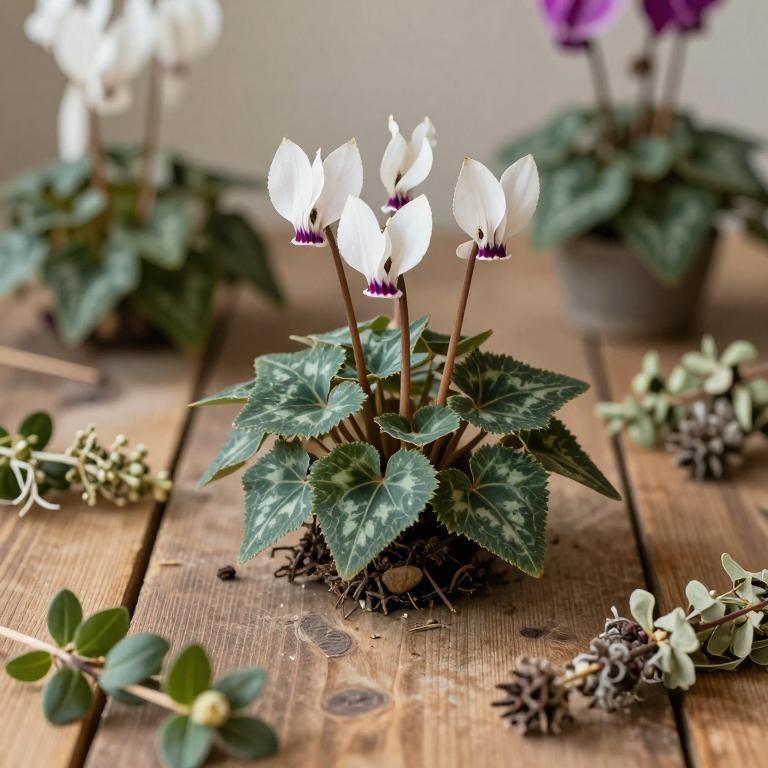
Sowbreads, scientifically known as Cyclamen, is a versatile genus of flowering plants cherished for their striking, reflexed petals and decorative foliage. While primarily ornamental, various species possess traditional medicinal properties used in folk healing. However, caution is essential, as many parts of the plant contain toxic compounds.
- Family
- Primulaceae
- Native range
- Europe
- Parts used
- Not available
- Common names
- Sowbreads
- Scientific synonyms
- Cyclaminum · Cyclaminus · 1 more
Names and Synonyms
Common Names
- Sowbreads
Scientific Names
Accepted name
CyclamenSynonyms
- Cyclaminum
- Cyclaminus
- Cyclaminos
Regional and Traditional Names
Spanish:
- Ciclamen
- Violeta de los Alpes
- Violeta Persa
- Violeta de Persia
- Pan de puerco
- Artanita
- Violeta Imperial
- Violetas de Persia
German:
- Alpenveilchen
- Zyklamen
- Zyklame
- Zyklamen
French:
- Pain de pourceau
- Cyclamens
- Pain de pourceau
Sources: Wikidata, Catalogue of Life
Taxonomical Classification
This plant belongs to the kingdom Plantae and the phylum Streptophyta, falling under the class Equisetopsida and subclass Magnoliidae. Within the order Ericales, it is classified under the family Primulaceae and the genus Cyclamen.
| Rank | Classification |
|---|---|
| Kingdom | Plantae |
| Phylum | Streptophyta |
| Class | Equisetopsida |
| Subclass | Magnoliidae |
| Order | Ericales |
| Family | Primulaceae |
| Genus | Cyclamen |
Sources: The World Checklist of Vascular Plants (WCVP)
Distribution
This plant exhibits a specific geographical distribution across several regions of Europe. In Northern Europe, it can be found growing in both Great Britain and Ireland. Moving into Middle Europe, the species is also present in Belgium. Its range extends further east to include the areas of Austria and the Czechia-Slovakia region. Together, these locations define the primary habitats for this medicinal flora.
| Region | Area |
|---|---|
| Northern Europe | Great Britain |
| Northern Europe | Ireland |
| Middle Europe | Austria |
| Middle Europe | Belgium |
| Middle Europe | Czechia-Slovakia |
| Middle Europe | Germany |
| Middle Europe | Hungary |
| Middle Europe | Poland |
| Middle Europe | Switzerland |
| Southwestern Europe | Baleares |
Sources: The World Checklist of Vascular Plants (WCVP)
Chemicals
Cyclamen has 6 reported phytochemicals identified across 0 scientific publications and several other databases. The most consistently reported chemicals include Flavonoids, Glycosides, Phenols, Saponins, Sterols.
| Chemical | Supporting sources | Consensus |
|---|---|---|
| Flavonoids | 1 supporting sources | ★☆☆☆☆ |
| Glycosides | 1 supporting sources | ★☆☆☆☆ |
| Phenols | 1 supporting sources | ★☆☆☆☆ |
| Saponins | 1 supporting sources | ★☆☆☆☆ |
| Sterols | 1 supporting sources | ★☆☆☆☆ |
| Tannins | 1 supporting sources | ★☆☆☆☆ |
Flavonoids
- Pharmaceuticals (Basel, Switzerland)
Glycosides
- Pharmaceuticals (Basel, Switzerland)
Phenols
- Pharmaceuticals (Basel, Switzerland)
Saponins
- Pharmaceuticals (Basel, Switzerland)
Sterols
- Pharmaceuticals (Basel, Switzerland)
Tannins
- Pharmaceuticals (Basel, Switzerland)
Activities
Cyclamen has 4 reported activities identified across 0 scientific publications and several other databases. The most consistently reported activities include Analgesic, Antimicrobial, Antioxidant, Cytotoxic.
| Activity | Supporting sources | Consensus |
|---|---|---|
| Analgesic | 1 supporting sources | ★☆☆☆☆ |
| Antimicrobial | 1 supporting sources | ★☆☆☆☆ |
| Antioxidant | 1 supporting sources | ★☆☆☆☆ |
| Cytotoxic | 1 supporting sources | ★☆☆☆☆ |
Analgesic
- Pharmaceuticals (Basel, Switzerland)
Antimicrobial
- Pharmaceuticals (Basel, Switzerland)
Antioxidant
- Pharmaceuticals (Basel, Switzerland)
Cytotoxic
- Pharmaceuticals (Basel, Switzerland)
Conditions
Cyclamen has 2 reported investigations on conditions identified across 0 scientific publications and several other databases. The most consistently reported conditions include cancer, infertility.
| Condition | Supporting sources | Consensus |
|---|---|---|
| Cancer | 1 supporting sources | ★☆☆☆☆ |
| Infertility | 1 supporting sources | ★☆☆☆☆ |
Cancer
- Pharmaceuticals (Basel, Switzerland)
Infertility
- Microscopy research and technique
Preparations
Cyclamen has 2 reported preparations identified across 0 scientific publications and several other databases. The most consistently reported preparations include Tuber extract, extracts of Cyclamen tubers.
| Preparation | Supporting sources | Consensus |
|---|---|---|
| Tuber extract | 1 supporting sources | ★☆☆☆☆ |
| Extracts of cyclamen tubers | 1 supporting sources | ★☆☆☆☆ |
Tuber extract
- Current medical mycology
Extracts of cyclamen tubers
- Pharmaceuticals (Basel, Switzerland)