Cucumis pustulatus
Cucumis pustulatus · Accepted scientific name
Scientific literature: Very Sparse (10 studies) · ★☆☆☆☆
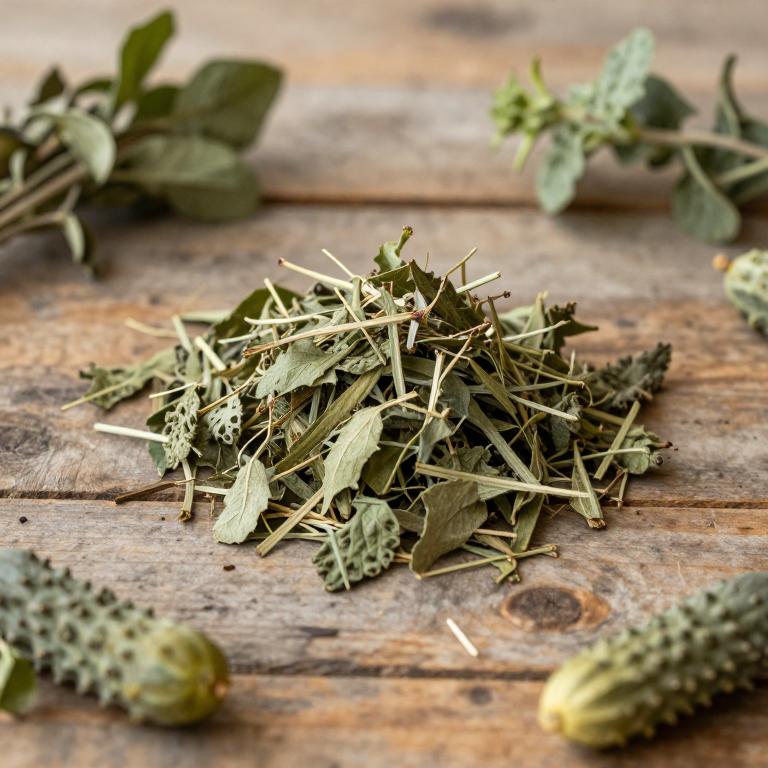
Cucumis pustulatus, scientifically known as Cucumis pustulatus, is a resilient medicinal plant valued for its diverse therapeutic properties. Often found in tropical regions, this species is traditionally utilized in various herbal remedies to address inflammatory conditions and skin ailments, offering significant potential for modern pharmacological research and natural healing.
- Family
- Cucurbitaceae
- Native range
- Africa
- Parts used
- Not available
- Common names
- Not available
- Scientific synonyms
- Cucumis Figarei Var. Ficifolius
Names and Synonyms
Scientific Names
Accepted name
Cucumis pustulatusSynonyms
- Cucumis figarei var. ficifolius
Sources: Wikidata
Taxonomical Classification
This plant belongs to the kingdom Plantae and is classified under the phylum Streptophyta and class Equisetopsida. Within the subclass Magnoliidae, it falls under the order Cucurbitaleales and the family Cucurbitaceae. Finally, its taxonomic identity is completed by its classification within the genus Cucumis.
| Rank | Classification |
|---|---|
| Kingdom | Plantae |
| Phylum | Streptophyta |
| Class | Equisetopsida |
| Subclass | Magnoliidae |
| Order | Cucurbitales |
| Family | Cucurbitaceae |
| Genus | Cucumis |
Sources: The World Checklist of Vascular Plants (WCVP)
Distribution
This plant exhibits a specific geographical distribution spanning parts of Macaronesia and West Tropical Africa. Within the Macaronesian region, its presence is recorded in Cape Verde. Moving into West Tropical Africa, the species can be found across several different nations. Specifically, it inhabits the territories of Burkina, Mali, and Niger. Furthermore, the plant is also documented to grow within the borders of Nigeria.
| Region | Area |
|---|---|
| Macaronesia | Cape Verde |
| West Tropical Africa | Burkina |
| West Tropical Africa | Mali |
| West Tropical Africa | Nigeria |
| West Tropical Africa | Niger |
| Northeast Tropical Africa | Chad |
| Northeast Tropical Africa | Eritrea |
| Northeast Tropical Africa | Ethiopia |
| Northeast Tropical Africa | Somalia |
| Northeast Tropical Africa | Sudan-South Sudan |
Sources: The World Checklist of Vascular Plants (WCVP)
Botanical Identification
Life history
The life history of Cucumis pustulatus is characterized by a perennial lifecycle, allowing the plant to persist through multiple growing seasons. In terms of its structural development and survival strategy, it is classified under the life form of a chamaephyte, indicating that its perennable buds are located close to the soil surface. This specific growth habit, consistent with both its chamaephyte classification across different botanical descriptors, enables the plant to endure varying environmental conditions while maintaining its ability to regrow and continue its biological processes over time.
- Life form :
- chamaephyte
- Lifecycle :
- perennial
Morphology
The morphology of Cucumis pustulatus is characterized by its growth form as a non-woody herb. It functions as an obligatory climber, utilizing specialized structures to ascend supporting surfaces rather than being self-supporting. As an independent organism, it does not exhibit parasitic behavior and maintains a terrestrial life habit, growing in soil rather than as an epiphyte.
- Climber :
- obligatory
- Epiphyte :
- terrestrial
- Growth form :
- herb
- Parasite :
- independent
- Woodiness :
- non-woody
Reproduction
The reproduction of Cucumis pustulatus is characterized by the production of seeds with highly specific morphological dimensions. The seed mass within a population exhibits subtle variations, with a calculated mean mass of 0.009403333 g. These individual seeds range in weight from a minimum of 0.00824 g to a maximum of 0.01038 g, reflecting a narrow distribution in reproductive output.
- Seed mass max:
- 0.01038 g
- Seed mass mean:
- 0.009403333 g
- Seed mass min:
- 0.00824 g
Sources: Global Inventory of Floras and Traits (GIFT)
Chemicals
Cucumis pustulatus has 5 reported phytochemicals identified across 0 scientific publications and several other databases. The most consistently reported chemicals include Flavonoids, Cardiac Glycosides, Saponins, Tannins, Terpenoid.
| Chemical | Supporting sources | Consensus |
|---|---|---|
| Flavonoids | 2 supporting sources | ★☆☆☆☆ |
| Cardiac Glycosides | 1 supporting sources | ★☆☆☆☆ |
| Saponins | 1 supporting sources | ★☆☆☆☆ |
| Tannins | 1 supporting sources | ★☆☆☆☆ |
| Terpenoid | 1 supporting sources | ★☆☆☆☆ |
Flavonoids
- BMC complementary medicine and therapies
- PloS one
Cardiac Glycosides
- PloS one
Saponins
- PloS one
Tannins
- PloS one
Terpenoid
- BMC complementary medicine and therapies
Conditions
Cucumis pustulatus has 4 reported investigations on conditions identified across 0 scientific publications and several other databases. The most consistently reported conditions include E. coli, MRSA, skin ulcers, urinary tract infections.
| Condition | Supporting sources | Consensus |
|---|---|---|
| E. coli | 1 supporting sources | ★☆☆☆☆ |
| Mrsa | 1 supporting sources | ★☆☆☆☆ |
| Skin ulcers | 1 supporting sources | ★☆☆☆☆ |
| Urinary tract infections | 1 supporting sources | ★☆☆☆☆ |
E. coli
- International journal of microbiology
Mrsa
- International journal of microbiology
Skin ulcers
- International journal of microbiology
Urinary tract infections
- BMC complementary medicine and therapies
Preparations
Cucumis pustulatus has 4 reported preparations identified across 0 scientific publications and several other databases. The most consistently reported preparations include 80% methanol, 80% methanolic extraction, Aqueous extraction, essential oils.
| Preparation | Supporting sources | Consensus |
|---|---|---|
| 80% methanol | 1 supporting sources | ★☆☆☆☆ |
| 80% methanolic extraction | 1 supporting sources | ★☆☆☆☆ |
| Aqueous extraction | 1 supporting sources | ★☆☆☆☆ |
| Essential oils | 1 supporting sources | ★☆☆☆☆ |
80% methanol
- BMC complementary medicine and therapies
80% methanolic extraction
- PloS one
Aqueous extraction
- PloS one
Essential oils
- International journal of microbiology