Croton matourensis
Croton matourensis · Accepted scientific name
Scientific literature: Very Sparse (7 studies) · ★☆☆☆☆
, scientifically known as Croton matourensis, is a medicinal shrub native to tropical regions. Renowned in traditional herbal medicine, it is frequently utilized for its potent bioactive compounds. Practitioners often employ its leaves and extracts to treat various ailments, leveraging its natural properties to promote healing and holistic wellness.
- Family
- Euphorbiaceae
- Native range
- Southern America
- Parts used
- Not available
- Common names
- Not available
- Scientific synonyms
- Luntia Sericea · Croton Cyathodenus · 11 more
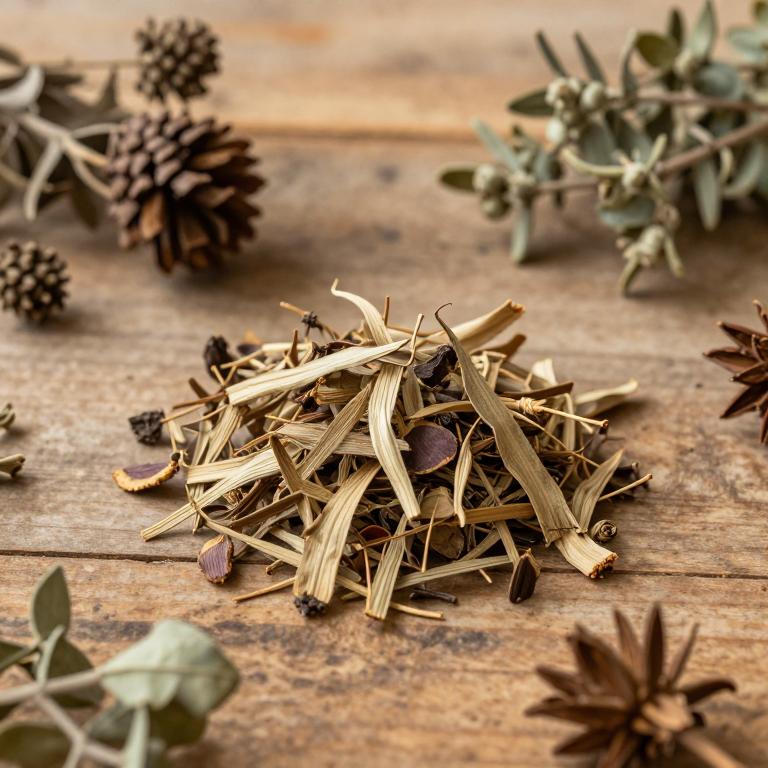
Names and Synonyms
Scientific Names
Accepted name
Croton matourensisSynonyms
- Luntia sericea
- Croton cyathodenus
- Oxydectes matourensis
- Oxydectes caryophyllus
- Croton matourensis var. benthamianus
- Croton matourensis var. poeppigianus
- Croton matourensis var. sericeus
- Croton pakaraimae
- Croton kavanayensis
- Croton impetiginosus
- Croton lanjouwensis
- Croton sericeus
- Croton caryophyllus
Regional and Traditional Names
French:
- Croton kavanayensis
- Oxydectes matourensis
- Luntia sericea
- Croton pakaraimae
- Croton lanjouwensis
- Croton impetiginosus
- Croton cyathodenus
Sources: Wikidata, Catalogue of Life
Taxonomical Classification
This plant belongs to the kingdom Plantae within the phylum Streptophyta and is classified under the class Equisetopsida. As a member of the subclass Magnoliidae and the order Malpighiales, it is specifically situated within the family Euphorbiaceae. Finally, it is identified by the genus Croton under the species name Croton matourensis.
| Rank | Classification |
|---|---|
| Kingdom | Plantae |
| Phylum | Streptophyta |
| Class | Equisetopsida |
| Subclass | Magnoliidae |
| Order | Malpighiales |
| Family | Euphorbiaceae |
| Genus | Croton |
Sources: The World Checklist of Vascular Plants (WCVP)
Distribution
This plant exhibits a specific distribution spanning across Central and Northern South America. In the Central American region, its presence is documented in Costa Rica and Panamá. Moving into Northern South America, it can be found inhabiting the tropical landscapes of French Guiana. The species is also widely distributed throughout the territories of Guyana. Finally, its range extends to include the nation of Suriname.
| Region | Area |
|---|---|
| Central America | Costa Rica |
| Central America | Panamá |
| Northern South America | French Guiana |
| Northern South America | Guyana |
| Northern South America | Suriname |
| Northern South America | Venezuela |
| Western South America | Bolivia |
| Western South America | Colombia |
| Western South America | Ecuador |
| Western South America | Peru |
Sources: The World Checklist of Vascular Plants (WCVP)
Botanical Identification
Ecology
The ecology of Croton matourensis is characterized by a broad altitudinal distribution and a high degree of habitat versatility within tropical ecosystems. This species thrives across a significant elevational gradient, ranging from sea level (0 m AMSL) up to a maximum altitude of 1100 m AMSL. Its ecological plasticity allows it to inhabit diverse and specialized environmental niches, including the nutrient-poor sandy soils of Campinarana, the transitional environments of Floressta Ciliar or Galeria, and the seasonally flooded habitats of Floressta de Igapó. Furthermore, it is well-adapted to the stable conditions of Floressta de Terra Firme as well as the open, fire-influenced landscapes of the Savauna Amazônica.
- Elevational range max:
- 1100 m AMSL
- Elevational range min:
- 0 m AMSL
- Habitat :
- Campinarana, Floresta Ciliar ou Galeria, Floresta de Igapó, Floresta de Terra Firme, Savana Amazônica
Life history
The life history of Croton matourensis is characterized by its status as a perennial species, ensuring its long-term persistence within its ecological niche. As a phanerophyte, the plant maintains its photosynthetic organs on elevated stems above the ground level, a structural adaptation that defines its growth habit. Furthermore, it exhibits an evergreen deciduousness pattern, retaining its foliage throughout the year rather than undergoing seasonal leaf shedding. This combination of a perennial lifecycle and a phanerophyte life form allows the species to maintain a stable and continuous presence in its habitat.
- Deciduousness :
- evergreen
- Life form :
- phanerophyte
- Lifecycle :
- perennial
Morphology
The morphology of Croton matourensis is characterized by a woody growth form, specifically developing as a tree. It functions as a self-supporting plant, categorized as neither a liana nor a vine, and is an independent organism that does not exhibit parasitic behavior. As a terrestrial species, it is neither aquatic nor an epiphyte. The plant displays significant vertical development, reaching an average height of 6 m, though it has the capacity to reach a maximum height of up to 25 m.
- Aquatic :
- terrestrial
- Climber :
- self-supporting
- Epiphyte :
- terrestrial
- Growth form :
- tree
- Parasite :
- independent
- Plant height max:
- 25 m
- Plant height mean:
- 6 m
- Woodiness :
- woody
Physiology
The physiology of Croton matourensis is characterized by a C3 photosynthetic pathway, utilizing the standard Calvin cycle to fix atmospheric carbon dioxide during the light-independent reactions. This metabolic strategy implies that the plant undergoes photorespiration under high-temperature or water-stressed conditions, a common trait among species utilizing the C3 mechanism. Furthermore, in terms of nutrient acquisition and symbiotic relationships, the plant is not a nitrogen fixer, meaning it lacks the specialized root nodules containing diazotrophic bacteria required to convert atmospheric nitrogen into bioavailable forms, relying instead on the uptake of nitrates and ammonium from the soil substrate.
- Nitrogen fixer :
- no
- Photosynthetic pathway :
- C3
Reproduction
The reproduction of Croton matourensis is driven by a complex biotic pollination syndrome, relying on living organisms rather than abiotic factors to facilitate the transfer of genetic material. This reproductive process is primarily mediated through insect pollination, where various small invertebrates play a critical role in the fertilization cycle. More specifically, the plant exhibits a specialized relationship with bees, which serve as highly effective pollinators, ensuring the successful movement of pollen between flowers. This multifaceted approach to biotic pollination highlights a reproductive strategy that leverages the movement of specific insect vectors to maintain genetic diversity and ensure the continuation of the species.
- Pollination syndrome :
- insect
- Pollination syndrome :
- bee
- Pollination syndrome :
- biotic
Sources: Global Inventory of Floras and Traits (GIFT)
Chemicals
Croton matourensis has 3 reported phytochemicals identified across 0 scientific publications and several other databases. The most consistently reported chemicals include Cembrene, P-CYMENE, Thunbergol.
| Chemical | Supporting sources | Consensus |
|---|---|---|
| Cembrene | 1 supporting sources | ★☆☆☆☆ |
| P-CYMENE | 1 supporting sources | ★☆☆☆☆ |
| Thunbergol | 1 supporting sources | ★☆☆☆☆ |
Cembrene
- Molecules (Basel, Switzerland)
P-CYMENE
- Molecules (Basel, Switzerland)
Thunbergol
- Molecules (Basel, Switzerland)
Activities
Croton matourensis has 1 reported activities identified across 0 scientific publications and several other databases. The most consistently reported activities include Cytotoxic.
| Activity | Supporting sources | Consensus |
|---|---|---|
| Cytotoxic | 1 supporting sources | ★☆☆☆☆ |
Cytotoxic
- Molecules (Basel, Switzerland)
Conditions
Croton matourensis has 3 reported investigations on conditions identified across 0 scientific publications and several other databases. The most consistently reported conditions include cancer, infections, tumor.
| Condition | Supporting sources | Consensus |
|---|---|---|
| Cancer | 1 supporting sources | ★☆☆☆☆ |
| Infections | 1 supporting sources | ★☆☆☆☆ |
| Tumor | 1 supporting sources | ★☆☆☆☆ |
Cancer
- Molecules (Basel, Switzerland)
Infections
- Molecules (Basel, Switzerland)
Tumor
- Molecules (Basel, Switzerland)