Croton gratissimus gratissimus
Croton gratissimus var. gratissimus · Accepted scientific name
Scientific literature: Very Sparse (12 studies) · ★☆☆☆☆
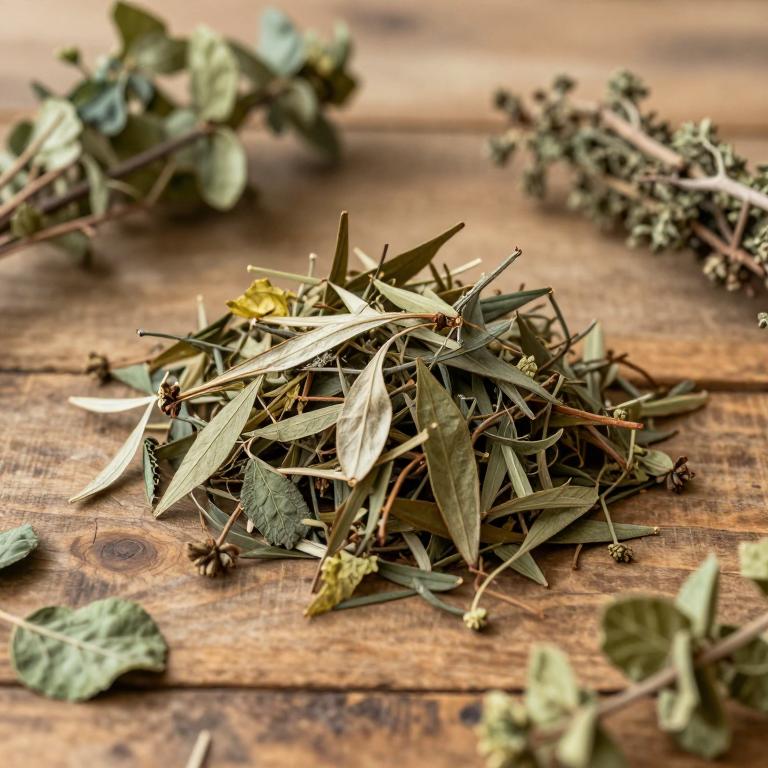
Croton gratissimus gratissimus, scientifically known as Croton gratissimus var. gratissimus, is a significant medicinal shrub found across tropical regions. Renowned for its diverse therapeutic properties, various parts of this plant are traditionally utilized in folk medicine to treat skin ailments, inflammation, and digestive issues, offering valuable ethnobotanical insights.
Names and Synonyms
Common Names
- Kalahari buku
- Lavendar Croton
- Lavender Fever-Berry
- Laventelkoorsbessie
- Sandalwood-Tree
Scientific Names
Accepted name
Croton gratissimus var. gratissimusSynonyms
- Croton antunesii
- Oxydectes welwitschiana
- Oxydectes zambesica
- Croton amabilis
- Oxydectes amabilis
- Croton microbotryus
- Croton zambesicus
- Croton welwitschianus
Regional and Traditional Names
German:
- Duft-Fiebernuss
- Lavendelbusch
- Pfefferkornbusch
Sources: Wikidata, Catalogue of Life
Taxonomical Classification
This plant belongs to the kingdom Plantae and the phylum Streptophyta, falling under the class Equisetopsida and subclass Magnoliidae. It is classified within the order Malpighiales and the family Euphorbiaceae. Finally, it is identified by the genus Croton under the specific variety Croton gratissimus var. gratissimus.
| Rank | Classification |
|---|---|
| Kingdom | Plantae |
| Phylum | Streptophyta |
| Class | Equisetopsida |
| Subclass | Magnoliidae |
| Order | Malpighiales |
| Family | Euphorbiaceae |
| Genus | Croton |
Sources: The World Checklist of Vascular Plants (WCVP)
Distribution
This plant exhibits a specific geographical distribution concentrated within the West Tropical Africa region. Its presence is documented across several diverse nations, including the country of Benin. Furthermore, it can be found growing within the borders of Burkina and Gambia. The species also extends its range into Ghana, demonstrating its regional prevalence. Finally, its habitat includes the territory of Guinea, completing its documented West African range.
| Region | Area |
|---|---|
| West Tropical Africa | Benin |
| West Tropical Africa | Burkina |
| West Tropical Africa | Gambia |
| West Tropical Africa | Ghana |
| West Tropical Africa | Guinea |
| West Tropical Africa | Ivory Coast |
| West Tropical Africa | Mali |
| West Tropical Africa | Nigeria |
| West Tropical Africa | Senegal |
| West Tropical Africa | Sierra Leone |
Sources: The World Checklist of Vascular Plants (WCVP)
Plant Parts
Croton gratissimus var. gratissimus has 3 reported plant parts identified across 4 scientific publications and several other databases that are studied for medicinal purposes. The most consistently reported plant part include stem, fruit, leaf.
| Plant part | Supporting sources | Consensus |
|---|---|---|
| Stem | 2 supporting sources | ★☆☆☆☆ |
| Fruit | 1 supporting sources | ★☆☆☆☆ |
| Leaf | 1 supporting sources | ★☆☆☆☆ |
Stem
- Phytochemistry
- Phytotherapy research : PTR
Fruit
- Frontiers in pharmacology
Leaf
- Journal of natural products
Chemicals
Croton gratissimus var. gratissimus has 7 reported phytochemicals identified across 4 scientific publications and several other databases. The most consistently reported chemicals include Betulinol, Crotocorylifuran, Crotozambefuran A, Crotozambefuran B, Crotozambefuran C.
| Chemical | Supporting sources | Consensus |
|---|---|---|
| Betulinol | 1 supporting sources | ★☆☆☆☆ |
| Crotocorylifuran | 1 supporting sources | ★☆☆☆☆ |
| Crotozambefuran A | 1 supporting sources | ★☆☆☆☆ |
| Crotozambefuran B | 1 supporting sources | ★☆☆☆☆ |
| Crotozambefuran C | 1 supporting sources | ★☆☆☆☆ |
| Lupeol | 1 supporting sources | ★☆☆☆☆ |
| Sitosterol | 1 supporting sources | ★☆☆☆☆ |
Betulinol
- Phytochemistry
Crotocorylifuran
- Phytochemistry
Crotozambefuran A
- Phytochemistry
Crotozambefuran B
- Phytochemistry
Crotozambefuran C
- Phytochemistry
Lupeol
- Phytochemistry
Sitosterol
- Phytochemistry
Activities
Croton gratissimus var. gratissimus has 1 reported activities identified across 4 scientific publications and several other databases. The most consistently reported activities include Hypoglycemic.
| Activity | Supporting sources | Consensus |
|---|---|---|
| Hypoglycemic | 1 supporting sources | ★☆☆☆☆ |
Hypoglycemic
- Plants (Basel, Switzerland)
Preparations
Croton gratissimus var. gratissimus has 5 reported preparations identified across 4 scientific publications and several other databases. The most consistently reported preparations include chloroform fractions obtained by liquid-liquid partitioning from ethanolic extracts of fruits, ethanolic extracts of fruits, extracts, leaves, stem bark.
| Preparation | Supporting sources | Consensus |
|---|---|---|
| Chloroform fractions obtained by liquid-liquid partitioning from ethanolic extracts of fruits | 1 supporting sources | ★☆☆☆☆ |
| Ethanolic extracts of fruits | 1 supporting sources | ★☆☆☆☆ |
| Extracts | 1 supporting sources | ★☆☆☆☆ |
| Leaves | 1 supporting sources | ★☆☆☆☆ |
| Stem bark | 1 supporting sources | ★☆☆☆☆ |
Chloroform fractions obtained by liquid-liquid partitioning from ethanolic extracts of fruits
- Frontiers in pharmacology
Ethanolic extracts of fruits
- Frontiers in pharmacology
Extracts
- Phytotherapy research : PTR
Leaves
- Journal of natural products
Stem bark
- Phytochemistry