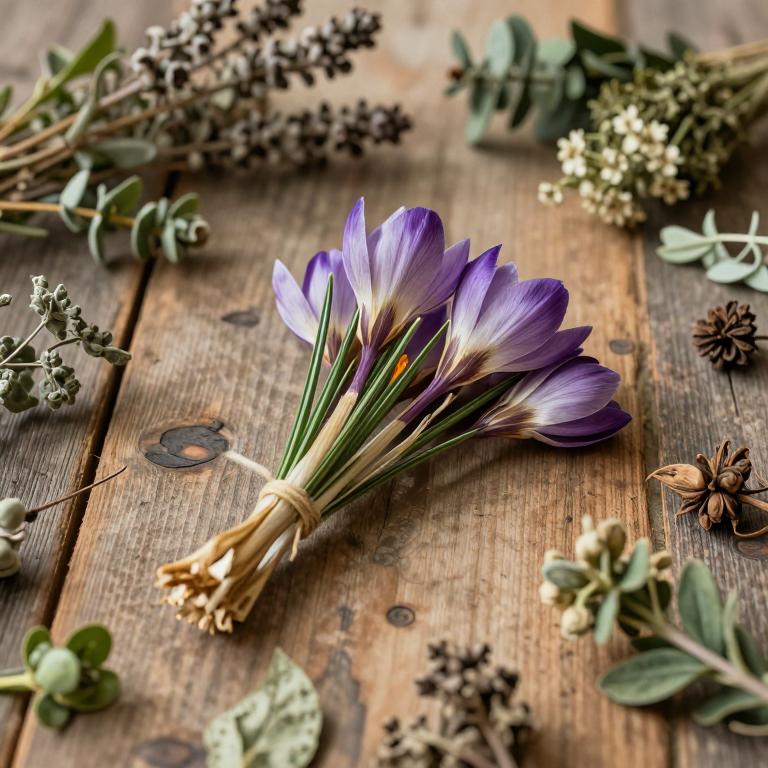
Crocus damascenus
Crocus damascenus · Accepted scientific name
Scientific literature: Very Sparse (3 studies) · ★☆☆☆☆
Crocus damascenus, scientifically known as Crocus damascenus, is a remarkable medicinal plant native to the Middle East. Renowned for its potent therapeutic properties, it is widely utilized in traditional medicine to treat inflammation, digestive issues, and respiratory ailments, offering a natural approach to enhancing overall wellness and vitality.
- Family
- Iridaceae
- Native range
- Asia-Temperate
- Parts used
- Not available
- Common names
- Not available
- Scientific synonyms
- Crocus Cancellatus F. Damascenus · Crocus Dianthus · 3 more
Names and Synonyms
Scientific Names
Accepted name
Crocus damascenusSynonyms
- Crocus cancellatus f. damascenus
- Crocus dianthus
- Crocus cancellatus var. damascenus
- Crocus edulis
- Crocus cancellatus subsp. damascenus
Sources: Wikidata, Catalogue of Life
Taxonomical Classification
This plant belongs to the kingdom Plantae within the phylum Streptophyta and is classified under the class Equisetopsida and subclass Magnoliidae. It further falls under the order Asparagales and the family Iridaceae. Finally, its taxonomic identity is defined by the genus Crocus, specifically as the species Crocus damascenus.
| Rank | Classification |
|---|---|
| Kingdom | Plantae |
| Phylum | Streptophyta |
| Class | Equisetopsida |
| Subclass | Magnoliidae |
| Order | Asparagales |
| Family | Iridaceae |
| Genus | Crocus |
Sources: The World Checklist of Vascular Plants (WCVP)
Distribution
This plant is native to the diverse landscapes of Western Asia. Its distribution begins in the eastern reaches of the region, where it can be found growing in Iran. Moving westward, the species is also widely documented throughout the territory of Iraq. The plant's range continues through the Levant, specifically inhabiting the areas of Lebanon and Syria. Finally, its geographical presence extends to Palestine and the various regions of Türkiye.
| Region | Area |
|---|---|
| Western Asia | Iran |
| Western Asia | Iraq |
| Western Asia | Lebanon-Syria |
| Western Asia | Palestine |
| Western Asia | Türkiye |
Sources: The World Checklist of Vascular Plants (WCVP)
Botanical Identification
Life history
The life history of Crocus damascenus is characterized by its specialized survival strategy as a perennial herb that relies on underground storage organs to endure seasonal environmental shifts. Classified fundamentally as a cryptophyte, the plant ensures its long-term persistence by keeping its vital regenerative tissues protected beneath the soil surface. More specifically, it functions as a geophyte, utilizing a specialized corm to store nutrients and water, which allows it to remain dormant during periods of drought or extreme temperatures. This life cycle involves a rhythmic progression where the plant emerges from its subterranean state to produce seasonal foliage and flowers, eventually retreating back into its geophytic storage structure to await the next favorable growing season.
- Life form :
- geophyte
- Life form :
- cryptophyte
Morphology
The morphology of Crocus damascenus is characterized by its growth habit as a terrestrial plant, functioning as an independent organism that does not rely on aquatic or semiaquatic environments for its primary life cycle. It is a self-supporting herb that lacks any climbing mechanisms, maintaining a stable, upright structure within its natural habitat. As a non-parasitic species, it remains entirely independent of other host plants for nutrients, and it does not exhibit epiphytic behavior, staying rooted in the soil rather than growing on other vegetation.
- Aquatic :
- terrestrial
- Climber :
- self-supporting
- Epiphyte :
- terrestrial
- Parasite :
- independent
Sources: Global Inventory of Floras and Traits (GIFT)
Chemicals
Crocus damascenus has 1 reported phytochemicals identified across 0 scientific publications and several other databases. The most consistently reported chemicals include Lipase.
| Chemical | Supporting sources | Consensus |
|---|---|---|
| Lipase | 1 supporting sources | ★☆☆☆☆ |
Lipase
- Journal of enzyme inhibition and medicinal chemistry
Preparations
Crocus damascenus has 2 reported preparations identified across 0 scientific publications and several other databases. The most consistently reported preparations include Crocus cancellatus subsp. damascenus extract, Stigma extract.
| Preparation | Supporting sources | Consensus |
|---|---|---|
| Crocus cancellatus subsp. damascenus extract | 1 supporting sources | ★☆☆☆☆ |
| Stigma extract | 1 supporting sources | ★☆☆☆☆ |
Crocus cancellatus subsp. damascenus extract
- Journal of enzyme inhibition and medicinal chemistry
Stigma extract
- Journal of enzyme inhibition and medicinal chemistry