Redspot Stonecrop
Crassula capitella · Accepted scientific name
Scientific literature: Very Sparse (14 studies) · ★☆☆☆☆
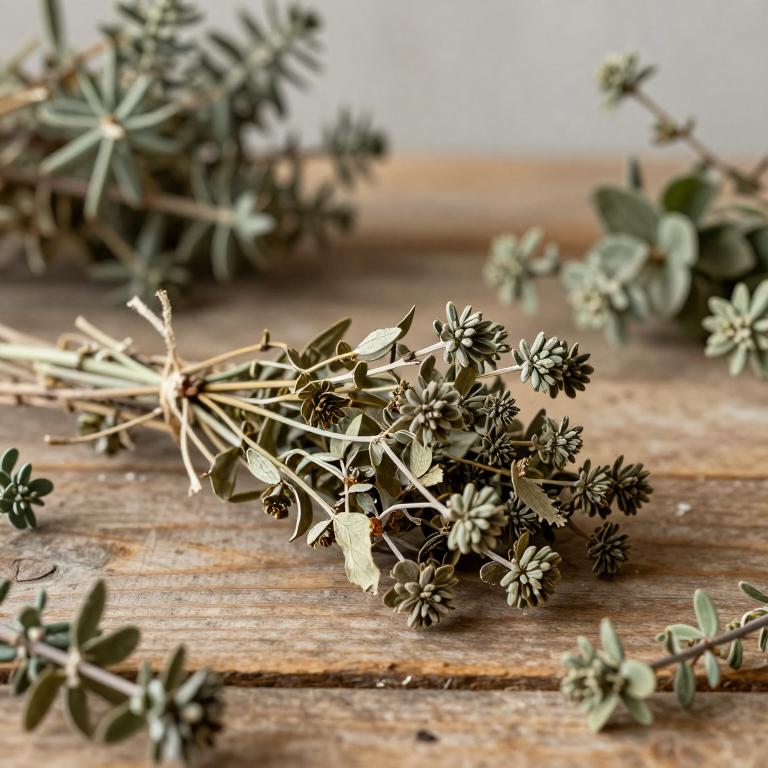
Redspot Stonecrop, scientifically known as Crassulia capitella, is a resilient succulent celebrated for its striking, deep-red foliage. While primarily used as an ornamental plant, it holds significance in traditional herbalism. This hardy species thrives in diverse environments, offering both aesthetic beauty and potential therapeutic applications in holistic wellness.
- Family
- Crassulaceae
- Native range
- Africa
- Parts used
- Leaf
- Common names
- Redspot Stonecrop
- Scientific synonyms
- Turgosea Capitella
Names and Synonyms
Common Names
- Redspot Stonecrop
Scientific Names
Accepted name
Crassula capitellaSynonyms
- Turgosea capitella
Sources: Wikidata, Catalogue of Life
Taxonomical Classification
This plant belongs to the kingdom Plantae and the phylum Streptophyta, falling under the class Equisetopsida and subclass Magnoliidae. Within the order Saxifragales, it is classified under the family Crassulaceae. Finally, its specific taxonomic identity is established within the genus Crassula.
| Rank | Classification |
|---|---|
| Kingdom | Plantae |
| Phylum | Streptophyta |
| Class | Equisetopsida |
| Subclass | Magnoliidae |
| Order | Saxifragales |
| Family | Crassulaceae |
| Genus | Crassula |
Sources: The World Checklist of Vascular Plants (WCVP)
Distribution
This plant is primarily found throughout the diverse landscapes of Southern Africa. Its natural range extends across the various Cape Provinces, where it adapts to specific local climates. Additionally, it can be located in the mountainous terrains of Lesotho. The species also inhabits regions within Namibia, demonstrating its ability to thrive in different environments. Finally, its geographical footprint includes the inland areas of the Free State and the coastal reaches of KwaZulu-Natal.
| Region | Area |
|---|---|
| Southern Africa | Cape Provinces |
| Southern Africa | Lesotho |
| Southern Africa | Namibia |
| Southern Africa | KwaZulu-Natal |
| Southern Africa | Free State |
Sources: The World Checklist of Vascular Plants (WCVP)
Botanical Identification
Ecology
The ecology of Crassula capitella is characterized by a broad adaptive capacity that allows it to thrive across a diverse altitudinal gradient. This species is found across an extensive elevational range, beginning from sea level at 0 m AMSL and extending up to a maximum altitude of 1900 m AMSL. Such a wide vertical distribution suggests an ability to tolerate varying climatic conditions, ranging from the warmer, more stable environments of lowland coastal or valley regions to the potentially cooler, more temperate, and higher-UV environments found in montane habitats. This adaptability facilitates its presence in a variety of niche environments, where it can navigate fluctuations in temperature, moisture availability, and atmospheric pressure throughout its natural range.
- Elevational range max:
- 1900 m AMSL
- Elevational range min:
- 0 m AMSL
Life history
The life history of Crassula capitella is characterized by a variable lifecycle that can manifest as an annual, biennial, or perennial organism depending on environmental stability and resource availability. As a succulent, its biological progression is heavily influenced by its ability to store water in its fleshy leaves, allowing it to endure periods of drought that might terminate the lives of less resilient species. In favorable conditions, it functions as a perennial, establishing a long-term presence through vegetative propagation and the development of sturdy root systems. However, in more ephemeral or harsh habitats, its life cycle may shift toward a biennial or even annual pattern, where the plant prioritizes rapid maturation and seed production to ensure the survival of the next generation before the onset of fatal environmental stressors. This adaptability in its temporal development enables the species to colonize diverse ecological niches, transitioning between life stages to optimize reproductive success.
- Lifecycle :
- biennial
Morphology
The morphology of Crassula capitella is characterized by a non-woody, herbaceous growth form, functioning as both a herb and a forb. As an independent organism, it does not exhibit parasitic behavior and is primarily terrestrial rather than being an epiphyte or aquatic species. The plant is self-supporting rather than acting as a climber, maintaining a compact structure that reaches a maximum plant height of 0.4 m.
- Aquatic :
- terrestrial
- Climber :
- self-supporting
- Epiphyte :
- terrestrial
- Growth form :
- herb
- Parasite :
- independent
- Plant height max:
- 0.4 m
- Woodiness :
- non-woody
Physiology
The physiology of Crassula capitella is characterized by its specialized metabolic adaptation to arid environments, specifically through the use of the CAM (Crassulacean Acid Metabolism) photosynthetic pathway. Unlike standard C3 or C4 plants, this species utilizes a temporal separation of carbon fixation to maximize water-use efficiency. During the night, the plant opens its stomata to absorb atmospheric carbon dioxide, which is then chemically fixed and stored as malic acid within large central vacuoles. During the daylight hours, the stomata remain tightly closed to prevent transpirational water loss, and the stored malic acid is decarboxylated to release CO2 internally, allowing the Calvin cycle to proceed using light energy captured by chlorophyll. This physiological mechanism enables Crassula capitella to maintain metabolic activity and succulent tissue hydration even under significant drought stress.
- Photosynthetic pathway :
- CAM
Reproduction
Reproduction in Crassula capitella occurs through both sexual and asexual mechanisms, though its reproductive success is heavily characterized by its specialized seed production. When the plant undergoes sexual reproduction via flowering, it produces exceptionally minute seeds that facilitate widespread dispersal. The physical characteristics of these seeds are remarkably consistent, with a recorded seed mass mean of 1e-05 g. This uniformity is reflected in the seed's weight range, as both the maximum and minimum seed mass values are strictly documented at 1e-05 g, indicating a highly standardized seed size within the species. This microscopic seed mass allows the plant to utilize wind or water for efficient dispersal, ensuring that offspring can colonize new microhabitats. In addition to these tiny seeds, the plant often utilizes vegetative propagation, where fragments of its succulent leaves or stems can develop into new individuals, providing a robust secondary strategy for population expansion.
- Seed mass mean:
- 1e-05 g
Sources: Global Inventory of Floras and Traits (GIFT)
Plant Parts
Crassula capitella has 1 reported plant parts identified across 1 scientific publications and several other databases that are studied for medicinal purposes. The most consistently reported plant part include leaf.
| Plant part | Supporting sources | Consensus |
|---|---|---|
| Leaf | 1 supporting sources | ★☆☆☆☆ |
Leaf
- Biomedicines
Chemicals
Crassula capitella has 5 reported phytochemicals identified across 1 scientific publications and several other databases. The most consistently reported chemicals include BETULINALDEHYDE, Betulin, Fatty acids, Lupeol, Terpenoids.
| Chemical | Supporting sources | Consensus |
|---|---|---|
| BETULINALDEHYDE | 1 supporting sources | ★☆☆☆☆ |
| Betulin | 1 supporting sources | ★☆☆☆☆ |
| Fatty acids | 1 supporting sources | ★☆☆☆☆ |
| Lupeol | 1 supporting sources | ★☆☆☆☆ |
| Terpenoids | 1 supporting sources | ★☆☆☆☆ |
BETULINALDEHYDE
- Biomedicines
Betulin
- Biomedicines
Fatty acids
- Biomedicines
Lupeol
- Biomedicines
Terpenoids
- Biomedicines
Activities
Crassula capitella has 4 reported activities identified across 1 scientific publications and several other databases. The most consistently reported activities include Antioxidant, Antibacterial, Anticancer, Antidiabetic.
| Activity | Supporting sources | Consensus |
|---|---|---|
| Antioxidant | 2 supporting sources | ★☆☆☆☆ |
| Antibacterial | 1 supporting sources | ★☆☆☆☆ |
| Anticancer | 1 supporting sources | ★☆☆☆☆ |
| Antidiabetic | 1 supporting sources | ★☆☆☆☆ |
Antioxidant
- The Journal of pharmacy and pharmacology
- Biomedicines
Antibacterial
- Biomedicines
Anticancer
- Biomedicines
Antidiabetic
- Biomedicines
Conditions
Crassula capitella has 3 reported investigations on conditions identified across 1 scientific publications and several other databases. The most consistently reported conditions include antidiabetic, antioxidant, rheumatoid arthritis.
| Condition | Supporting sources | Consensus |
|---|---|---|
| Antidiabetic | 1 supporting sources | ★☆☆☆☆ |
| Antioxidant | 1 supporting sources | ★☆☆☆☆ |
| Rheumatoid arthritis | 1 supporting sources | ★☆☆☆☆ |
Antidiabetic
- Biomedicines
Antioxidant
- Biomedicines
Rheumatoid arthritis
- The Journal of pharmacy and pharmacology
Preparations
Crassula capitella has 3 reported preparations identified across 1 scientific publications and several other databases. The most consistently reported preparations include extract, methanolic extracts obtained from the inflorescences (CCIE), methanolic extracts obtained from the leaves (CCLE).
| Preparation | Supporting sources | Consensus |
|---|---|---|
| Extract | 1 supporting sources | ★☆☆☆☆ |
| Methanolic extracts obtained from the inflorescences (ccie) | 1 supporting sources | ★☆☆☆☆ |
| Methanolic extracts obtained from the leaves (ccle) | 1 supporting sources | ★☆☆☆☆ |
Extract
- The Journal of pharmacy and pharmacology
Methanolic extracts obtained from the inflorescences (ccie)
- Biomedicines
Methanolic extracts obtained from the leaves (ccle)
- Biomedicines