John Charles-weed
Condea verticillata · Accepted scientific name
Scientific literature: Sparse (79 studies) · ★★☆☆☆
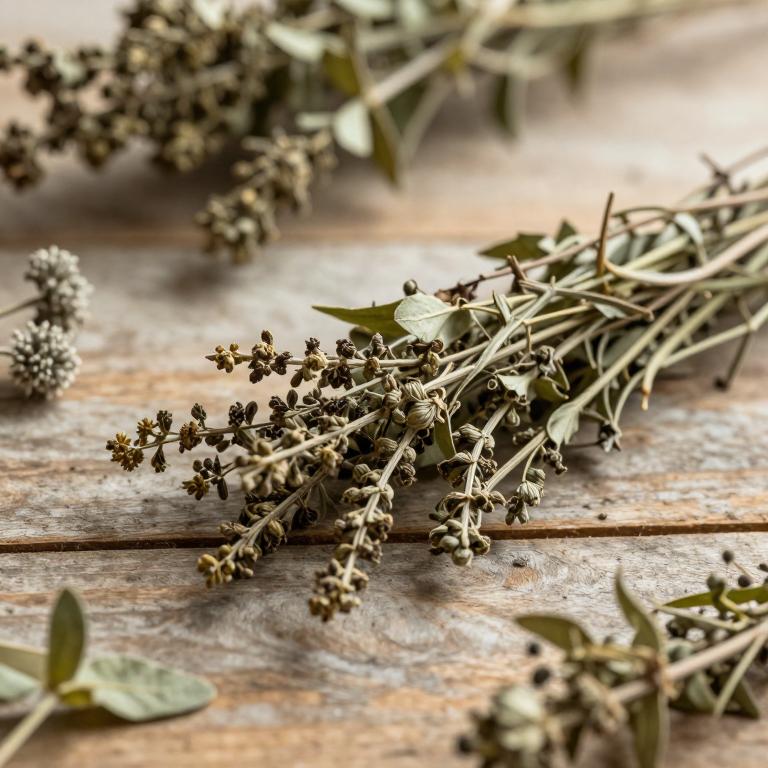
John Charles-weed, scientifically known as Condea verticillata, is a distinctive medicinal plant revered in traditional healing practices. Characterized by its unique whorled leaf arrangement, this species offers significant therapeutic potential. Exploring its phytochemical properties provides vital insights into its role in treating various ailments and supporting holistic wellness.
Names and Synonyms
Common Names
- John Charles-weed
- grand baume
- wild basilic
- Desert lavender
Scientific Names
Accepted name
Condea verticillataSynonyms
- Mesosphaerum verticillatum
- Stachys patens
- Hyptis pringlei
- Hyptis verticillata
- Hyptis parviflora
- Hyptis axillaris
- Mentha hyptiformis
Regional and Traditional Names
Spanish:
- escobilla
- herbe-volcan
- hoja de matin
- oja matin
Sources: Wikidata, Catalogue of Life
Taxonomical Classification
This plant belongs to the kingdom Plantae within the phylum Streptophyta and the class Equisetopsida. It is further classified under the subclass Magnoliidae and the order Lamiales, falling into the family Lamiaceae. Ultimately, it is identified by the genus Condea, specifically as the species Condea verticillata.
| Rank | Classification |
|---|---|
| Kingdom | Plantae |
| Phylum | Streptophyta |
| Class | Equisetopsida |
| Subclass | Magnoliidae |
| Order | Lamiales |
| Family | Lamiaceae |
| Genus | Condea |
Sources: The World Checklist of Vascular Plants (WCVP)
Distribution
This plant exhibits a diverse geographical distribution spanning across the Pacific and North America. In the North-Central Pacific, it can be found growing in Hawaii. Its range also extends to the Southeastern United States, specifically within the state of Florida. Within Mexico, the species is widely distributed across the Central, Northeast, and Gulf regions. This broad presence highlights the adaptable nature of the plant across various subtropical environments.
| Region | Area |
|---|---|
| North-Central Pacific | Hawaii |
| Southeastern U.S.A. | Florida |
| Mexico | Mexico Central |
| Mexico | Mexico Northeast |
| Mexico | Mexico Gulf |
| Mexico | Mexico Southwest |
| Mexico | Mexico Southeast |
| Central America | Belize |
| Central America | Costa Rica |
| Central America | El Salvador |
Sources: The World Checklist of Vascular Plants (WCVP)
Botanical Identification
Ecology
The ecology of Condea verticillata is characterized by its ability to inhabit a broad altitudinal spectrum, spanning from sea level up to an elevation of 1000 m AMSL. This wide elevational range suggests a high degree of adaptability to varying environmental gradients, allowing the species to persist in both coastal lowland habitats and lower montane ecosystems. By occupying niches from 0 to 1000 m AMSL, the plant likely encounters diverse microclimates, varying levels of humidity, and shifting soil compositions, which necessitates physiological flexibility to thrive across these distinct ecological zones.
- Elevational range max:
- 1000 m AMSL
- Elevational range min:
- 0 m AMSL
Life history
The life history of Condea verticillata is characterized by its status as a perennial organism, allowing it to persist through multiple growing seasons rather than completing its cycle within a single year. In terms of its growth habit and structural strategy, the plant is classified as a chamaephyte, meaning its perennating buds are located close to the soil surface, typically just above the ground level, which helps protect its vital tissues during unfavorable environmental conditions.
- Life form :
- chamaephyte
- Lifecycle :
- perennial
Morphology
The morphology of Condea verticillata is characterized by a versatile growth habit that ranges from a woody shrub to a forb, depending on its specific environmental context. As a plant capable of occupying various niches, it exhibits a flexible ecological profile, existing in aquatic, semiaquatic, or terrestrial habitats. While it possesses the structural capacity to act as a self-supporting climber, it does not function as an obligatory vine or liana, often maintaining a self-supporting stature. In its growth patterns, it can present as a woody organism or a more herbaceous forb, demonstrating significant morphological plasticity. Furthermore, the plant is an independent organism that does not rely on parasitic relationships, and in terms of its epiphytic potential, it remains strictly terrestrial rather than functioning as a holoepiphyte or hemiepiphyte.
- Aquatic :
- terrestrial
- Climber :
- self-supporting
- Epiphyte :
- terrestrial
- Growth form :
- shrub
- Growth form :
- forb
- Parasite :
- independent
- Woodiness :
- woody
Sources: Global Inventory of Floras and Traits (GIFT)
Chemicals
Condea verticillata has 23 reported phytochemicals identified across 0 scientific publications and several other databases. The most consistently reported chemicals include (r)-5-hydroxypyrrolidin-2-one, ALPHA-PINENE, BETA-PINENE, Lignans, Sideritoflavone.
| Chemical | Supporting sources | Consensus |
|---|---|---|
| (r)-5-hydroxypyrrolidin-2-one | 2 supporting sources | ★☆☆☆☆ |
| ALPHA-PINENE | 2 supporting sources | ★☆☆☆☆ |
| BETA-PINENE | 2 supporting sources | ★☆☆☆☆ |
| Lignans | 2 supporting sources | ★☆☆☆☆ |
| Sideritoflavone | 2 supporting sources | ★☆☆☆☆ |
| THYMOL | 2 supporting sources | ★☆☆☆☆ |
| podophyllotoxin | 2 supporting sources | ★☆☆☆☆ |
| rosmarinic acid | 2 supporting sources | ★☆☆☆☆ |
| (-)-yatein | 1 supporting sources | ★☆☆☆☆ |
| 2-alpha-Hydroxyursolic acid | 1 supporting sources | ★☆☆☆☆ |
(r)-5-hydroxypyrrolidin-2-one
- Planta medica
- Current topics in medicinal chemistry
ALPHA-PINENE
- Planta medica
- Current topics in medicinal chemistry
BETA-PINENE
- Planta medica
- Current topics in medicinal chemistry
Lignans
- Dr. Duke
- Current topics in medicinal chemistry
Sideritoflavone
- Planta medica
- Current topics in medicinal chemistry
THYMOL
- Planta medica
- Current topics in medicinal chemistry
podophyllotoxin
- Dr. Duke
- Phytochemical analysis : PCA
rosmarinic acid
- Planta medica
- Current topics in medicinal chemistry
(-)-yatein
- Journal of natural products
2-alpha-Hydroxyursolic acid
- Journal of natural products
Activities
Condea verticillata has 41 reported activities identified across 0 scientific publications and several other databases. The most consistently reported activities include Antibacterial, Antimitotic, Antioxidant, Antisecretory, Antiviral.
| Activity | Supporting sources | Consensus |
|---|---|---|
| Antibacterial | 2 supporting sources | ★☆☆☆☆ |
| Antimitotic | 2 supporting sources | ★☆☆☆☆ |
| Antioxidant | 2 supporting sources | ★☆☆☆☆ |
| Antisecretory | 2 supporting sources | ★☆☆☆☆ |
| Antiviral | 2 supporting sources | ★☆☆☆☆ |
| Cytotoxic | 2 supporting sources | ★☆☆☆☆ |
| Abortifacient | 1 supporting sources | ★☆☆☆☆ |
| Allergenic | 1 supporting sources | ★☆☆☆☆ |
| Anticondylomata | 1 supporting sources | ★☆☆☆☆ |
| Antiestrogenic | 1 supporting sources | ★☆☆☆☆ |
Antibacterial
- Planta medica
- Journal of ethnopharmacology
Antimitotic
- Dr. Duke
- Journal of ethnopharmacology
Antioxidant
- Dr. Duke
- Journal of ethnopharmacology
Antisecretory
- Planta medica
- Journal of ethnopharmacology
Antiviral
- Dr. Duke
- Journal of ethnopharmacology
Cytotoxic
- Planta medica
- Journal of natural products
Abortifacient
- Dr. Duke
Allergenic
- Dr. Duke
Anticondylomata
- Dr. Duke
Antiestrogenic
- Dr. Duke
Preparations
Condea verticillata has 2 reported preparations identified across 0 scientific publications and several other databases. The most consistently reported preparations include aqueous extract, essential oil.
| Preparation | Supporting sources | Consensus |
|---|---|---|
| Aqueous extract | 1 supporting sources | ★☆☆☆☆ |
| Essential oil | 1 supporting sources | ★☆☆☆☆ |
Aqueous extract
- Planta medica
Essential oil
- Planta medica