Colliguaja odorifera
Colliguaja odorifera · Accepted scientific name
Scientific literature: Very Sparse (5 studies) · ★☆☆☆☆
Colliguaja odorifera, scientifically known as Colliguaja odorifera, is a versatile medicinal shrub native to South America. Renowned for its aromatic properties, it is widely utilized in traditional folk medicine to treat digestive ailments, respiratory issues, and inflammation. Its potent bioactive compounds offer significant therapeutic potential in modern herbal pharmacology.
- Family
- Euphorbiaceae
- Native range
- Southern America
- Parts used
- Not available
- Common names
- Not available
- Scientific synonyms
- Colliguaja Obtusa · Colliguaja Triquetra · 1 more
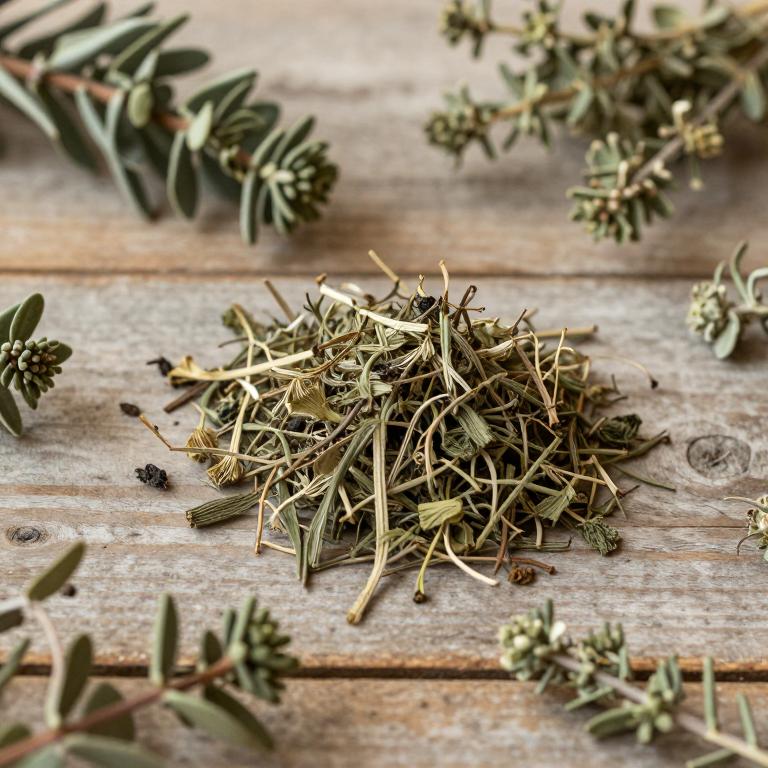
Names and Synonyms
Scientific Names
Accepted name
Colliguaja odoriferaSynonyms
- Colliguaja obtusa
- Colliguaja triquetra
- Croton colliguaja
Regional and Traditional Names
Spanish:
- Colliguaja triquetra
- Colliguaja obtusa
- Croton colliguay
- Colliguay
Sources: Wikidata, Catalogue of Life
Taxonomical Classification
This plant belongs to the kingdom Plantae within the phylum Streptophyta and the class Equisetopsida. It is further classified under the subclass Magnoliidae and the order Malpighiales. Within the family Euphorbiaceae, it is specifically identified by the genus Colliguja.
| Rank | Classification |
|---|---|
| Kingdom | Plantae |
| Phylum | Streptophyta |
| Class | Equisetopsida |
| Subclass | Magnoliidae |
| Order | Malpighiales |
| Family | Euphorbiaceae |
| Genus | Colliguaja |
Sources: The World Checklist of Vascular Plants (WCVP)
Distribution
This plant, known scientifically as Colliguja odorifera, exhibits a specific distribution within the Southern South American continent. Its natural habitat is primarily concentrated within the borders of Chile. Specifically, the species can be found growing across the region of Chile North. Additionally, its presence extends further south into Chile Central. This limited range highlights the plant's unique ecological niche within the Chilean landscape.
| Region | Area |
|---|---|
| Southern South America | Chile Central |
| Southern South America | Chile North |
Sources: The World Checklist of Vascular Plants (WCVP)
Botanical Identification
Ecology
The ecology of Colliguja odorifera is characterized by its distribution across a broad altitudinal gradient, allowing it to inhabit diverse topographical niches. This species is found at elevations ranging from 0 m AMSL to a maximum of 1300 m AMSL, demonstrating a significant capacity for environmental adaptation across both lowland and montane landscapes. This wide elevational range suggests that the plant can tolerate varying degrees of temperature fluctuations and atmospheric pressure changes, facilitating its establishment in diverse ecological zones within its native habitat.
- Elevational range max:
- 1300 m AMSL
- Elevational range min:
- 0 m AMSL
Life history
The life history of Colliguja odorifera is characterized by a perennial lifecycle, allowing the plant to persist through multiple growing seasons. In terms of its structural growth strategy and life form, it exhibits a dual classification within botanical frameworks, manifesting as a phanerophyte due to its ability to maintain its buds above the ground level, while also being categorized as a nanophanerophyte, indicating that its woody stems are relatively short and kept close to the substrate.
- Life form :
- nanophanerophyte
- Life form :
- phanerophyte
- Lifecycle :
- perennial
Morphology
The morphology of Colliguja odorifera is characterized by a woody growth form, specifically manifesting as a shrub. It functions as an independent organism rather than a parasite and is primarily terrestrial in its ecological habit, although it occupies a spectrum that can include semiaquatic environments. In terms of structural support, the plant is self-supporting, functioning neither as an obligatory climber nor as a liana, but maintaining its own upright posture without the need for external hosts or specialized climbing mechanisms.
- Aquatic :
- terrestrial
- Climber :
- self-supporting
- Epiphyte :
- terrestrial
- Growth form :
- shrub
- Parasite :
- independent
- Woodiness :
- woody
Reproduction
The reproduction of Colliguja odorifera is centered on the production and dispersal of its seeds, which exhibit highly specific morphological characteristics regarding their weight. The reproductive output of this species is characterized by a remarkably consistent seed mass, with a recorded mean value of 0.10062 g. This uniformity is absolute across the sampled population, as both the maximum and minimum seed mass values are identical at 0.10062 g. This lack of variance in seed mass suggests a highly standardized developmental process during the maturation of the seeds, ensuring that each individual unit produced for the next generation maintains a precise energetic investment and physical scale.
- Seed mass mean:
- 0.10062 g
Sources: Global Inventory of Floras and Traits (GIFT)
Chemicals
Colliguaja odorifera has 4 reported phytochemicals identified across 0 scientific publications and several other databases. The most consistently reported chemicals include ETHYL GALLATE, Gallic acid, METHYL GALLATE, shikimic acid.
| Chemical | Supporting sources | Consensus |
|---|---|---|
| ETHYL GALLATE | 1 supporting sources | ★☆☆☆☆ |
| Gallic acid | 1 supporting sources | ★☆☆☆☆ |
| METHYL GALLATE | 1 supporting sources | ★☆☆☆☆ |
| shikimic acid | 1 supporting sources | ★☆☆☆☆ |
ETHYL GALLATE
- Plants (Basel, Switzerland)
Gallic acid
- Plants (Basel, Switzerland)
METHYL GALLATE
- Plants (Basel, Switzerland)
shikimic acid
- Plants (Basel, Switzerland)
Conditions
Colliguaja odorifera has 1 reported investigations on conditions identified across 0 scientific publications and several other databases. The most consistently reported conditions include toothaches.
| Condition | Supporting sources | Consensus |
|---|---|---|
| Toothaches | 1 supporting sources | ★☆☆☆☆ |
Toothaches
- Plants (Basel, Switzerland)