Coleus strobilifer
Coleus strobilifer · Accepted scientific name
Scientific literature: Moderate (121 studies) · ★★★☆☆
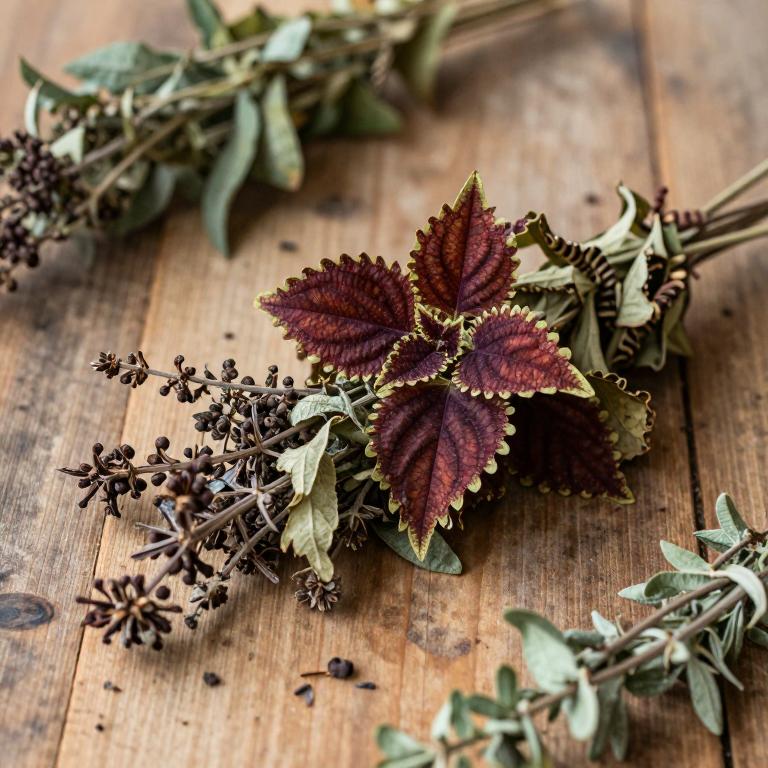
, scientifically known as Coleus strobilifer, is a vibrant ornamental plant prized for its strikingly multicolored foliage. Beyond its aesthetic appeal, it holds significance in traditional herbal practices. This versatile species thrives in tropical environments, offering a unique combination of visual splendor and potential therapeutic properties in various medicinal applications.
- Family
- Not available
- Native range
- Asia-Temperate
- Parts used
- Not available
- Common names
- Not available
- Scientific synonyms
- Not available
Names and Synonyms
Scientific Names
Accepted name
Coleus strobiliferDistribution
This plant exhibits a widespread distribution across several key regions of Asia. In the East, it can be found specifically throughout Southeast China. Its presence is also heavily concentrated within the Indian Subcontinent, covering major areas such as India and Nepal. Furthermore, the species thrives in the specific environmental niches of Assam and the East Himalaya. Together, these locations highlight the diverse geographical range of this medicinal species.
| Region | Area |
|---|---|
| China | China Southeast |
| Indian Subcontinent | Assam |
| Indian Subcontinent | East Himalaya |
| Indian Subcontinent | India |
| Indian Subcontinent | Nepal |
| Indian Subcontinent | Sri Lanka |
| Indian Subcontinent | West Himalaya |
| Indo-China | Myanmar |
| Indo-China | Thailand |
Sources: The World Checklist of Vascular Plants (WCVP)
Botanical Identification
Life history
The life history of Coleus strobilifer is characterized by its classification as a therophyte, a growth form defined by its ability to complete its life cycle within a single growing season. In its natural or cultivated environments, it functions as both a nanophanerophyte and a phanerophyte depending on the structural development of its stems and foliage, though it fundamentally adheres to the therophyte strategy of surviving through ephemeral growth. As a therophyte, the plant relies on the production of seeds to endure unfavorable seasonal conditions, ensuring that its biological lineage persists even after the parent organism has perished at the end of its annual cycle. This life cycle allows the species to rapidly exploit available resources, utilizing its seasonal period to achieve maximum vegetative expansion and reproductive output before returning to a dormant seed state.
- Life form :
- therophyte
Morphology
The morphology of Coleus strobilifer is characterized by its growth habit as a terrestrial plant, existing as an independent organism that does not function as a parasite. In terms of its structural support, the plant is classified as self-supporting, lacking the specialized climbing mechanisms required to be an obligatory or facultative climber. Instead, it maintains its upright or spreading posture through its own structural integrity, growing directly from the soil as a non-epiphytic, terrestrial species.
- Climber :
- self-supporting
- Epiphyte :
- terrestrial
- Parasite :
- independent
Sources: Global Inventory of Floras and Traits (GIFT)
Chemicals
Coleus strobilifer has 3 reported phytochemicals identified across 0 scientific publications and several other databases. The most consistently reported chemicals include EO, apigenin, luteolin.
| Chemical | Supporting sources | Consensus |
|---|---|---|
| EO | 1 supporting sources | ★☆☆☆☆ |
| apigenin | 1 supporting sources | ★☆☆☆☆ |
| luteolin | 1 supporting sources | ★☆☆☆☆ |
EO
- Dr. Duke
apigenin
- Dr. Duke
luteolin
- Dr. Duke
Activities
Coleus strobilifer has 118 reported activities identified across 0 scientific publications and several other databases. The most consistently reported activities include 11B-HSD-Inhibitor, Aldose-Reductase-Inhibitor, AntiADD, AntiHIV, Antiaflatoxin.
| Activity | Supporting sources | Consensus |
|---|---|---|
| 11B-HSD-Inhibitor | 1 supporting sources | ★☆☆☆☆ |
| Aldose-Reductase-Inhibitor | 1 supporting sources | ★☆☆☆☆ |
| AntiADD | 1 supporting sources | ★☆☆☆☆ |
| AntiHIV | 1 supporting sources | ★☆☆☆☆ |
| Antiaflatoxin | 1 supporting sources | ★☆☆☆☆ |
| Antiaggregant | 1 supporting sources | ★☆☆☆☆ |
| Antiaging | 1 supporting sources | ★☆☆☆☆ |
| Antiallergic | 1 supporting sources | ★☆☆☆☆ |
| Antiangiogenic | 1 supporting sources | ★☆☆☆☆ |
| Antiarrhythmic | 1 supporting sources | ★☆☆☆☆ |
11B-HSD-Inhibitor
- Dr. Duke
Aldose-Reductase-Inhibitor
- Dr. Duke
AntiADD
- Dr. Duke
AntiHIV
- Dr. Duke
Antiaflatoxin
- Dr. Duke
Antiaggregant
- Dr. Duke
Antiaging
- Dr. Duke
Antiallergic
- Dr. Duke
Antiangiogenic
- Dr. Duke
Antiarrhythmic
- Dr. Duke