Common Thicket Spurflower
Coleus madagascariensis · Accepted scientific name
Scientific literature: Very Sparse (10 studies) · ★☆☆☆☆
Common Thicket Spurflower, scientifically known as Coleus madagascariensis, is a versatile medicinal shrub native to Africa. Renowned for its vibrant foliage, this plant is traditionally used to treat respiratory ailments, skin infections, and digestive issues. Its potent bioactive compounds make it a significant subject in ethnobotanical and pharmacological research.
- Family
- Lamiaceae
- Native range
- Africa
- Parts used
- Not available
- Common names
- Common Thicket Spurflower · Thicket Spurflower
- Scientific synonyms
- Ocimum Madagascariense · Plectranthus Hirtus · 2 more
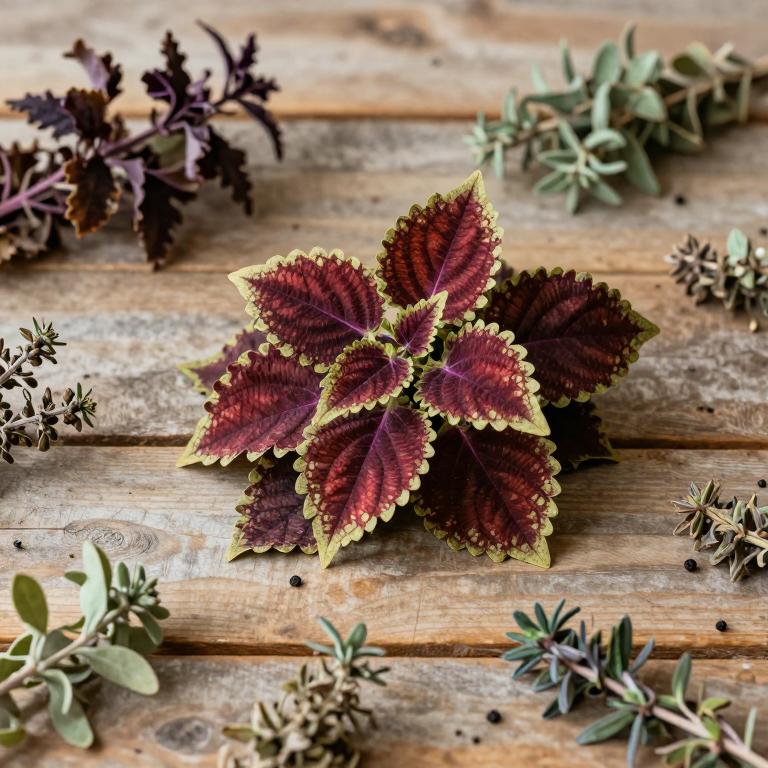
Names and Synonyms
Common Names
- Common Thicket Spurflower
- Thicket Spurflower
Scientific Names
Accepted name
Coleus madagascariensisSynonyms
- Ocimum madagascariense
- Plectranthus hirtus
- Ocimum auricula
- Plectranthus madagascariensis
Regional and Traditional Names
French:
- Baume du perou
Sources: Wikidata, Catalogue of Life
Taxonomical Classification
This plant belongs to the kingdom Plantae within the phylum Streptophyta and is classified under the class Equisetopsida and subclass Magnoliidae. It is further organized into the order Lamiales and the family Lamiaceae. Finally, it is categorized under the genus Coleus.
| Rank | Classification |
|---|---|
| Kingdom | Plantae |
| Phylum | Streptophyta |
| Class | Equisetopsida |
| Subclass | Magnoliidae |
| Order | Lamiales |
| Family | Lamiaceae |
| Genus | Coleus |
Sources: The World Checklist of Vascular Plants (WCVP)
Distribution
This plant exhibits a specific geographical distribution concentrated within the southern regions of the continent. In South Tropical Africa, it can be found growing in Mozambique. Its presence extends throughout Southern Africa, specifically within the Cape Provinces. Furthermore, the species is documented in the KwaZulu-Natal and Free State regions. Finally, its range includes the territory of Eswatini.
| Region | Area |
|---|---|
| South Tropical Africa | Mozambique |
| Southern Africa | Cape Provinces |
| Southern Africa | KwaZulu-Natal |
| Southern Africa | Free State |
| Southern Africa | Eswatini |
| Southern Africa | Northern Provinces |
| Western Indian Ocean | Mauritius |
| Western Indian Ocean | Réunion |
Sources: The World Checklist of Vascular Plants (WCVP)
Botanical Identification
Ecology
The ecology of Coleus madagascariensis is characterized by a broad altitudinal distribution, allowing it to inhabit diverse topographical landscapes. This species is capable of thriving across a significant vertical gradient, with its presence recorded from low-lying areas as shallow as 6 m AMSL to much higher montane environments reaching a maximum elevation of 1676 m AMSL. This extensive elevational range suggests a high degree of ecological plasticity, enabling the plant to adapt to varying atmospheric pressures, temperature fluctuations, and moisture regimes found between sea level and high-altitude ecosystems.
- Elevational range max:
- 1676 m AMSL
- Elevational range min:
- 6 m AMSL
Life history
The life history of Coleus madagascariensis is characterized by its classification as a perennial plant, allowing it to persist through multiple growing seasons. In terms of its structural development and survival strategy, the species is categorized as a chamaephyte, a life form where the majority of the vegetative buds are located close to the soil surface, often protected by a layer of leaf litter or minimal soil cover. This growth habit ensures its resilience within its ecological niche, maintaining a stable presence over time through its perennial lifecycle and its specific chamaephyte morphology.
- Life form :
- chamaephyte
- Lifecycle :
- perennial
Morphology
The morphology of Coleus madagascariensis is characterized by a non-woody, herbaceous growth form, functioning as both a herb and a forb. This plant is a self-supporting species that does not exhibit climbing behavior, nor does it act as a parasite or an epiphyte, maintaining a strictly terrestrial existence rather than being aquatic or semiaquatic. Structurally, it is an independent organism that reaches a maximum plant height of approximately 0.4 m.
- Aquatic :
- terrestrial
- Climber :
- self-supporting
- Epiphyte :
- terrestrial
- Growth form :
- herb
- Parasite :
- independent
- Plant height max:
- 0.4 m
- Woodiness :
- non-woody
Reproduction
Reproduction in Coleus madagascariensis is primarily facilitated through the production of minute seeds, which exhibit highly consistent physical characteristics. The reproductive output is characterized by a very low seed mass, with the mean mass recorded at 0.00027 g. This uniformity is reflected in the lack of variance within the population, as both the maximum and minimum recorded seed mass values are identical at 0.00027 g. Such precision in seed size suggests a stabilized reproductive strategy, where the plant produces small, lightweight seeds that likely aid in dispersal while maintaining a constant energetic investment per individual seed unit.
- Seed mass mean:
- 0.00027 g
Sources: Global Inventory of Floras and Traits (GIFT)
Chemicals
Coleus madagascariensis has 3 reported phytochemicals identified across 0 scientific publications and several other databases. The most consistently reported chemicals include Coleon-U-quinone, Horminone, rosmarinic acid.
| Chemical | Supporting sources | Consensus |
|---|---|---|
| Coleon-U-quinone | 2 supporting sources | ★☆☆☆☆ |
| Horminone | 1 supporting sources | ★☆☆☆☆ |
| rosmarinic acid | 1 supporting sources | ★☆☆☆☆ |
Coleon-U-quinone
- Plants (Basel, Switzerland)
- Journal of enzyme inhibition and medicinal chemistry
Horminone
- Plants (Basel, Switzerland)
rosmarinic acid
- Journal of enzyme inhibition and medicinal chemistry
Activities
Coleus madagascariensis has 3 reported activities identified across 0 scientific publications and several other databases. The most consistently reported activities include Antimicrobial, Antioxidant, Cytotoxic.
| Activity | Supporting sources | Consensus |
|---|---|---|
| Antimicrobial | 2 supporting sources | ★☆☆☆☆ |
| Antioxidant | 2 supporting sources | ★☆☆☆☆ |
| Cytotoxic | 2 supporting sources | ★☆☆☆☆ |
Antimicrobial
- Journal of enzyme inhibition and medicinal chemistry
- Biomolecules
Antioxidant
- Plants (Basel, Switzerland)
- Biomolecules
Cytotoxic
- Plants (Basel, Switzerland)
- Biomolecules