Ethiopian Hullwort
Coleus abyssinicus · Accepted scientific name
Scientific literature: Very Sparse (9 studies) · ★☆☆☆☆
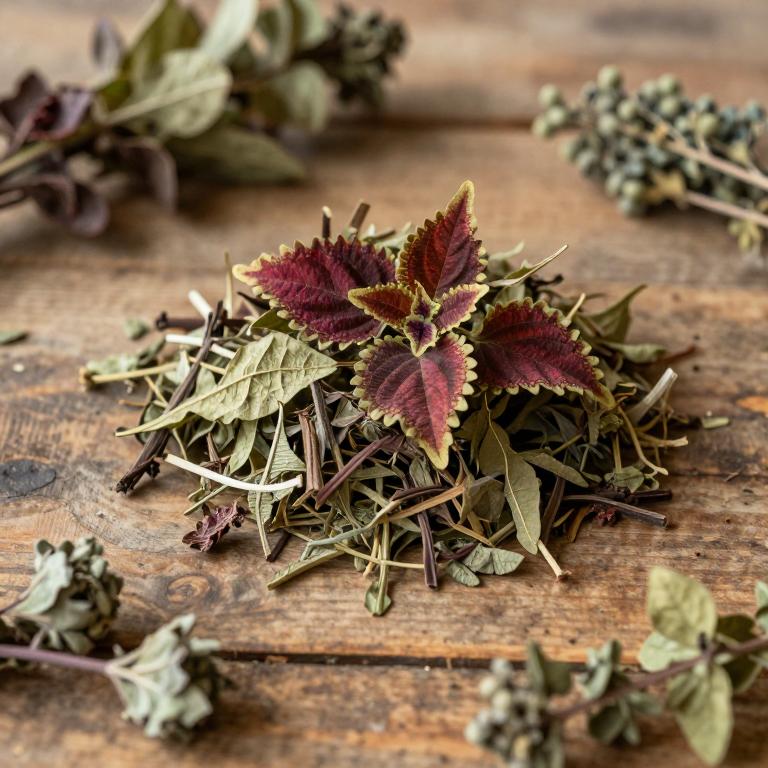
Ethiopian Hullwort, scientifically known as Coleus abyssinicus, is a vibrant medicinal herb native to East Africa. Renowned for its striking foliage and aromatic properties, this plant is traditionally used in various herbal remedies to treat respiratory ailments, digestive issues, and skin irritations, offering significant therapeutic potential in ethnobotany.
- Family
- Lamiaceae
- Native range
- Africa
- Parts used
- Leaf · Root
- Common names
- Ethiopian Hullwort
- Scientific synonyms
- Pycnostachys Abyssinica
Names and Synonyms
Common Names
- Ethiopian Hullwort
Scientific Names
Accepted name
Coleus abyssinicusSynonyms
- Pycnostachys abyssinica
Sources: Wikidata, Catalogue of Life
Taxonomical Classification
This plant belongs to the kingdom Plantae and the phylum Streptophyta, falling under the class Equisetopsida and subclass Magnoliidae. It is categorized within the order Lamiales and the family Lamiaceae, specifically belonging to the genus Coleus.
| Rank | Classification |
|---|---|
| Kingdom | Plantae |
| Phylum | Streptophyta |
| Class | Equisetopsida |
| Subclass | Magnoliidae |
| Order | Lamiales |
| Family | Lamiaceae |
| Genus | Coleus |
Sources: The World Checklist of Vascular Plants (WCVP)
Distribution
This plant, known scientifically as Coleus abyssinicus, possesses a very specific and limited range of occurrence. Its documented presence is centered primarily within the region of Northeast Tropical Africa. Specifically, the species is native to the diverse landscapes of Ethiopia. This concentrated distribution suggests that the plant is uniquely adapted to the particular environmental conditions found in this area. Consequently, understanding its habitat in Ethiopia is essential for its conservation and study.
| Region | Area |
|---|---|
| Northeast Tropical Africa | Ethiopia |
Sources: The World Checklist of Vascular Plants (WCVP)
Botanical Identification
Morphology
The morphology of Coleus abyssinicus is characterized by its specific growth form and structural composition, primarily presenting as a shrub. In terms of its physical constitution, the plant exhibits a woody nature, distinguishing its stems and structural framework from non-woody herbaceous species.
- Growth form :
- shrub
- Woodiness :
- woody
Sources: Global Inventory of Floras and Traits (GIFT)
Plant Parts
Coleus abyssinicus has 3 reported plant parts identified across 3 scientific publications and several other databases that are studied for medicinal purposes. The most consistently reported plant part include leaf, root, stem.
| Plant part | Supporting sources | Consensus |
|---|---|---|
| Leaf | 1 supporting sources | ★☆☆☆☆ |
| Root | 1 supporting sources | ★☆☆☆☆ |
| Stem | 1 supporting sources | ★☆☆☆☆ |
Leaf
- TheScientificWorldJournal
Root
- Pharmaceutical biology
Stem
- Pharmaceutical biology
Chemicals
Coleus abyssinicus has 4 reported phytochemicals identified across 3 scientific publications and several other databases. The most consistently reported chemicals include Estragole, Flavonoid, Tannins, exo-Fenchyl acetate.
| Chemical | Supporting sources | Consensus |
|---|---|---|
| Estragole | 1 supporting sources | ★☆☆☆☆ |
| Flavonoid | 1 supporting sources | ★☆☆☆☆ |
| Tannins | 1 supporting sources | ★☆☆☆☆ |
| exo-Fenchyl acetate | 1 supporting sources | ★☆☆☆☆ |
Estragole
- Pharmaceutical biology
Flavonoid
- TheScientificWorldJournal
Tannins
- TheScientificWorldJournal
exo-Fenchyl acetate
- Pharmaceutical biology
Activities
Coleus abyssinicus has 2 reported activities identified across 3 scientific publications and several other databases. The most consistently reported activities include Antimicrobial, Bacteriostatic.
| Activity | Supporting sources | Consensus |
|---|---|---|
| Antimicrobial | 1 supporting sources | ★☆☆☆☆ |
| Bacteriostatic | 1 supporting sources | ★☆☆☆☆ |
Antimicrobial
- Pharmaceutical biology
Bacteriostatic
- TheScientificWorldJournal
Preparations
Coleus abyssinicus has 5 reported preparations identified across 3 scientific publications and several other databases. The most consistently reported preparations include Leaf and root methanol extracts, essential oil (EO), fine powder, gradient solvent extracts, stem and root EO.
| Preparation | Supporting sources | Consensus |
|---|---|---|
| Leaf and root methanol extracts | 1 supporting sources | ★☆☆☆☆ |
| Essential oil (eo) | 1 supporting sources | ★☆☆☆☆ |
| Fine powder | 1 supporting sources | ★☆☆☆☆ |
| Gradient solvent extracts | 1 supporting sources | ★☆☆☆☆ |
| Stem and root eo | 1 supporting sources | ★☆☆☆☆ |
Leaf and root methanol extracts
- Pharmaceutical biology
Essential oil (eo)
- Pharmaceutical biology
Fine powder
- TheScientificWorldJournal
Gradient solvent extracts
- Pharmaceutical biology
Stem and root eo
- Pharmaceutical biology