traveler's-joy
Clematis brachiata · Accepted scientific name
Scientific literature: Very Sparse (31 studies) · ★☆☆☆☆
traveler's-joy, scientifically known as Clematis brachiata, is a charming climbing perennial native to the southeastern United States. Renowned for its delicate, star-shaped white flowers, this woody vine thrives in woodland settings. While primarily admired for its ornamental beauty, it holds a unique place in traditional botanical studies and landscapes.
- Family
- Ranunculaceae
- Native range
- Africa
- Parts used
- Leaf · Flower
- Common names
- Traveler'S-Joy
- Scientific synonyms
- Clematis Biloba · Clematis Brachiata Var. Burkei · 11 more
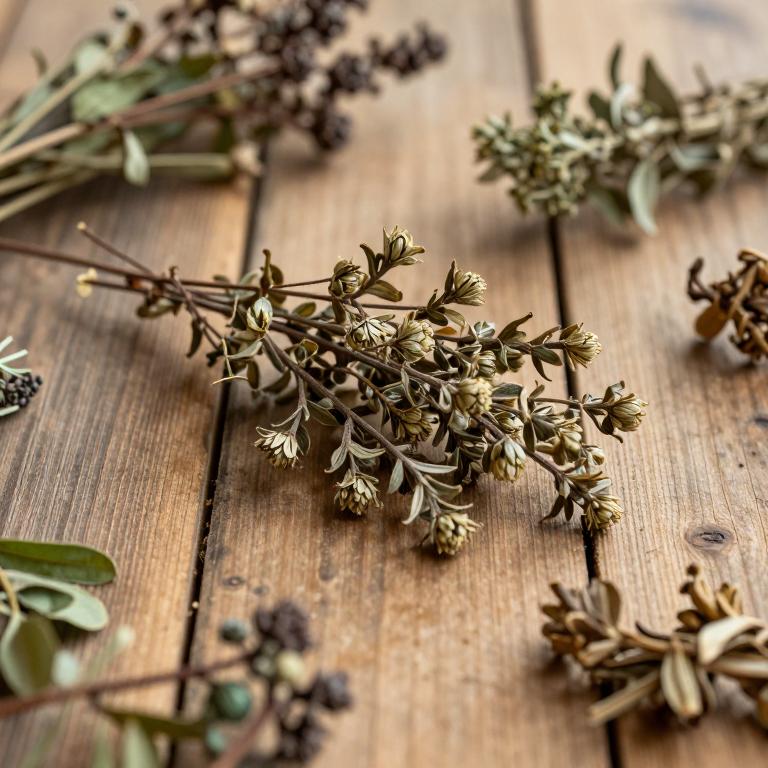
Names and Synonyms
Common Names
- traveler's-joy
Scientific Names
Accepted name
Clematis brachiataSynonyms
- Clematis biloba
- Clematis brachiata var. burkei
- Clematis comosa
- Clematis kerrii
- Clematis orientalis var. subglabra
- Clematis petersiana
- Clematis orientalis subsp. brachiata
- Clematis orientalis f. massoniana
- Clematis stewartiae
- Clematis stewartiae var. wilmsii
- Clematis triloba var. congensis
- Clematis thunbergii var. congensis
- Clematis tibestica
Regional and Traditional Names
Spanish:
- Clematis orientalis var. subglabra
- Clematis orientalis var. bolusiana
- Clematis massoniana
- Clematis biloba
- Clematis stewartiae var. wilmsii
- Clematis thunbergii var. congensis
- Clematis petersiana
- Clematis kerrii
- Clematis oweniae
- Clematis triloba var. congensis
- Clematis comosa
- Clematis orientalis subsp. oweniae
- Clematis thunbergii
- Clematis orientalis subsp. brachiata
- Clematis orientalis f. massoniana
- Clematis stewartiae
Sources: Wikidata, Catalogue of Life
Taxonomical Classification
This plant, Clematis brachiata, belongs to the kingdom Plantae and the phylum Streptophyta. Within the class Equisetopsida and subclass Magnoliidae, it is classified under the order Ranunculales. Finally, it is a member of the family Ranunculaceae and the genus Clematis.
| Rank | Classification |
|---|---|
| Kingdom | Plantae |
| Phylum | Streptophyta |
| Class | Equisetopsida |
| Subclass | Magnoliidae |
| Order | Ranunculales |
| Family | Ranunculaceae |
| Genus | Clematis |
Sources: The World Checklist of Vascular Plants (WCVP)
Distribution
This plant exhibits a diverse distribution across several key regions of the African continent. In West Tropical Africa, its presence is noted specifically in Senegal. Moving toward the center of the continent, it can be found within West-Central Tropical Africa in both Cameroon and Congo. The species also extends into Northeast Tropical Africa, where it inhabits the territory of Chad. Finally, its geographical range reaches as far as Ethiopia in the northeast.
| Region | Area |
|---|---|
| West Tropical Africa | Senegal |
| West-Central Tropical Africa | Cameroon |
| West-Central Tropical Africa | Congo |
| Northeast Tropical Africa | Chad |
| Northeast Tropical Africa | Ethiopia |
| East Tropical Africa | Kenya |
| South Tropical Africa | Angola |
| South Tropical Africa | Malawi |
| South Tropical Africa | Mozambique |
| South Tropical Africa | Zambia |
Sources: The World Checklist of Vascular Plants (WCVP)
Botanical Identification
Ecology
The ecology of Clematis brachiata is characterized by a broad altitudinal distribution, allowing it to inhabit diverse topographical landscapes. It can be found across a wide elevational range, starting from sea level at 0 m AMSL and extending up to a maximum altitude of 2125 m AMSL. This expansive vertical gradient suggests that the species possesses a high degree of adaptability to varying temperature regimes, atmospheric pressures, and moisture levels found throughout different montane and lowland ecosystems.
- Elevational range max:
- 2125 m AMSL
- Elevational range min:
- 0 m AMSL
Life history
The life history of Clematis brachiata is characterized by its existence as a perennial plant, allowing it to persist through multiple growing seasons. It exhibits a chamaephyte life form, typically maintaining its buds or woody structures at or near the soil surface to survive varying environmental conditions. Furthermore, the plant follows a deciduous growth pattern, shedding its foliage annually as part of its seasonal cycle.
- Deciduousness :
- deciduous
- Life form :
- chamaephyte
- Lifecycle :
- perennial
Morphology
The morphology of Clematis brachiata is characterized by its growth habit as a woody liana, functioning as an obligatory climber that relies on external structures for support. As an independent organism, it does not exhibit parasitic behavior and maintains a terrestrial existence rather than being aquatic or epiphytic. In terms of stature, the plant displays significant vertical variability, with heights ranging from a minimum of 0.5 m to a maximum of 6.09 m, maintaining an average plant height of approximately 3.5 m.
- Aquatic :
- terrestrial
- Climber :
- liana
- Climber :
- obligatory
- Epiphyte :
- terrestrial
- Parasite :
- independent
- Plant height max:
- 6.09 m
- Plant height mean:
- 3.5 m
- Plant height min:
- 0.5 m
- Woodiness :
- woody
Physiology
The physiology of Clematis brachiata is characterized by a C3 photosynthetic pathway, which dictates its carbon fixation process through the direct carboxylation of ribulose-1,5-bisphosphate by the enzyme RuBisCO. This metabolic strategy implies that the plant primarily fixes atmospheric carbon dioxide during the light-independent reactions without the specialized adaptations found in C4 or CAM species, making its efficiency highly dependent on ambient temperature and moisture levels. Furthermore, in terms of nutrient acquisition and symbiotic relationships, the plant does not function as a nitrogen fixer, meaning it lacks the specialized root nodules or biological mechanisms required to convert atmospheric nitrogen into usable forms and must instead rely on the uptake of nitrates or ammonium from the soil substrate.
- Nitrogen fixer :
- no
- Photosynthetic pathway :
- C3
Reproduction
The reproduction of Clematis brachiata is characterized by the production of seeds with specific morphological weight profiles. The seed mass within a population exhibits subtle variations, ranging from a minimum of 0.00146 g to a maximum of 0.00186 g. When considering the collective data, the average seed mass is calculated at a mean of 0.001686667 g. These precise measurements indicate a highly consistent seed size distribution, which is a critical factor in the plant's dispersal and subsequent germination success.
- Seed mass max:
- 0.00186 g
- Seed mass mean:
- 0.001686667 g
- Seed mass min:
- 0.00146 g
Sources: Global Inventory of Floras and Traits (GIFT)
Plant Parts
Clematis brachiata has 4 reported plant parts identified across 5 scientific publications and several other databases that are studied for medicinal purposes. The most consistently reported plant part include leaf, flower, root, stem.
| Plant part | Supporting sources | Consensus |
|---|---|---|
| Leaf | 2 supporting sources | ★☆☆☆☆ |
| Flower | 1 supporting sources | ★☆☆☆☆ |
| Root | 1 supporting sources | ★☆☆☆☆ |
| Stem | 1 supporting sources | ★☆☆☆☆ |
Leaf
- Journal of ethnopharmacology
- Pakistan journal of biological sciences : PJBS
Flower
- Pakistan journal of biological sciences : PJBS
Root
- Pakistan journal of biological sciences : PJBS
Stem
- Pakistan journal of biological sciences : PJBS
Chemicals
Clematis brachiata has 6 reported phytochemicals identified across 5 scientific publications and several other databases. The most consistently reported chemicals include Cardiac Glycosides, Flavonoids, Saponins, Steroids, Tannins.
| Chemical | Supporting sources | Consensus |
|---|---|---|
| Cardiac Glycosides | 1 supporting sources | ★☆☆☆☆ |
| Flavonoids | 1 supporting sources | ★☆☆☆☆ |
| Saponins | 1 supporting sources | ★☆☆☆☆ |
| Steroids | 1 supporting sources | ★☆☆☆☆ |
| Tannins | 1 supporting sources | ★☆☆☆☆ |
| Terpenoids | 1 supporting sources | ★☆☆☆☆ |
Cardiac Glycosides
- Pakistan journal of biological sciences : PJBS
Flavonoids
- Pakistan journal of biological sciences : PJBS
Saponins
- Pakistan journal of biological sciences : PJBS
Steroids
- Pakistan journal of biological sciences : PJBS
Tannins
- Pakistan journal of biological sciences : PJBS
Terpenoids
- Pakistan journal of biological sciences : PJBS
Activities
Clematis brachiata has 7 reported activities identified across 5 scientific publications and several other databases. The most consistently reported activities include Analgesic, Antibacterial, Antifungal, Antioxidant, Antiplasmodial.
| Activity | Supporting sources | Consensus |
|---|---|---|
| Analgesic | 1 supporting sources | ★☆☆☆☆ |
| Antibacterial | 1 supporting sources | ★☆☆☆☆ |
| Antifungal | 1 supporting sources | ★☆☆☆☆ |
| Antioxidant | 1 supporting sources | ★☆☆☆☆ |
| Antiplasmodial | 1 supporting sources | ★☆☆☆☆ |
| Antipyretic | 1 supporting sources | ★☆☆☆☆ |
| Vermifuge | 1 supporting sources | ★☆☆☆☆ |
Analgesic
- Pakistan journal of biological sciences : PJBS
Antibacterial
- Pakistan journal of biological sciences : PJBS
Antifungal
- Pakistan journal of biological sciences : PJBS
Antioxidant
- Pakistan journal of biological sciences : PJBS
Antiplasmodial
- Pakistan journal of biological sciences : PJBS
Antipyretic
- Pakistan journal of biological sciences : PJBS
Vermifuge
- Pakistan journal of biological sciences : PJBS
Conditions
Clematis brachiata has 7 reported investigations on conditions identified across 5 scientific publications and several other databases. The most consistently reported conditions include back pain, eye disorders, fever, headaches, malaria.
| Condition | Supporting sources | Consensus |
|---|---|---|
| Back pain | 1 supporting sources | ★☆☆☆☆ |
| Eye disorders | 1 supporting sources | ★☆☆☆☆ |
| Fever | 1 supporting sources | ★☆☆☆☆ |
| Headaches | 1 supporting sources | ★☆☆☆☆ |
| Malaria | 1 supporting sources | ★☆☆☆☆ |
| Sexually transmitted infections | 1 supporting sources | ★☆☆☆☆ |
| Snakebites | 1 supporting sources | ★☆☆☆☆ |
Back pain
- Pakistan journal of biological sciences : PJBS
Eye disorders
- Pakistan journal of biological sciences : PJBS
Fever
- Pakistan journal of biological sciences : PJBS
Headaches
- Pakistan journal of biological sciences : PJBS
Malaria
- Pakistan journal of biological sciences : PJBS
Sexually transmitted infections
- Pakistan journal of biological sciences : PJBS
Snakebites
- Pakistan journal of biological sciences : PJBS