Yellow broomrape
Cistanche phelypaea · Accepted scientific name
Scientific literature: Very Sparse (3 studies) · ★☆☆☆☆
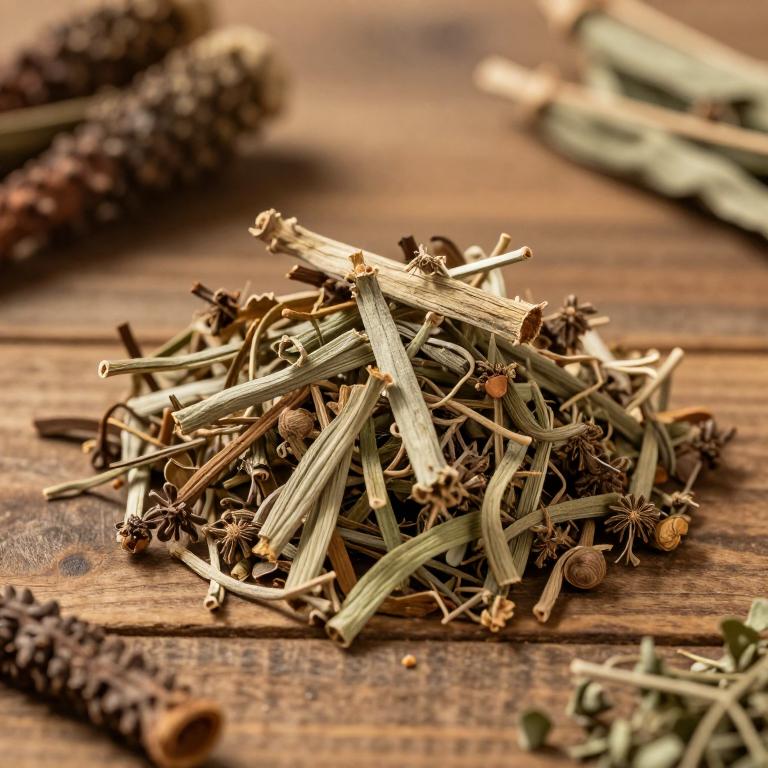
Yellow broomrape, scientifically known as Cisstanche phelypaea, is a parasitic herbaceous plant native to North America. Lacking chlorophyll, it derives nutrients from host plant roots. Historically utilized in traditional medicine, this unique species is valued for its distinct yellow blooms and its specific role within diverse prairie ecosystems.
- Family
- Orobanchaceae
- Native range
- Europe
- Parts used
- Not available
- Common names
- Yellow Broomrape
- Scientific synonyms
- Phelypaea Brunneri · Cistanche Tinctoria F. Lusitanica · 11 more
Names and Synonyms
Common Names
- Yellow Broomrape
Scientific Names
Accepted name
Cistanche phelypaeaSynonyms
- Phelypaea brunneri
- Cistanche tinctoria f. lusitanica
- Cistanche tinctoria f. major
- Cistanche phelypaea var. transiens
- Phelypaea lutea var. major
- Lathraea phelypaea
- Phelypaea lusitanica
- Cistanche lusitanica
- Phelypaea hesperugo
- Cistanche lutea f. minor
- Cistanche hesperugo
- Cistanche allochroa
- Cistanche brunneri
Regional and Traditional Names
German:
- Gelbe Cistanche
- Gelbe Cistanche
Sources: Wikidata, Catalogue of Life
Taxonomical Classification
This plant, known scientifically as Cistanche phelypaea, belongs to the kingdom Plantae and the phylum Streptophyta. Within the class Equisetopsida and subclass Magnoliidae, it is classified under the order Lamiales and the family Orobanchaceae. Its specific taxonomic placement concludes within the genus Cistanche.
| Rank | Classification |
|---|---|
| Kingdom | Plantae |
| Phylum | Streptophyta |
| Class | Equisetopsida |
| Subclass | Magnoliidae |
| Order | Lamiales |
| Family | Orobanchaceae |
| Genus | Cistanche |
Sources: The World Checklist of Vascular Plants (WCVP)
Distribution
This plant exhibits a specific geographical range primarily concentrated across the Mediterranean region. Within Southwestern Europe, its presence is documented in France, Portugal, and Spain. The distribution extends further into Southeastern Europe, where it can be found in Italy. Additionally, the species is located on the island of Kriti. Together, these locations highlight its preference for the varied landscapes of Southern Europe.
| Region | Area |
|---|---|
| Southwestern Europe | France |
| Southwestern Europe | Portugal |
| Southwestern Europe | Spain |
| Southeastern Europe | Italy |
| Southeastern Europe | Kriti |
| Northern Africa | Algeria |
| Northern Africa | Egypt |
| Northern Africa | Libya |
| Northern Africa | Morocco |
| Northern Africa | Tunisia |
Sources: The World Checklist of Vascular Plants (WCVP)
Botanical Identification
Life history
The life history of Cistanche phelypaea is characterized by a perennial lifecycle, allowing the plant to persist through multiple growing seasons. As a specialized parasitic organism, its developmental strategy is categorized under the life forms of both a geophyte and a cryptophyte, indicating that its vital organs and regenerative structures are protected beneath the soil surface. This survival mechanism enables the plant to endure unfavorable environmental conditions by remaining dormant until seasonal cues trigger its emergence.
- Life form :
- geophyte
- Life form :
- cryptophyte
- Lifecycle :
- perennial
Morphology
The morphology of Cistanche phelypaea is characterized by its growth form as a non-woody herb. As a self-supporting plant, it lacks climbing structures and is classified as an obligatory parasite, relying on host organisms for nutrients. It is a terrestrial species, not found in aquatic or epiphytic environments. In terms of stature, the plant exhibits a variable height, with individual specimens typically ranging from a minimum of approximately 0.15 meters to a maximum of 1 meter, maintaining a mean plant height of roughly 0.3 meters.
- Aquatic :
- terrestrial
- Climber :
- self-supporting
- Epiphyte :
- terrestrial
- Growth form :
- herb
- Parasite :
- obligatory
- Plant height max:
- 1 m
- Plant height mean:
- 0.3 m
- Plant height min:
- 0.152400305 m
- Woodiness :
- non-woody
Physiology
The physiology of Cistanche phelypaea is characterized by specific vegetative morphological dimensions and nutritional strategies. The plant produces elliptic-shaped leaves that typically range in length from a minimum of 2 cm to a maximum of 3 cm. These leaves exhibit a narrow width profile, with measurements fluctuating between a minimum of 0.5 cm and a maximum of 1.2 cm. Regarding its metabolic nitrogen acquisition, the plant does not function as a nitrogen fixer, relying instead on alternative nutritional pathways inherent to its biological classification.
- Leaf form :
- elliptic
- Leaf length max:
- 3 cm
- Leaf length min:
- 2 cm
- Leaf width max:
- 1.2 cm
- Leaf width min:
- 0.5 cm
- Nitrogen fixer :
- no
Reproduction
The reproduction of Cistanche phelypaea is characterized by a distinctive flowering period that begins in January and concludes in April, though the timing can be variable depending on environmental conditions. The plant produces inflorescences in the form of a spike, featuring flowers that exhibit a brown coloration. These flowers vary in size, with lengths ranging from a minimum of 3 cm to a maximum of 6 cm. Following pollination, the plant produces seeds that are notably minute; the seed mass typically averages 6e-05 g, with individual seeds weighing as little as 5e-05 g and reaching a maximum of 7e-05 g.
- Flower colour :
- brown
- Flower length max:
- 6 cm
- Flower length min:
- 3 cm
- Flowering time :
- Jan
- Flowering time :
- Apr
- Inflorescence :
- spike
- Seed mass max:
- 7e-05 g
- Seed mass mean:
- 6e-05 g
- Seed mass min:
- 5e-05 g
Sources: Global Inventory of Floras and Traits (GIFT)
Chemicals
Cistanche phelypaea has 2 reported phytochemicals identified across 0 scientific publications and several other databases. The most consistently reported chemicals include Fatty acids, oleic acid.
| Chemical | Supporting sources | Consensus |
|---|---|---|
| Fatty acids | 1 supporting sources | ★☆☆☆☆ |
| oleic acid | 1 supporting sources | ★☆☆☆☆ |
Fatty acids
- Scientific reports
oleic acid
- Scientific reports
Conditions
Cistanche phelypaea has 1 reported investigations on conditions identified across 0 scientific publications and several other databases. The most consistently reported conditions include Alzheimer's disease.
| Condition | Supporting sources | Consensus |
|---|---|---|
| Alzheimer's disease | 1 supporting sources | ★☆☆☆☆ |
Alzheimer's disease
- Scientific reports
Preparations
Cistanche phelypaea has 1 reported preparations identified across 0 scientific publications and several other databases. The most consistently reported preparations include fatty acids extracted from the wild C. phelypaea.
| Preparation | Supporting sources | Consensus |
|---|---|---|
| Fatty acids extracted from the wild c. phelypaea | 1 supporting sources | ★☆☆☆☆ |
Fatty acids extracted from the wild c. phelypaea
- Scientific reports