thistle
Cirsium · Accepted scientific name
Scientific literature: Very Sparse (13 studies) · ★☆☆☆☆
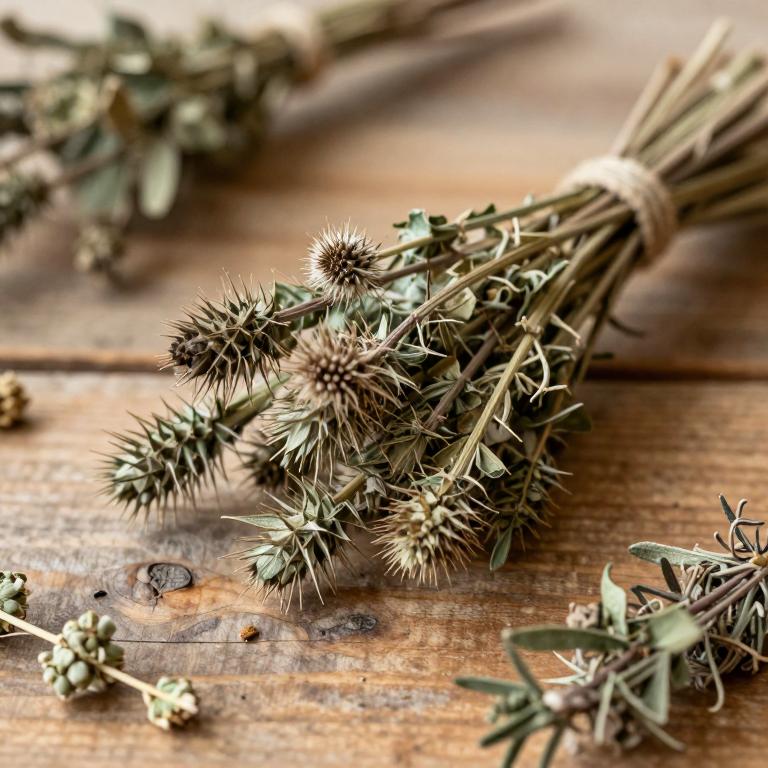
Thistle, scientifically known as Cirsium, is a diverse genus of flowering plants celebrated for its impressive, prickly foliage and vibrant blooms. Beyond their striking appearance, many species offer significant medicinal potential, traditionally used in herbal remedies to support digestive health, reduce inflammation, and promote overall systemic wellness.
Names and Synonyms
Common Names
- thistle
- Plume Thistles
- Thistles
Scientific Names
Accepted name
CirsiumSynonyms
- Cephalonoplos
- Breea
- Ascalea
- Epitrachys
- Echenais
- Erythrolaena
- Eriolepis
- Onotrophe
- Lophiolepis
- × Lophiocirsium
- Xylanthema
- Onopix
- Spanioptilon
- Ixine
Regional and Traditional Names
German:
- Kratzdisteln
- Kratzdistel
- Kratzdisteln
French:
- Cirse
- cirses
- Cirse
Sources: Wikidata, Catalogue of Life
Taxonomical Classification
This plant belongs to the kingdom Plantae within the phylum Streptophyta and the class Equisetopsida. It is further classified under the subclass Magnoliidae and the order Asterales, falling within the family Asteraceae. Ultimately, its taxonomic identity is defined by the genus Cirsium.
| Rank | Classification |
|---|---|
| Kingdom | Plantae |
| Phylum | Streptophyta |
| Class | Equisetopsida |
| Subclass | Magnoliidae |
| Order | Asterales |
| Family | Asteraceae |
| Genus | Cirsium |
Sources: The World Checklist of Vascular Plants (WCVP)
Distribution
This plant exhibits a specific geographical distribution across several regions in Northern Europe. It can be found growing within the territories of Denmark and Finland. Additionally, the species is present in the Faroe Islands, which are known as Føroyar. Its range also extends to the island of Iceland. Finally, the plant is documented to inhabit various parts of Great Britain.
| Region | Area |
|---|---|
| Northern Europe | Denmark |
| Northern Europe | Finland |
| Northern Europe | Føroyar |
| Northern Europe | Great Britain |
| Northern Europe | Iceland |
| Northern Europe | Ireland |
| Northern Europe | Norway |
| Northern Europe | Sweden |
| Middle Europe | Austria |
| Middle Europe | Belgium |
Sources: The World Checklist of Vascular Plants (WCVP)
Chemicals
Cirsium has 10 reported phytochemicals identified across 0 scientific publications and several other databases. The most consistently reported chemicals include (7R,8S)-dehydroconiferyl alcohol-8,5'-dehydroconiferyl aldehyde-9-O-beta-D-glucopyranoside, (7S,8R)-dihydro-dehydrodiconiferyl alcohol-9-O-beta-D-glucopyranoside, BETA-SITOSTEROL, Flavonoids, Pectolinarin.
| Chemical | Supporting sources | Consensus |
|---|---|---|
| (7R,8S)-dehydroconiferyl alcohol-8,5'-dehydroconiferyl aldehyde-9-O-beta-D-glucopyranoside | 1 supporting sources | ★☆☆☆☆ |
| (7S,8R)-dihydro-dehydrodiconiferyl alcohol-9-O-beta-D-glucopyranoside | 1 supporting sources | ★☆☆☆☆ |
| BETA-SITOSTEROL | 1 supporting sources | ★☆☆☆☆ |
| Flavonoids | 1 supporting sources | ★☆☆☆☆ |
| Pectolinarin | 1 supporting sources | ★☆☆☆☆ |
| RUTIN | 1 supporting sources | ★☆☆☆☆ |
| Sterols | 1 supporting sources | ★☆☆☆☆ |
| Triterpenes | 1 supporting sources | ★☆☆☆☆ |
| isokaempferide-7-O-beta-D-glucopyranoside | 1 supporting sources | ★☆☆☆☆ |
| sucrose | 1 supporting sources | ★☆☆☆☆ |
(7R,8S)-dehydroconiferyl alcohol-8,5'-dehydroconiferyl aldehyde-9-O-beta-D-glucopyranoside
- Zhong yao cai = Zhongyaocai = Journal of Chinese medicinal materials
(7S,8R)-dihydro-dehydrodiconiferyl alcohol-9-O-beta-D-glucopyranoside
- Zhong yao cai = Zhongyaocai = Journal of Chinese medicinal materials
BETA-SITOSTEROL
- Zhong yao cai = Zhongyaocai = Journal of Chinese medicinal materials
Flavonoids
- Journal of ethnopharmacology
Pectolinarin
- Zhong yao cai = Zhongyaocai = Journal of Chinese medicinal materials
RUTIN
- Zhong yao cai = Zhongyaocai = Journal of Chinese medicinal materials
Sterols
- Journal of ethnopharmacology
Triterpenes
- Journal of ethnopharmacology
isokaempferide-7-O-beta-D-glucopyranoside
- Zhong yao cai = Zhongyaocai = Journal of Chinese medicinal materials
sucrose
- Zhong yao cai = Zhongyaocai = Journal of Chinese medicinal materials
Activities
Cirsium has 3 reported activities identified across 0 scientific publications and several other databases. The most consistently reported activities include Antibacterial, Antioxidant, Hepatoprotective.
| Activity | Supporting sources | Consensus |
|---|---|---|
| Antibacterial | 1 supporting sources | ★☆☆☆☆ |
| Antioxidant | 1 supporting sources | ★☆☆☆☆ |
| Hepatoprotective | 1 supporting sources | ★☆☆☆☆ |
Antibacterial
- Journal of ethnopharmacology
Antioxidant
- Journal of ethnopharmacology
Hepatoprotective
- Journal of ethnopharmacology