red thistle
Cirsium ehrenbergii · Accepted scientific name
Scientific literature: Very Sparse (10 studies) · ★☆☆☆☆
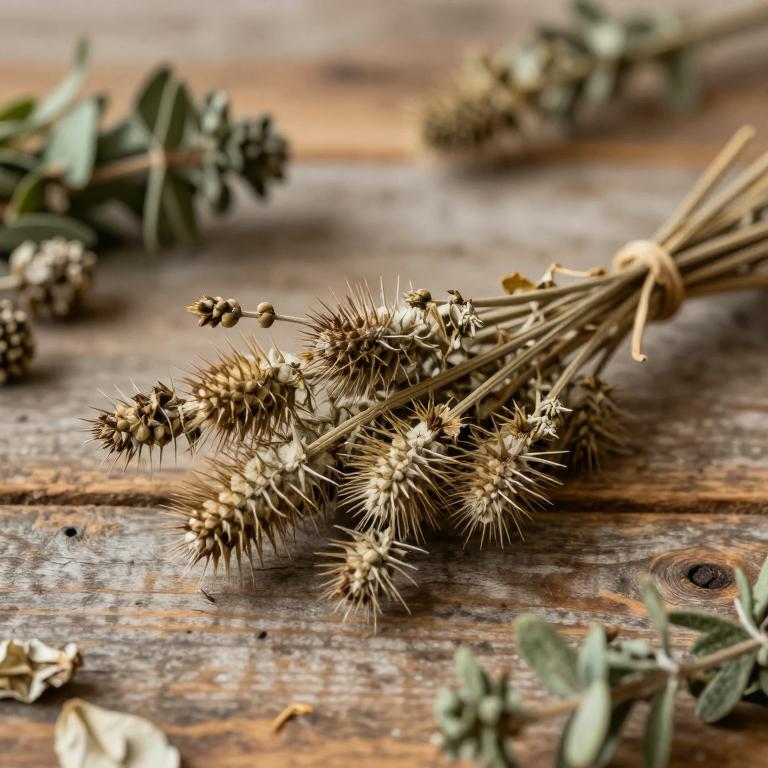
Red thistle, scientifically known as Cirsium ehrenbergii, is a resilient perennial native to arid regions. Renowned for its striking, vibrant blossoms, this plant holds significant ethnobotanical value. Traditionally used in various cultures, its components offer potential therapeutic properties, making it a subject of interest for medicinal plant research.
- Family
- Asteraceae
- Native range
- Northern America
- Parts used
- Root · Flower
- Common names
- Red Thistle
- Scientific synonyms
- Not available
Names and Synonyms
Common Names
- red thistle
Scientific Names
Accepted name
Cirsium ehrenbergiiRegional and Traditional Names
Spanish:
- Cardo santo
- Flor de cardo
Sources: Wikidata, Catalogue of Life
Taxonomical Classification
This plant belongs to the kingdom Plantae and is classified under the phylum Streptophyta and the class Equisetopsida. Within the subclass Magnoliidae and the order Asterales, it is a member of the Asteraceae family. Specifically, it is identified by its genus, Cirsium.
| Rank | Classification |
|---|---|
| Kingdom | Plantae |
| Phylum | Streptophyta |
| Class | Equisetopsida |
| Subclass | Magnoliidae |
| Order | Asterales |
| Family | Asteraceae |
| Genus | Cirsium |
Sources: The World Checklist of Vascular Plants (WCVP)
Distribution
This plant is widely distributed across various regions throughout the country of Mexico. It can be found growing in the central parts of Mexico, spanning the Mexico Central area. Its presence extends into the northeastern territories, specifically within Mexico Northeast. Additionally, the species inhabits the coastal and inland stretches of Mexico Gulf. Finally, its range reaches the western and southern reaches of the country through Mexico Northwest and Mexico Southwest.
| Region | Area |
|---|---|
| Mexico | Mexico Central |
| Mexico | Mexico Northeast |
| Mexico | Mexico Gulf |
| Mexico | Mexico Northwest |
| Mexico | Mexico Southwest |
Sources: The World Checklist of Vascular Plants (WCVP)
Plant Parts
Cirsium ehrenbergii has 2 reported plant parts identified across 3 scientific publications and several other databases that are studied for medicinal purposes. The most consistently reported plant part include root, flower.
| Plant part | Supporting sources | Consensus |
|---|---|---|
| Root | 2 supporting sources | ★☆☆☆☆ |
| Flower | 1 supporting sources | ★☆☆☆☆ |
Root
- Journal of ethnopharmacology
- Proceedings of the Western Pharmacology Society
Flower
- Proceedings of the Western Pharmacology Society
Chemicals
Cirsium ehrenbergii has 4 reported phytochemicals identified across 3 scientific publications and several other databases. The most consistently reported chemicals include Linarin, Pseudotaraxasterol, STIGMASTEROL, Taraxasterol.
| Chemical | Supporting sources | Consensus |
|---|---|---|
| Linarin | 1 supporting sources | ★☆☆☆☆ |
| Pseudotaraxasterol | 1 supporting sources | ★☆☆☆☆ |
| STIGMASTEROL | 1 supporting sources | ★☆☆☆☆ |
| Taraxasterol | 1 supporting sources | ★☆☆☆☆ |
Linarin
- Journal of ethnopharmacology
Pseudotaraxasterol
- Journal of ethnopharmacology
STIGMASTEROL
- Journal of ethnopharmacology
Taraxasterol
- Journal of ethnopharmacology
Activities
Cirsium ehrenbergii has 1 reported activities identified across 3 scientific publications and several other databases. The most consistently reported activities include Antidepressant.
| Activity | Supporting sources | Consensus |
|---|---|---|
| Antidepressant | 1 supporting sources | ★☆☆☆☆ |
Antidepressant
- Journal of ethnopharmacology
Conditions
Cirsium ehrenbergii has 1 reported investigations on conditions identified across 3 scientific publications and several other databases. The most consistently reported conditions include depression.
| Condition | Supporting sources | Consensus |
|---|---|---|
| Depression | 1 supporting sources | ★☆☆☆☆ |
Depression
- Journal of ethnopharmacology
Preparations
Cirsium ehrenbergii has 1 reported preparations identified across 3 scientific publications and several other databases. The most consistently reported preparations include infusion.
| Preparation | Supporting sources | Consensus |
|---|---|---|
| Infusion | 1 supporting sources | ★☆☆☆☆ |
Infusion
- Proceedings of the Western Pharmacology Society