Chrysanthemum × morifolium
Chrysanthemum × morifolium · Accepted scientific name
Scientific literature: Very Sparse (4 studies) · ★☆☆☆☆
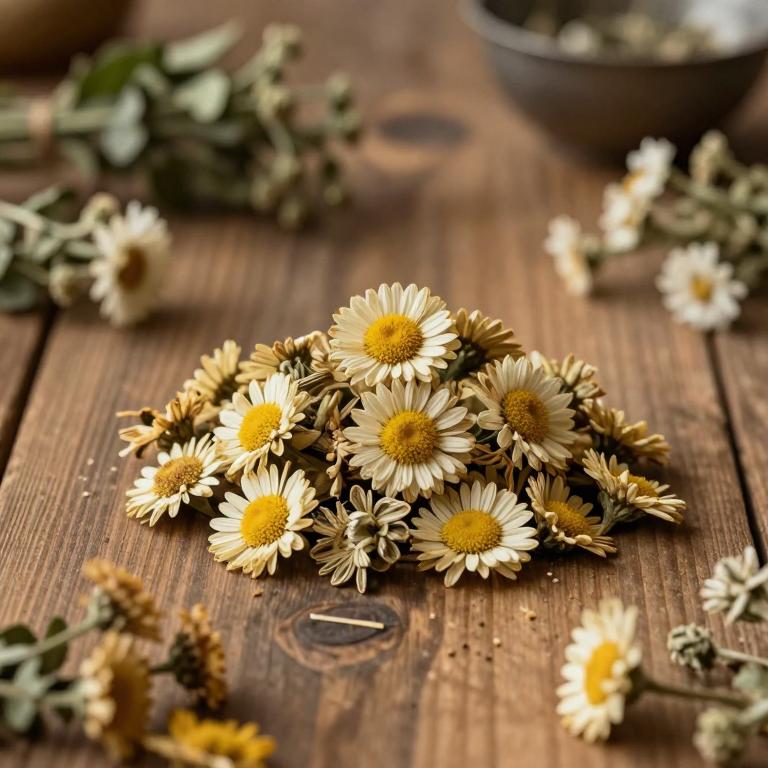
, scientifically known as Chrysanthemum × morifoliuim, is a versatile medicinal herb cherished in traditional wellness practices. Renowned for its cooling properties, this plant is frequently utilized to alleviate inflammation, reduce fever, and support ocular health. Its aromatic flowers offer potent antioxidant benefits, making it a staple in herbal remedies.
- Family
- Asteraceae
- Native range
- Europe
- Parts used
- Not available
- Common names
- Not available
- Scientific synonyms
- Dendranthema × Grandiflorum · Chrysanthemum × Morifolium Var. Sinense · 20 more
Names and Synonyms
Scientific Names
Accepted name
Chrysanthemum × morifoliumSynonyms
- Dendranthema × grandiflorum
- Chrysanthemum × morifolium var. sinense
- Tanacetum × sinense
- Chrysanthemum indicum var. maruyamanum
- Chrysanthemum indicum var. tsurugisanense
- Matricaria × morifolia
- Anthemis × artemisifolia
- Dendranthema × morifolium
- Dendranthema indicum var. tsurugisanense
- Chrysanthemum × sinense
- Pyrethrum × sinense
- Chrysanthemum × maximoviczianum
- Anthemis × stipulacea
- Dendranthema × sinense
- Anthemis × grandiflora
- Chrysanthemum × hortorum
- Chrysanthemum × stipulaceum
- Dendranthema indicum var. maruyamanum
- Chrysanthemum indicum var. purpureum
- Chrysanthemum × morifolium var. gracile
- Chrysanthemum × sinense var. spontaneum
- Pyrethrum × sinense var. plenum
Sources: Catalogue of Life
Taxonomical Classification
This plant belongs to the kingdom Plantae and the phylum Streptophyta, falling under the class Equisetopsida and subclass Magnoliidae. Within the order Asterales and the family Asteraceae, it is classified under the genus Chrysanthemum.
| Rank | Classification |
|---|---|
| Kingdom | Plantae |
| Phylum | Streptophyta |
| Class | Equisetopsida |
| Subclass | Magnoliidae |
| Order | Asterales |
| Family | Asteraceae |
| Genus | Chrysanthemum |
Sources: The World Checklist of Vascular Plants (WCVP)
Distribution
This plant exhibits a diverse geographical range that spans multiple continents and climatic zones. In Middle Europe, it can be found growing within the borders of Germany. Its distribution extends into Southeastern Europe, specifically throughout Italy. The species also reaches into Northern Africa, with documented presence in Tunisia. Finally, in Asia, it is located in South-Central China as well as on the island of Hainan.
| Region | Area |
|---|---|
| Middle Europe | Germany |
| Southeastern Europe | Italy |
| Northern Africa | Tunisia |
| China | China South-Central |
| China | Hainan |
| China | Inner Mongolia |
| China | Manchuria |
| China | China North-Central |
| China | Qinghai |
| China | China Southeast |
Sources: The World Checklist of Vascular Plants (WCVP)
Botanical Identification
Ecology
The ecology of Chrysanthemum × morifolium is characterized by its adaptability to diverse environments, frequently appearing in both indoor settings and along roadsides. It thrives across a significant altitudinal gradient, with a mean elevational range centered around 2200 m AMSL.
- Elevational range mean:
- 2200 m AMSL
- Habitat :
- indoor, roadsides
Life history
The life history of Chrysanthemum × morifolium is characterized by its classification as a perennial, though its growth patterns can be variable depending on environmental conditions and cultivation practices. As a perennial species, the plant is capable of surviving for multiple growing seasons, often regenerating through rhizomatous root systems that allow it to re-establish itself annually. While it maintains a perennial nature, it is frequently managed in horticultural settings as an annual or biennial to optimize flowering cycles and aesthetic appeal. The developmental stages involve a period of vegetative growth where the plant establishes a robust root system and foliage, followed by a distinct reproductive phase where it produces complex inflorescences. Depending on the specific cultivar and climate, the life cycle may exhibit fluctuations in dormancy and vigor, reflecting its inherent capacity for variable life history traits.
- Lifecycle :
- perennial
Morphology
The morphology of Chrysanthemum × morifolium is characterized by its growth form as a non-woody herb, specifically categorized as a forb or subshrub. It is a self-supporting plant that does not exhibit climbing tendencies such as a liana or vine, nor does it function as an epiphyte, maintaining a strictly terrestrial existence. As an independent organism, it does not exhibit parasitic behavior. In terms of physical dimensions, the plant is relatively low-growing, with a stature ranging from a minimum height of 0.25 m to a maximum height of 1 m. While it is primarily terrestrial, its ecological niche can span across aquatic, semiaquatic, and terrestrial environments.
- Aquatic :
- terrestrial
- Climber :
- self-supporting
- Epiphyte :
- terrestrial
- Growth form :
- herb
- Parasite :
- independent
- Plant height max:
- 1 m
- Plant height min:
- 0.25 m
- Woodiness :
- non-woody
Physiology
The physiology of Chrysanthemum × morifolium is characterized by its reliance on the C3 photosynthetic pathway, which involves the direct fixation of atmospheric carbon dioxide through the Calvin cycle using the enzyme RuBisCO. This metabolic process makes the plant particularly sensitive to photorespiration under high-temperature or high-light conditions, necessitating efficient stomatal regulation to balance gas exchange with water loss. Furthermore, the species lacks succulence, meaning it does not possess specialized thickened tissues for storing significant volumes of water within its leaves or stems. Consequently, its physiological water management relies on a standard vascular system and transpiration control rather than internal water reservoirs, making its hydration status highly dependent on consistent soil moisture and ambient humidity levels.
- Photosynthetic pathway :
- C3
- Succulence :
- no
Reproduction
Reproduction in Chrysanthemum × morifolium is primarily facilitated through its flowering processes and complex seed dispersal mechanisms. As a member of the Asteraceae family, the plant produces composite flower heads that contain numerous small florets, which are essential for sexual reproduction through pollination. Once fertilization occurs, the plant employs various methods to spread its progeny across different environments. The dispersal syndrome of this species is multifaceted, exhibiting characteristics of anemochory, where wind carries the lightweight seeds or pappus structures to new locations. Additionally, the plant displays tendencies toward autochory through self-dispersal mechanisms, and can be subject to anthropochory due to human intervention in cultivation and movement. It also exhibits unspecialized dispersal patterns, often involving zoochorous elements where seeds may be inadvertently moved by animals, ensuring a wide range of potential colonization sites.
- Dispersal syndrome :
- anemochorous
Sources: Global Inventory of Floras and Traits (GIFT)
Chemicals
Chrysanthemum × morifolium has 1 reported phytochemicals identified across 0 scientific publications and several other databases. The most consistently reported chemicals include Terpenes.
| Chemical | Supporting sources | Consensus |
|---|---|---|
| Terpenes | 1 supporting sources | ★☆☆☆☆ |
Terpenes
- BMC plant biology
Conditions
Chrysanthemum × morifolium has 2 reported investigations on conditions identified across 0 scientific publications and several other databases. The most consistently reported conditions include passive cutaneous anaphylaxis, type I hypersensitivity.
| Condition | Supporting sources | Consensus |
|---|---|---|
| Passive cutaneous anaphylaxis | 1 supporting sources | ★☆☆☆☆ |
| Type i hypersensitivity | 1 supporting sources | ★☆☆☆☆ |
Passive cutaneous anaphylaxis
- Journal of medicinal food
Type i hypersensitivity
- Journal of medicinal food