Cattleya-alliance
Cattleya · Accepted scientific name
Scientific literature: Very Sparse (4 studies) · ★☆☆☆☆
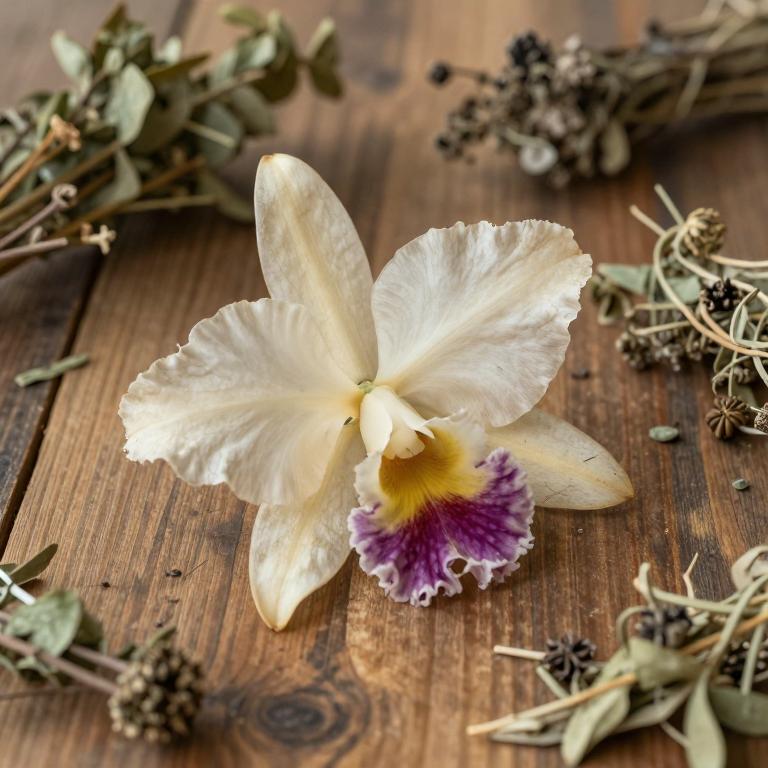
Cattleya-alliance, scientifically known as Cattleya, is a renowned genus of orchids celebrated for their breathtaking, large blooms. While primarily prized as ornamental wonders, various species possess traditional medicinal properties. Historically, different cultures have utilized their extracts for topical healing and restorative purposes, highlighting their dual importance in botany.
- Family
- Orchidaceae
- Native range
- Southern America
- Parts used
- Not available
- Common names
- Cattleya-Alliance
- Scientific synonyms
- Chironiella · Cattleyella · 14 more
Names and Synonyms
Common Names
- Cattleya-alliance
Scientific Names
Accepted name
CattleyaSynonyms
- Chironiella
- Cattleyella
- × Sophrocattleya
- × Hadrocattleya
- × Hadrodungsia
- Dungsia
- Hoffmannseggella
- Sophronitis
- Hadrolaelia
- Eunannos
- × Microcattleya
- Microlaelia
- Maelenia
- Lophoglotis
- × Brasicattleya
- Brasilaelia
Regional and Traditional Names
Spanish:
- Maelenia
- Catleya
Sources: Wikidata, Catalogue of Life
Taxonomical Classification
This plant belongs to the kingdom Plantae and the phylum Streptophyta, falling under the class Equisetopsida and subclass Magnoliidae. Within the order Asparagales, it is a member of the Orchidaceae family. Specifically, it is classified under the genus Cattleya.
| Rank | Classification |
|---|---|
| Kingdom | Plantae |
| Phylum | Streptophyta |
| Class | Equisetopsida |
| Subclass | Magnoliidae |
| Order | Asparagales |
| Family | Orchidaceae |
| Genus | Cattleya |
Sources: The World Checklist of Vascular Plants (WCVP)
Distribution
This plant exhibits a diverse range of habitats across several tropical regions. In Central America, its presence is documented in both Costa Rica and Panamá. Its distribution extends into the Caribbean, where it can be found in Trinidad-Tobago as well as the Windward Islands. Furthermore, the species reaches into Northern South America, specifically inhabiting French Guiana. Together, these locations highlight the widespread nature of Cattleya throughout these warm, humid environments.
| Region | Area |
|---|---|
| Central America | Costa Rica |
| Central America | Panamá |
| Caribbean | Trinidad-Tobago |
| Caribbean | Windward Is. |
| Northern South America | French Guiana |
| Northern South America | Guyana |
| Northern South America | Suriname |
| Northern South America | Venezuela |
| Western South America | Bolivia |
| Western South America | Colombia |
Sources: The World Checklist of Vascular Plants (WCVP)
Chemicals
Cattleya has 4 reported phytochemicals identified across 0 scientific publications and several other databases. The most consistently reported chemicals include Chromones, Flavonoids, Tannins, polyphenols.
| Chemical | Supporting sources | Consensus |
|---|---|---|
| Chromones | 1 supporting sources | ★☆☆☆☆ |
| Flavonoids | 1 supporting sources | ★☆☆☆☆ |
| Tannins | 1 supporting sources | ★☆☆☆☆ |
| polyphenols | 1 supporting sources | ★☆☆☆☆ |
Chromones
- Molecules (Basel, Switzerland)
Flavonoids
- Molecules (Basel, Switzerland)
Tannins
- Molecules (Basel, Switzerland)
polyphenols
- Molecules (Basel, Switzerland)
Preparations
Cattleya has 1 reported preparations identified across 0 scientific publications and several other databases. The most consistently reported preparations include ethanolic plant extracts.
| Preparation | Supporting sources | Consensus |
|---|---|---|
| Ethanolic plant extracts | 1 supporting sources | ★☆☆☆☆ |
Ethanolic plant extracts
- Molecules (Basel, Switzerland)