Japanese Chestnut
Castanea crenata · Accepted scientific name
Scientific literature: Very Sparse (31 studies) · ★☆☆☆☆
Japanese Chestnut, scientifically known as Castanea crenata, is a deciduous tree native to East Asia. Renowned for its edible nuts, it holds significant medicinal value in traditional practices. Its leaves and bark are often utilized for their antioxidant, anti-inflammatory, and antimicrobial properties, offering diverse therapeutic potential in natural medicine.
- Family
- Fagaceae
- Native range
- Europe
- Parts used
- Flower · Leaf
- Common names
- Japanese Chestnuts
- Scientific synonyms
- Castanea Japonica Var. Crenata · Castanea Vulgaris Var. Kusakuri · 49 more
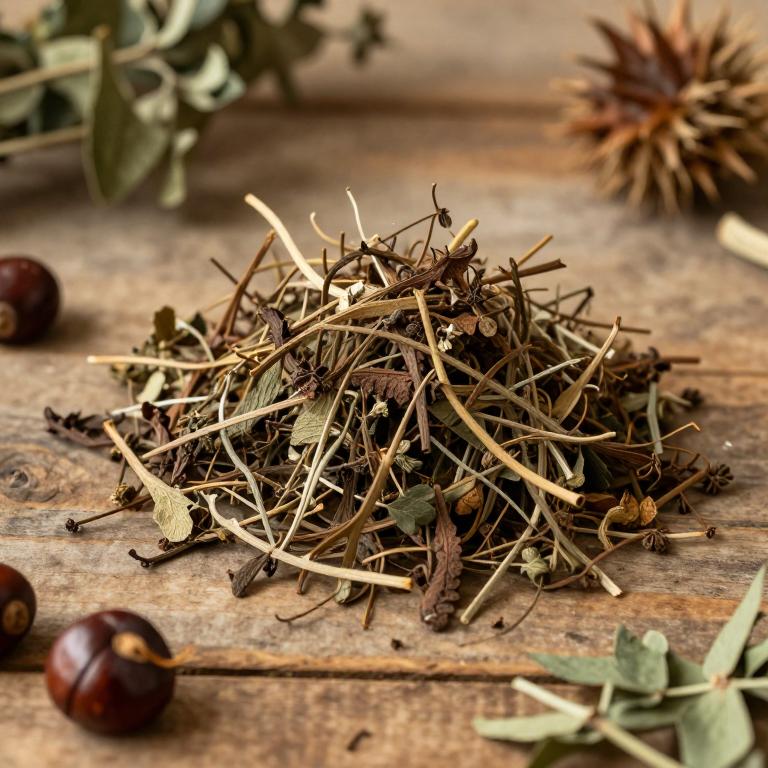
Names and Synonyms
Common Names
- Japanese Chestnuts
Scientific Names
Accepted name
Castanea crenataSynonyms
- Castanea japonica var. crenata
- Castanea vulgaris var. kusakuri
- Castanea pubinervis
- Castanea crenata var. caudata
- Castanea crenata var. dulcis
- Castanea crenata var. pulchella
- Castanea crenata var. kawasei
- Castanea japonica
- Castanea crenata f. gigantea
- Castanea crenata var. femina
- Castanea crenata subvar. bournetii
- Castanea crenata var. imperfecta
- Castanea crenata var. canescens
- Castanea crenata var. elongata
- Castanea crenata var. pleiocarpa
- Castanea crenata var. japonica
- Castanea crenata var. syakacephala
- Castanea crenata var. kusakuri
- Castanea crenata var. longispina
- Castanea crenata var. obtexta
- Castanea crenata var. ookasi
- Castanea crenata f. femina
- Castanea sativa var. pendula
- Castanea crenata f. imperfecta
- Castanea crenata var. quercina
- Castanea crenata f. pleiocarpa
- Castanea crenata var. siba-kuri
- Castanea crenata f. pulchella
- Castanea crenata var. stricta
- Castanea crenata f. syakacephala
- Castanea crenata var. tamba
- Castanea crenata f. pendula
- Castanea chinensis
- Castanea japonica var. canescens
- Castanea japonica var. elongata
- Castanea japonica var. kusakuri
- Castanea japonica var. longispina
- Castanea japonica var. obtexta
- Castanea japonica var. ookasi
- Castanea japonica var. quercina
- Castanea japonica var. siba-kuri
- Castanea japonica var. stricta
- Castanea vulgaris var. elongata
- Castanea vulgaris var. japonica
- Castanea vulgaris var. subdentata
- Castanea sativa var. pubinervis
- Castanea stricta
- Castanea kusakuri
- Castanea sativa var. japonica
- Castanea pubinervis var. pendula
- Castanea crenata var. pendula
Regional and Traditional Names
Spanish:
- Castanea stricta
- Castaño japonés
- Castanea japonica
- Castanea pubinervi
- Castaño japones
- Castano japonés
- Castano japones
- castaño del Japón
German:
- Japanische Kastanie
- japanische Kastanie
French:
- Chataignier crenele
- Castanea japonica
- Châtaignier Crénelé
- Châtaignier du Japon
- Châtaignier Japonais
- châtaignier du Japon
- Châtaignier crénelé
Sources: Wikidata, Catalogue of Life
Taxonomical Classification
This plant belongs to the kingdom Plantae and the phylum Streptophyta, falling under the class Equisetopsida and subclass Magnoliidae. Within the order Fagales and the family Fagaceae, it is classified under the genus Castaenea. Specifically, Castaenea crenata represents a unique species within this botanical hierarchy.
| Rank | Classification |
|---|---|
| Kingdom | Plantae |
| Phylum | Streptophyta |
| Class | Equisetopsida |
| Subclass | Magnoliidae |
| Order | Fagales |
| Family | Fagaceae |
| Genus | Castanea |
Sources: The World Checklist of Vascular Plants (WCVP)
Distribution
This plant exhibits a wide geographical distribution that spans across both Europe and Asia. In Southwestern Europe, it can be found growing in the regions of Portugal and Spain. Its presence extends into Southeastern Europe, specifically within the borders of Italy. Moving toward Eastern Asia, the species is naturally established in Japan. Finally, the distribution reaches Korea, completing its range across these diverse continental territories.
| Region | Area |
|---|---|
| Southwestern Europe | Portugal |
| Southwestern Europe | Spain |
| Southeastern Europe | Italy |
| Eastern Asia | Japan |
| Eastern Asia | Korea |
| Northeastern U.S.A. | New York |
Sources: The World Checklist of Vascular Plants (WCVP)
Botanical Identification
Life history
The life history of Castanea crenata is characterized by its existence as a perennial species, ensuring its presence in the ecosystem over many successive years. As a phanerophyte, the plant maintains its photosynthetic organs at a significant height above the ground, a structural adaptation that defines its growth habit. Its seasonal cycle is marked by being deciduous, meaning it sheds its foliage annually, typically in response to changing environmental conditions or temperature shifts. This combination of a long-lived perennial lifecycle, a phanerophyte life form, and a deciduous nature dictates its rhythmic patterns of growth, dormancy, and seasonal transformation within its natural habitat.
- Deciduousness :
- deciduous
- Life form :
- phanerophyte
- Lifecycle :
- perennial
Morphology
The morphology of Castanea crenata is characterized by its stature as a large, woody tree that typically reaches a mean height of approximately 15 meters. As a terrestrial species, it grows independently in its environment without being aquatic or an epiphyte, and it functions as a self-supporting organism rather than a climber, liana, or vine. It does not exhibit parasitic behavior, maintaining an independent growth habit. The plant's structural integrity is defined by its woody nature, establishing a robust growth form consistent with its classification as a tree.
- Aquatic :
- terrestrial
- Climber :
- self-supporting
- Epiphyte :
- terrestrial
- Growth form :
- tree
- Parasite :
- independent
- Plant height mean:
- 15 m
- Woodiness :
- woody
Physiology
The physiology of Castanea crenata is characterized by a C3 photosynthetic pathway, a common metabolic strategy that allows the plant to fix carbon dioxide through the Calvin cycle. Its vegetative structure is defined by specific foliar dimensions, where the leaves exhibit a variable morphology with a mean length of 12 cm, ranging from a minimum of 8 cm to a maximum of 16 cm. The width of the leaves is similarly variable, maintaining a mean width of 3.75 cm, with measurements spanning from a minimum of 3 cm to a maximum of 4.5 cm.
- Leaf length max:
- 16 cm
- Leaf length mean:
- 12 cm
- Leaf length min:
- 8 cm
- Leaf width max:
- 4.5 cm
- Leaf width mean:
- 3.75 cm
- Leaf width min:
- 3 cm
- Photosynthetic pathway :
- C3
Reproduction
The reproduction of Castanea crenata is characterized by its specific inflorescence and fruit development patterns. The plant produces inflorescences that range in length from a minimum of 0.07 m to a maximum of 0.2 m. Following pollination, the development of the fruit shows notable variation in dimensions, with fruit lengths ranging from a minimum of 4 cm to a maximum of 5.5 cm (averaging 4.75 cm) and fruit widths spanning from 5 cm to a maximum of 6 cm (averaging 5.5 cm), ultimately resulting in a dry fruit texture. The resulting seeds are substantial in size and weight; seed mass varies from a minimum of 10.9 g to a maximum of 30.303 g, with a mean mass of approximately 20.5856225 g. Furthermore, the seed volume is highly consistent, recorded at a mean and range of 27,000 mm³, where the minimum and maximum values both reach this 27,000 mm³ threshold.
- Fruit dryness :
- dry
- Fruit length max:
- 5.5 cm
- Fruit length mean:
- 4.75 cm
- Fruit length min:
- 4 cm
- Fruit width max:
- 6 cm
- Fruit width mean:
- 5.5 cm
- Fruit width min:
- 5 cm
- Inflorescence length max:
- 0.2 m
- Inflorescence length min:
- 0.07 m
- Seed mass max:
- 30.303 g
- Seed mass mean:
- 20.5856225 g
- Seed mass min:
- 10.9 g
- Seed volume max:
- 27000 mm³
Sources: Global Inventory of Floras and Traits (GIFT)
Plant Parts
Castanea crenata has 2 reported plant parts identified across 2 scientific publications and several other databases that are studied for medicinal purposes. The most consistently reported plant part include flower, leaf.
| Plant part | Supporting sources | Consensus |
|---|---|---|
| Flower | 1 supporting sources | ★☆☆☆☆ |
| Leaf | 1 supporting sources | ★☆☆☆☆ |
Flower
- Antioxidants (Basel, Switzerland)
Leaf
- Antioxidants (Basel, Switzerland)
Chemicals
Castanea crenata has 10 reported phytochemicals identified across 2 scientific publications and several other databases. The most consistently reported chemicals include CATECHIN, Ellagic, Ellagitannins, Flavonoid, Flavonoids.
| Chemical | Supporting sources | Consensus |
|---|---|---|
| CATECHIN | 1 supporting sources | ★☆☆☆☆ |
| Ellagic | 1 supporting sources | ★☆☆☆☆ |
| Ellagitannins | 1 supporting sources | ★☆☆☆☆ |
| Flavonoid | 1 supporting sources | ★☆☆☆☆ |
| Flavonoids | 1 supporting sources | ★☆☆☆☆ |
| Gallic acid | 1 supporting sources | ★☆☆☆☆ |
| Isoquercitrin | 1 supporting sources | ★☆☆☆☆ |
| RUTIN | 1 supporting sources | ★☆☆☆☆ |
| Tannin | 1 supporting sources | ★☆☆☆☆ |
| myricetin | 1 supporting sources | ★☆☆☆☆ |
CATECHIN
- Antioxidants (Basel, Switzerland)
Ellagic
- Antioxidants (Basel, Switzerland)
Ellagitannins
- Biomolecules
Flavonoid
- Antioxidants (Basel, Switzerland)
Flavonoids
- Biomolecules
Gallic acid
- Antioxidants (Basel, Switzerland)
Isoquercitrin
- Antioxidants (Basel, Switzerland)
RUTIN
- Antioxidants (Basel, Switzerland)
Tannin
- Antioxidants (Basel, Switzerland)
myricetin
- Antioxidants (Basel, Switzerland)
Conditions
Castanea crenata has 3 reported investigations on conditions identified across 2 scientific publications and several other databases. The most consistently reported conditions include blood circulation, diarrhea, digestion.
| Condition | Supporting sources | Consensus |
|---|---|---|
| Blood circulation | 1 supporting sources | ★☆☆☆☆ |
| Diarrhea | 1 supporting sources | ★☆☆☆☆ |
| Digestion | 1 supporting sources | ★☆☆☆☆ |
Blood circulation
- Biomolecules
Diarrhea
- Biomolecules
Digestion
- Biomolecules
Preparations
Castanea crenata has 6 reported preparations identified across 2 scientific publications and several other databases. The most consistently reported preparations include barks, flowers, inner skin extract, inner skins, kernels.
| Preparation | Supporting sources | Consensus |
|---|---|---|
| Barks | 1 supporting sources | ★☆☆☆☆ |
| Flowers | 1 supporting sources | ★☆☆☆☆ |
| Inner skin extract | 1 supporting sources | ★☆☆☆☆ |
| Inner skins | 1 supporting sources | ★☆☆☆☆ |
| Kernels | 1 supporting sources | ★☆☆☆☆ |
| Leaves | 1 supporting sources | ★☆☆☆☆ |
Barks
- Antioxidants (Basel, Switzerland)
Flowers
- Antioxidants (Basel, Switzerland)
Inner skin extract
- Antioxidants (Basel, Switzerland)
Inner skins
- Antioxidants (Basel, Switzerland)
Kernels
- Antioxidants (Basel, Switzerland)
Leaves
- Antioxidants (Basel, Switzerland)