fire bush
Calligonum comosum · Accepted scientific name
Scientific literature: Very Sparse (18 studies) · ★☆☆☆☆
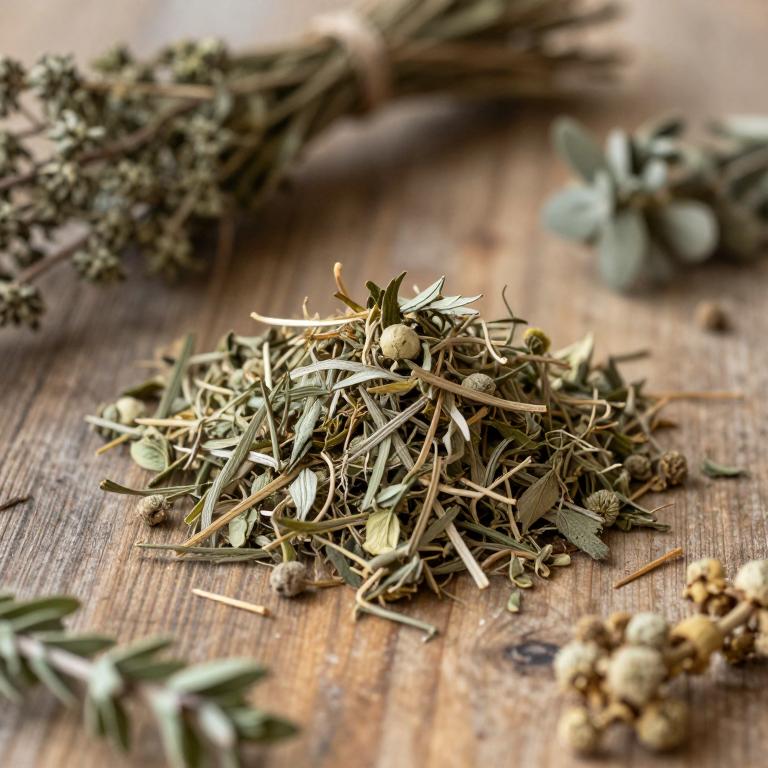
Fire bush, scientifically known as Calligonum comosum, is a resilient, sand-binding shrub native to the arid regions of the Middle East and Central Asia. Renowned for its medicinal properties, it is traditionally used to treat respiratory ailments, skin conditions, and inflammatory issues, offering significant therapeutic potential in herbal medicine.
- Family
- Polygonaceae
- Native range
- Africa
- Parts used
- Leaf · Seed
- Common names
- Arta
- Scientific synonyms
- Calligonum Polygonoides Subsp. Comosus · Pallasia Comosa · 2 more
Names and Synonyms
Common Names
- arta
Scientific Names
Accepted name
Calligonum comosumSynonyms
- Calligonum polygonoides subsp. comosus
- Pallasia comosa
- Calligonum mejidum
- Calligonum mejidum var. thirtharicum
Sources: Wikidata, Catalogue of Life
Taxonomical Classification
This plant belongs to the kingdom Plantae and is classified under the phylum Streptophyta and the class Equisetopsida. Within the subclass Magnoliidae, it is further organized into the order Caryophyllales and the family Polygonaceae. Finally, it is identified by the genus Calligonum, specifically as the species Calligonum comosum.
| Rank | Classification |
|---|---|
| Kingdom | Plantae |
| Phylum | Streptophyta |
| Class | Equisetopsida |
| Subclass | Magnoliidae |
| Order | Caryophyllales |
| Family | Polygonaceae |
| Genus | Calligonum |
Sources: The World Checklist of Vascular Plants (WCVP)
Distribution
This plant, known as Calligonum comosum, is primarily distributed across the arid landscapes of Northern Africa. Within this region, it can be found growing in the sandy environments of Algeria. Its presence also extends through the desert territories of Egypt and Libya. Furthermore, the species is widely documented throughout the nation of Morocco. Finally, the geographical range of this medicinal plant includes the diverse terrains of Tunisia.
| Region | Area |
|---|---|
| Northern Africa | Algeria |
| Northern Africa | Egypt |
| Northern Africa | Libya |
| Northern Africa | Morocco |
| Northern Africa | Tunisia |
| Northern Africa | Western Sahara |
| West Tropical Africa | Mali |
| West Tropical Africa | Mauritania |
| West Tropical Africa | Niger |
| Northeast Tropical Africa | Chad |
Sources: The World Checklist of Vascular Plants (WCVP)
Botanical Identification
Ecology
The ecology of Calligonum comosum is defined by its specialized adaptation to arid and semi-arid desert environments, where it thrives in sandy substrates and shifting dunes. This species is specifically distributed within a defined altitudinal corridor, occupying an elevational range that begins at a minimum of 500 m AMSL and extends to a maximum of 1000 m AMSL. Within these parameters, the plant plays a crucial role in stabilizing desert soils and providing microhabitats for various desert fauna. Its physiological resilience allows it to withstand extreme temperature fluctuations and low moisture availability, characteristic of the sandy terrains found within its specific elevational niche.
- Elevational range max:
- 1000 m AMSL
- Elevational range min:
- 500 m AMSL
Life history
The life history of Calligonum comosum is characterized by a perennial lifecycle, allowing the plant to persist across multiple growing seasons in its arid habitats. Structurally, it is classified as a phanerophyte, specifically exhibiting the traits of a nanophanerophyte, which indicates that its perennially renewing buds are located on aerial shoots above the soil surface. This phanerophyte life form enables the species to maintain a stable presence in desert ecosystems, utilizing its perennial nature to survive environmental fluctuations.
- Life form :
- phanerophyte
- Lifecycle :
- perennial
Morphology
The morphology of Calligonum comosum is characterized by a woody growth form, specifically classified as a shrub. As a terrestrial species, it does not exhibit aquatic or semiaquatic tendencies, nor does it function as an epiphyte. The plant is a self-supporting organism, lacking any climbing or liana-like habits, and it grows as an independent entity rather than acting as a parasite.
- Aquatic :
- terrestrial
- Climber :
- self-supporting
- Epiphyte :
- terrestrial
- Growth form :
- shrub
- Parasite :
- independent
- Woodiness :
- woody
Reproduction
The reproduction of Calligonum comosum is characterized by a specific phenological window and specialized dispersal mechanisms. The flowering period for this species typically begins in March and concludes in April, though the timing can be variable. Following pollination, the plant produces seeds with a relatively light profile, featuring a mean seed mass of approximately 0.0222416665 g. The individual seed weight fluctuates within a specific range, with a minimum recorded mass of 0.01755 g and a maximum mass of 0.03929 g. To facilitate the spread of its offspring, the species utilizes an anemochorous dispersal syndrome, relying on wind currents to transport its seeds across the landscape.
- Dispersal syndrome :
- anemochorous
- Flowering time :
- Mar
- Flowering time :
- Apr
- Seed mass max:
- 0.03929 g
- Seed mass mean:
- 0.0222416665 g
- Seed mass min:
- 0.01755 g
Sources: Global Inventory of Floras and Traits (GIFT)
Plant Parts
Calligonum comosum has 2 reported plant parts identified across 3 scientific publications and several other databases that are studied for medicinal purposes. The most consistently reported plant part include leaf, seed.
| Plant part | Supporting sources | Consensus |
|---|---|---|
| Leaf | 2 supporting sources | ★☆☆☆☆ |
| Seed | 1 supporting sources | ★☆☆☆☆ |
Leaf
- Saudi pharmaceutical journal : SPJ : the official publication of the Saudi Pharmaceutical Society
- Frontiers in cell and developmental biology
Seed
- African journal of traditional, complementary, and alternative medicines : AJTCAM
Chemicals
Calligonum comosum has 6 reported phytochemicals identified across 3 scientific publications and several other databases. The most consistently reported chemicals include CAMPESTEROL, DL-ALPHA-TOCOPHEROL, Kaempferol-3-O-glucoside-7-O-rhamnoside, Sterols, Terpenoids.
| Chemical | Supporting sources | Consensus |
|---|---|---|
| CAMPESTEROL | 1 supporting sources | ★☆☆☆☆ |
| DL-ALPHA-TOCOPHEROL | 1 supporting sources | ★☆☆☆☆ |
| Kaempferol-3-O-glucoside-7-O-rhamnoside | 1 supporting sources | ★☆☆☆☆ |
| Sterols | 1 supporting sources | ★☆☆☆☆ |
| Terpenoids | 1 supporting sources | ★☆☆☆☆ |
| quercetin 3-O-glucuronide | 1 supporting sources | ★☆☆☆☆ |
CAMPESTEROL
- Frontiers in cell and developmental biology
DL-ALPHA-TOCOPHEROL
- Frontiers in cell and developmental biology
Kaempferol-3-O-glucoside-7-O-rhamnoside
- Saudi pharmaceutical journal : SPJ : the official publication of the Saudi Pharmaceutical Society
Sterols
- African journal of traditional, complementary, and alternative medicines : AJTCAM
Terpenoids
- African journal of traditional, complementary, and alternative medicines : AJTCAM
quercetin 3-O-glucuronide
- Saudi pharmaceutical journal : SPJ : the official publication of the Saudi Pharmaceutical Society
Activities
Calligonum comosum has 2 reported activities identified across 3 scientific publications and several other databases. The most consistently reported activities include Antioxidant, Cytotoxic.
| Activity | Supporting sources | Consensus |
|---|---|---|
| Antioxidant | 1 supporting sources | ★☆☆☆☆ |
| Cytotoxic | 1 supporting sources | ★☆☆☆☆ |
Antioxidant
- Immunological investigations
Cytotoxic
- Saudi pharmaceutical journal : SPJ : the official publication of the Saudi Pharmaceutical Society
Conditions
Calligonum comosum has 4 reported investigations on conditions identified across 3 scientific publications and several other databases. The most consistently reported conditions include breast cancer, bacterial infections, cancer, colon cancer.
| Condition | Supporting sources | Consensus |
|---|---|---|
| Breast cancer | 2 supporting sources | ★☆☆☆☆ |
| Bacterial infections | 1 supporting sources | ★☆☆☆☆ |
| Cancer | 1 supporting sources | ★☆☆☆☆ |
| Colon cancer | 1 supporting sources | ★☆☆☆☆ |
Breast cancer
- Saudi pharmaceutical journal : SPJ : the official publication of the Saudi Pharmaceutical Society
- Frontiers in cell and developmental biology
Bacterial infections
- Saudi pharmaceutical journal : SPJ : the official publication of the Saudi Pharmaceutical Society
Cancer
- Saudi pharmaceutical journal : SPJ : the official publication of the Saudi Pharmaceutical Society
Colon cancer
- Saudi pharmaceutical journal : SPJ : the official publication of the Saudi Pharmaceutical Society
Preparations
Calligonum comosum has 10 reported preparations identified across 3 scientific publications and several other databases. The most consistently reported preparations include 10% ethanol extract of the aerial parts, Ethanol extracts of leaves, aqueous extracts, chloroform, ethanol.
| Preparation | Supporting sources | Consensus |
|---|---|---|
| 10% ethanol extract of the aerial parts | 1 supporting sources | ★☆☆☆☆ |
| Ethanol extracts of leaves | 1 supporting sources | ★☆☆☆☆ |
| Aqueous extracts | 1 supporting sources | ★☆☆☆☆ |
| Chloroform | 1 supporting sources | ★☆☆☆☆ |
| Ethanol | 1 supporting sources | ★☆☆☆☆ |
| Ethanolic extract | 1 supporting sources | ★☆☆☆☆ |
| Ethyl acetate | 1 supporting sources | ★☆☆☆☆ |
| Organic extracts | 1 supporting sources | ★☆☆☆☆ |
| Plant extracts | 1 supporting sources | ★☆☆☆☆ |
| Water | 1 supporting sources | ★☆☆☆☆ |
10% ethanol extract of the aerial parts
- Fitoterapia
Ethanol extracts of leaves
- Frontiers in cell and developmental biology
Aqueous extracts
- African journal of traditional, complementary, and alternative medicines : AJTCAM
Chloroform
- Saudi pharmaceutical journal : SPJ : the official publication of the Saudi Pharmaceutical Society
Ethanol
- Saudi pharmaceutical journal : SPJ : the official publication of the Saudi Pharmaceutical Society
Ethanolic extract
- Saudi pharmaceutical journal : SPJ : the official publication of the Saudi Pharmaceutical Society
Ethyl acetate
- Saudi pharmaceutical journal : SPJ : the official publication of the Saudi Pharmaceutical Society
Organic extracts
- African journal of traditional, complementary, and alternative medicines : AJTCAM
Plant extracts
- Immunological investigations
Water
- Saudi pharmaceutical journal : SPJ : the official publication of the Saudi Pharmaceutical Society