hare's ear
Bupleurum rotundifolium · Accepted scientific name
Scientific literature: Very Sparse (4 studies) · ★☆☆☆☆
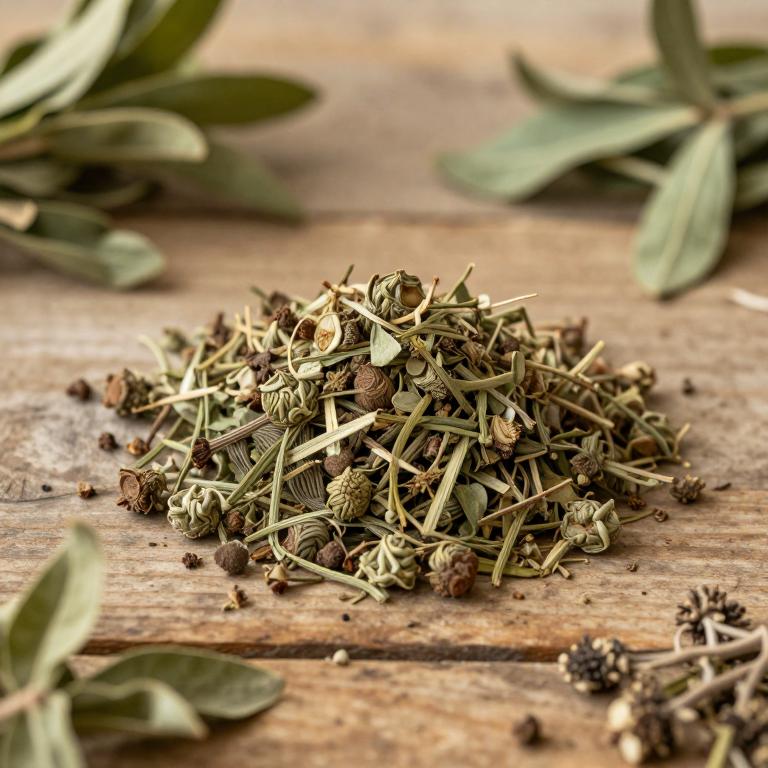
Hare's ear, scientifically known as Bupleurum rotundifolium, is a charming perennial herb native to Europe. Distinguished by its delicate, umbellifer flowers and distinctive rounded leaves, this plant is valued in traditional medicine. Its bioactive compounds offer potential therapeutic benefits, particularly in supporting liver health and reducing systemic inflammation.
Names and Synonyms
Common Names
- hare's ear
- round-leaved thoroughwax
- Thorow-Wax
- hare's-ear
- thoroughwax
- throw-wax
Scientific Names
Accepted name
Bupleurum rotundifoliumSynonyms
- Perfoliata rotundifolia
- Diatropa rotundifolia
- Selinum perfoliatum
- Perfolisa obtusifolia
- Bupleurum rotundifolium var. alpinum
- Bupleurum rotundifolium f. oblongum
- Bupleurum perfoliatum var. rotundifolium
- Tenoria rotundifolia
- Bupleurum rotundifolium var. petiolatum
Regional and Traditional Names
Spanish:
- Bupleurum perfoliatum
- Diatropa rotundifolia
- Bupleurum agrestinum
- Tenoria rotundifolia
- Perfoliata
- Haloche
German:
- Rundblättriges Hasenohr
- Durchwachsenes Hasenohr
- Acker-Hasenohr
- durchwachsenes Hasenohr
- Rundblaettriges Hasenohr
French:
- Buplèvre à feuilles rondes
- Buplevre a feuilles rondes
- buplèvre à feuilles rondes
- Buplevre a feuilles rondes
Sources: Wikidata, Catalogue of Life
Taxonomical Classification
This plant belongs to the kingdom Plantae and the phylum Streptophyta, falling under the class Equisetopsida and subclass Magnoliidae. Within the order Apiales, it is classified under the family Apiaceae. Specifically, its taxonomic identity is defined by the genus Bupleurum, of which Bupleurum rotundifolium is a member.
| Rank | Classification |
|---|---|
| Kingdom | Plantae |
| Phylum | Streptophyta |
| Class | Equisetopsida |
| Subclass | Magnoliidae |
| Order | Apiales |
| Family | Apiaceae |
| Genus | Bupleurum |
Sources: The World Checklist of Vascular Plants (WCVP)
Distribution
This plant exhibits a broad distribution across several regions of the European continent. In Northern Europe, it can be found inhabiting the landscapes of Denmark and Great Britain. Its presence extends further north into the territories of Norway and Sweden. Additionally, the species is documented within the central reaches of the continent. Specifically, its geographical range includes the country of Austria in Middle Europe.
| Region | Area |
|---|---|
| Northern Europe | Denmark |
| Northern Europe | Great Britain |
| Northern Europe | Norway |
| Northern Europe | Sweden |
| Middle Europe | Austria |
| Middle Europe | Belgium |
| Middle Europe | Czechia-Slovakia |
| Middle Europe | Germany |
| Middle Europe | Hungary |
| Middle Europe | Netherlands |
Sources: The World Checklist of Vascular Plants (WCVP)
Botanical Identification
Ecology
The ecology of Bupleurum rotundifolium is characterized by its preference for disturbed or open environments, frequently colonizing anthropogenic landscapes such as crop fields and old fields. These habitats provide the necessary light and soil conditions for its growth patterns. Furthermore, the species exhibits a significant altitudinal distribution, with a mean elevational range of approximately 2200 m AMSL, indicating its ability to adapt to varying mountainous or highland ecological zones.
- Elevational range mean:
- 2200 m AMSL
- Habitat :
- crop fields, old fields
Life history
The life history of Bupleurum rotundifolium is characterized by its status as an annual plant, completing its entire developmental cycle within a single growing season. As a therophyte, it maintains its survival strategy by producing seeds that remain dormant until the following season, avoiding the stresses of unfavorable environmental conditions through this ephemeral life cycle. The plant exhibits a deciduous nature, shedding its foliage as it transitions through its life stages. This specific life form ensures that the organism focuses its energy on rapid growth, flowering, and seed production, rather than maintaining permanent above-ground vegetative structures.
- Deciduousness :
- deciduous
- Life form :
- therophyte
- Lifecycle :
- annual
Morphology
The morphology of Bupleurum rotundifolium is characterized by its growth form as a non-woody herb, specifically classified as a forb. This self-supporting plant grows in a terrestrial habitat and functions as an independent organism, lacking any parasitic or epiphytic tendencies. In terms of stature, it is a relatively low-growing species with a plant height that typically ranges from a minimum of 0.15 m to a maximum of 0.8 m, with an average height of approximately 0.3 m.
- Aquatic :
- terrestrial
- Climber :
- self-supporting
- Epiphyte :
- terrestrial
- Growth form :
- herb
- Growth form :
- forb
- Parasite :
- independent
- Plant height max:
- 0.8 m
- Plant height mean:
- 0.3 m
- Plant height min:
- 0.15 m
- Woodiness :
- non-woody
Physiology
The physiology of Bupleurum rotundifolium is characterized by a C3 photosynthetic pathway, which facilitates carbon fixation through the Calvin cycle under standard environmental conditions. The plant is non-carnivorous, relying entirely on its root system and soil nutrients rather than capturing prey for sustenance. Morphologically, its leaves exhibit a mean size of approximately 28.35833 cm², contributing to its overall canopy structure. Furthermore, the plant maintains a mean Specific Leaf Area (SLA) of 290 cm²/g, a metric that reflects its leaf thickness and resource allocation strategy regarding light interception and photosynthetic efficiency.
- Carnivory :
- non-carnivorous
- Leaf size mean:
- 28.35833 cm²
- Photosynthetic pathway :
- C3
- Specific Leaf Area (SLA) mean:
- 290 cm²/g
Reproduction
The reproduction of Bupleurum rotundifolium is primarily a sexual process, as asexual reproduction is absent in this species. The flowering period typically begins in June and extends through July. During this stage, the plant utilizes a biotic pollination syndrome, specifically relying on insects to facilitate the transfer of pollen. While the plant is capable of self-fertilization, its reproductive success is tied to these insect interactions. Once fertilization occurs, the plant produces seeds with a highly specific mass profile; the average seed mass is approximately 0.0030338335 g, with individual seeds ranging from a minimum of 0.00157 g to a maximum of 0.00328 g. Following seed maturation, the dispersal syndrome is classified as anthropochorous, indicating that the seeds are spread via human activity.
- Dispersal syndrome :
- anthropochorous
- Flowering time :
- Jun
- Flowering time :
- Jul
- Pollination syndrome :
- insect
- Pollination syndrome :
- biotic
- Reproduction asexual :
- absent
- Seed mass max:
- 0.00328 g
- Seed mass mean:
- 0.0030338335 g
- Seed mass min:
- 0.00157 g
- Self fertilization :
- present
Sources: Global Inventory of Floras and Traits (GIFT)
Chemicals
Bupleurum rotundifolium has 3 reported phytochemicals identified across 0 scientific publications and several other databases. The most consistently reported chemicals include Rotundioside C, Rotundioside E, Rotundioside F.
| Chemical | Supporting sources | Consensus |
|---|---|---|
| Rotundioside C | 1 supporting sources | ★☆☆☆☆ |
| Rotundioside E | 1 supporting sources | ★☆☆☆☆ |
| Rotundioside F | 1 supporting sources | ★☆☆☆☆ |
Rotundioside C
- Life sciences
Rotundioside E
- Life sciences
Rotundioside F
- Life sciences
Preparations
Bupleurum rotundifolium has 1 reported preparations identified across 0 scientific publications and several other databases. The most consistently reported preparations include methanolic extract.
| Preparation | Supporting sources | Consensus |
|---|---|---|
| Methanolic extract | 1 supporting sources | ★☆☆☆☆ |
Methanolic extract
- Life sciences