ananas
Bromelia pinguin · Accepted scientific name
Scientific literature: Very Extensive (225 studies) · ★★★★★
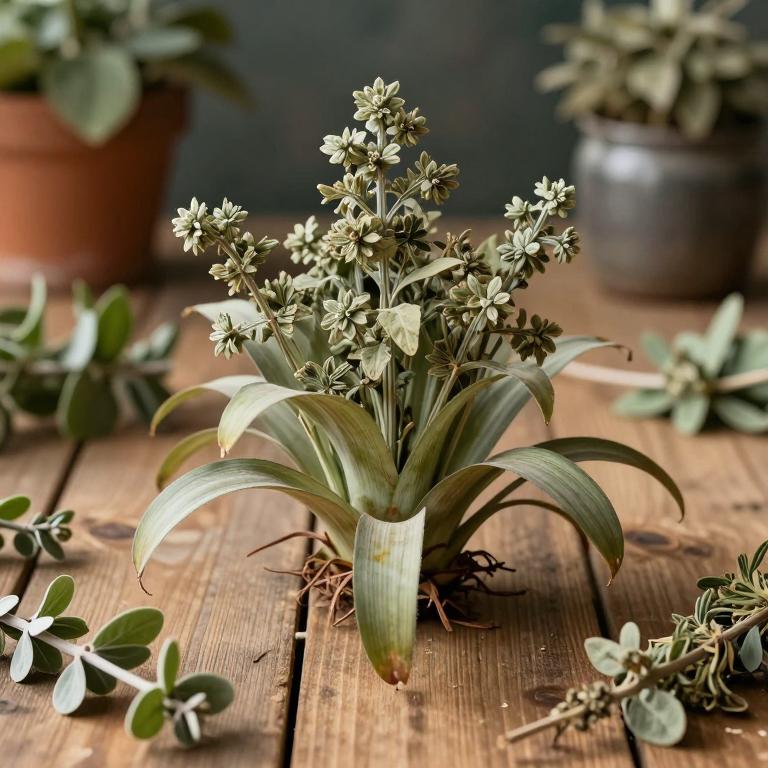
Ananas, scientifically known as Bromelia pinguin, is a resilient, bromeliad species native to the Caribbean and coastal regions. Characterized by its spiny, succulent leaves, this plant serves as a vital medicinal resource. It is traditionally utilized for its diverse therapeutic properties, ranging from treating skin ailments to digestive issues.
Names and Synonyms
Common Names
- Pingwing
- pinguin
- wild pine
Scientific Names
Accepted name
Bromelia pinguinSynonyms
- Agallostachys pinguin
- Karatas pinguin
- Agallostachys fastuosa
- Bromelia ignea
- Bromelia fastuosa
- Ananas pinguin
Regional and Traditional Names
Spanish:
- Ananas pinguin
- Agallostachys fastuosa
- Tumbiriche
- Bromelia ignea
- Bromelia acarna
- Agallostachys pinguin
- Karatas pinguin
- Bromelia fastuosa
- Timbiriche
- Bromelia peguin
- Chicuipo
- Bromelia sepiaria
- Bromelia paraguayensis
- maya
- piñuela
- piña corredora
- timbiriche
German:
- Pinguinananas
French:
- ananas marron
- Ananas pinguin
Sources: Wikidata, Catalogue of Life
Taxonomical Classification
This plant belongs to the kingdom Plantae and the phylum Streptophyta, falling under the class Equisetopsida and subclass Magnoliidae. Within the order Poales, it is classified under the family Bromeliacaceae. Finally, it is identified by the genus Bromelia, specifically as the species Bromelia pinguin.
| Rank | Classification |
|---|---|
| Kingdom | Plantae |
| Phylum | Streptophyta |
| Class | Equisetopsida |
| Subclass | Magnoliidae |
| Order | Poales |
| Family | Bromeliaceae |
| Genus | Bromelia |
Sources: The World Checklist of Vascular Plants (WCVP)
Distribution
This plant is primarily distributed across several key regions within the Southeastern United States, specifically found in Florida. Its range extends significantly into Mexico, where it inhabits the Northeast portion of the country. Furthermore, the species can be located throughout the Mexican Gulf coastal areas. It also makes a presence in the Northwest regions of Mexico. Finally, the plant's geographical reach includes the Southwest territory of Mexico.
| Region | Area |
|---|---|
| Southeastern U.S.A. | Florida |
| Mexico | Mexico Northeast |
| Mexico | Mexico Gulf |
| Mexico | Mexico Northwest |
| Mexico | Mexico Southwest |
| Mexico | Mexico Southeast |
| Central America | Belize |
| Central America | Costa Rica |
| Central America | El Salvador |
| Central America | Guatemala |
Sources: The World Checklist of Vascular Plants (WCVP)
Botanical Identification
Ecology
The ecology of Bromelia pinguin is characterized by its broad adaptability across diverse topographical gradients, spanning an elevational range from 0 m to a maximum of 1900 m AMSL. This species is primarily found inhabiting forest environments, where it integrates into the local ecosystem by utilizing available space and resources within these wooded landscapes. Its ability to thrive from sea level up to high-altitude montane zones reflects a significant tolerance for varying environmental conditions and altitudinal shifts.
- Elevational range max:
- 1900 m AMSL
- Elevational range min:
- 0 m AMSL
- Habitat :
- forest
Life history
The life history of Bromelia pinguin is characterized by its nature as a perennial plant, allowing it to persist in its environment through multiple growing seasons. In terms of its structural development and survival strategy, the species is classified as a hemicryptophyte, a life form where the perennating buds are located at or just below the soil surface, protected by organic matter or leaf bases. This specific growth habit enables the plant to endure environmental fluctuations and maintain its presence within its ecological niche over an extended period.
- Life form :
- hemicryptophyte
- Lifecycle :
- perennial
Morphology
The morphology of Bromelia pinguin is characterized by a growth form classified as a non-woody herb and a forb. This terrestrial plant reaches an average height of approximately 1.1 m and is entirely independent, functioning as a non-parasitic organism. It is a self-supporting species that does not exhibit climbing behaviors such as liana or vine tendencies, nor does it function as an epiphyte, maintaining a strictly terrestrial existence.
- Aquatic :
- terrestrial
- Climber :
- self-supporting
- Epiphyte :
- terrestrial
- Growth form :
- herb
- Growth form :
- forb
- Parasite :
- independent
- Plant height mean:
- 1.1 m
- Woodiness :
- non-woody
Physiology
The physiology of Bromelia pinguin is characterized by specialized adaptations for survival in nutrient-poor, seasonally dry environments, primarily through its efficient water management and metabolic processes. As a member of the Bromeliaceae family, it typically employs Crassulacean Acid Metabolism (CAM) or a modified C3 pathway to optimize carbon fixation while minimizing transpirational water loss, allowing it to maintain cellular turgor during periods of drought. Its root system is adapted for both anchorage and the absorption of moisture from the substrate, though it often relies on the collection of nutrients through its leaf rosette structure. Regarding its nutrient acquisition capabilities, Bromelia pinguin is not a nitrogen fixer; it lacks the symbiotic relationship with nitrogen-fixing bacteria required to convert atmospheric nitrogen into usable forms, meaning it must rely on the decomposition of organic matter and mineral availability within the soil for its nitrogen requirements. This reliance on external nitrogen sources, coupled with its ability to sequester nutrients from leaf litter trapped in its central tank, dictates its growth patterns and ecological niche within its native habitat.
- Nitrogen fixer :
- no
Reproduction
The reproduction of Bromelia pinguin is characterized by a specialized dispersal strategy and specific seed morphology. The plant produces fleshy fruits, which indicates a dispersal syndrome categorized as zoochorous, relying on animals to aid in the movement of its seeds. The seeds themselves exhibit highly uniform physical properties, with a constant seed volume of 22 mm³ (ranging from a minimum to a maximum of 22 mm³) and a consistent seed mass of 0.03135 g (with the mean, minimum, and maximum all recorded at 0.03135 g). This combination of fleshy fruit production and consistent seed metrics facilitates its biological spread through animal interaction.
- Dispersal syndrome :
- zoochorous
- Fruit dryness :
- fleshy
- Seed mass mean:
- 0.03135 g
- Seed volume max:
- 22 mm³
Sources: Global Inventory of Floras and Traits (GIFT)
Plant Parts
Bromelia pinguin has 1 reported plant parts identified across 1 scientific publications and several other databases that are studied for medicinal purposes. The most consistently reported plant part include fruit.
| Plant part | Supporting sources | Consensus |
|---|---|---|
| Fruit | 1 supporting sources | ★☆☆☆☆ |
Fruit
- The West Indian medical journal
Chemicals
Bromelia pinguin has 13 reported phytochemicals identified across 1 scientific publications and several other databases. The most consistently reported chemicals include Ash, CALCIUM, FAT, IRON, Nitrogen.
| Chemical | Supporting sources | Consensus |
|---|---|---|
| Ash | 1 supporting sources | ★☆☆☆☆ |
| CALCIUM | 1 supporting sources | ★☆☆☆☆ |
| FAT | 1 supporting sources | ★☆☆☆☆ |
| IRON | 1 supporting sources | ★☆☆☆☆ |
| Nitrogen | 1 supporting sources | ★☆☆☆☆ |
| PHOSPHORUS | 1 supporting sources | ★☆☆☆☆ |
| ascorbic acid | 1 supporting sources | ★☆☆☆☆ |
| beta-carotene | 1 supporting sources | ★☆☆☆☆ |
| glyphosate | 1 supporting sources | ★☆☆☆☆ |
| niacin | 1 supporting sources | ★☆☆☆☆ |
Ash
- Dr. Duke
CALCIUM
- Dr. Duke
FAT
- Dr. Duke
IRON
- Dr. Duke
Nitrogen
- Dr. Duke
PHOSPHORUS
- Dr. Duke
ascorbic acid
- Dr. Duke
beta-carotene
- Dr. Duke
glyphosate
- Cureus
niacin
- Dr. Duke
Activities
Bromelia pinguin has 209 reported activities identified across 1 scientific publications and several other databases. The most consistently reported activities include Acidulant, Aldose-Reductase-Inhibitor, Allergenic, Analgesic, Androgenic?.
| Activity | Supporting sources | Consensus |
|---|---|---|
| Acidulant | 1 supporting sources | ★☆☆☆☆ |
| Aldose-Reductase-Inhibitor | 1 supporting sources | ★☆☆☆☆ |
| Allergenic | 1 supporting sources | ★☆☆☆☆ |
| Analgesic | 1 supporting sources | ★☆☆☆☆ |
| Androgenic? | 1 supporting sources | ★☆☆☆☆ |
| Angiotensin-Receptor-Blocker | 1 supporting sources | ★☆☆☆☆ |
| AntiAGE | 1 supporting sources | ★☆☆☆☆ |
| AntiCFS | 1 supporting sources | ★☆☆☆☆ |
| AntiCTS | 1 supporting sources | ★☆☆☆☆ |
| AntiCrohn's | 1 supporting sources | ★☆☆☆☆ |
Acidulant
- Dr. Duke
Aldose-Reductase-Inhibitor
- Dr. Duke
Allergenic
- Dr. Duke
Analgesic
- Dr. Duke
Androgenic?
- Dr. Duke
Angiotensin-Receptor-Blocker
- Dr. Duke
AntiAGE
- Dr. Duke
AntiCFS
- Dr. Duke
AntiCTS
- Dr. Duke
AntiCrohn's
- Dr. Duke
Conditions
Bromelia pinguin has 2 reported investigations on conditions identified across 1 scientific publications and several other databases. The most consistently reported conditions include apoptosis, inflammation.
| Condition | Supporting sources | Consensus |
|---|---|---|
| Apoptosis | 1 supporting sources | ★☆☆☆☆ |
| Inflammation | 1 supporting sources | ★☆☆☆☆ |
Apoptosis
- Cureus
Inflammation
- Cureus
Preparations
Bromelia pinguin has 1 reported preparations identified across 1 scientific publications and several other databases. The most consistently reported preparations include extract.
| Preparation | Supporting sources | Consensus |
|---|---|---|
| Extract | 1 supporting sources | ★☆☆☆☆ |
Extract
- Cureus