Begonias
Begonia · Accepted scientific name
Scientific literature: Very Sparse (5 studies) · ★☆☆☆☆
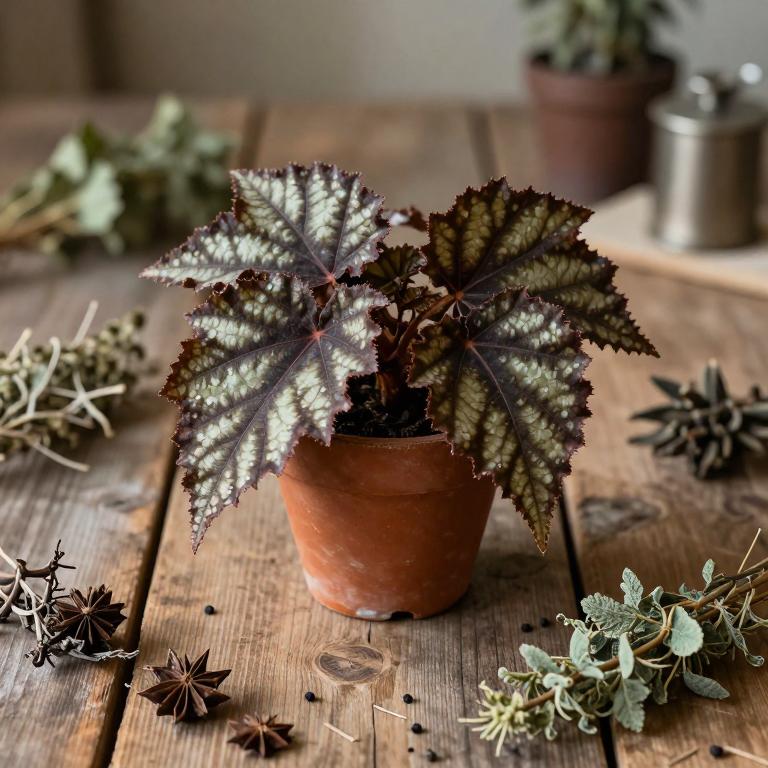
Begonias, scientifically known as Begonia, is a diverse genus of flowering plants celebrated for their striking foliage and vibrant blooms. Beyond their ornamental beauty in gardens, various species possess medicinal properties, traditionally used in folk medicine to treat inflammation, skin ailments, and digestive issues through their unique bioactive compounds.
- Family
- Begoniaceae
- Native range
- Europe
- Parts used
- Not available
- Common names
- Begonias
- Scientific synonyms
- Begoniella · Tittelbachia · 41 more
Names and Synonyms
Common Names
- Begonias
Scientific Names
Accepted name
BegoniaSynonyms
- Begoniella
- Tittelbachia
- Mezierea
- Nephromischus
- Lauchea
- Semibegoniella
- Weilbachia
- Steineria
- Wageneria
- Trilomisa
- Moschkowitzia
- Symbegonia
- Trendelenburgia
- Magnusia
- Huszia
- Lepsia
- Gireoudia
- Barya
- Gaerdtia
- Augustia
- Haagea
- Gurltia
- Rachia
- Isopteryx
- Trachelocarpus
- Rossmannia
- Reichenheimia
- Pilderia
- Platyclinium
- Scheidweileria
- Stibadotheca
- Sphenanthera
- Sassea
- Ewaldia
- Eupetalum
- Diploclinium
- Doratometra
- Donaldia
- Cyathocnemis
- Casparya
- Cladomischus
- Knesebeckia
- Saueria
Regional and Traditional Names
Spanish:
- Gireoudia
- Gurltia
- Doratometra
- Donaldia
- Trilomisa
- Cyathocnemis
- Casparya
- Symbegonia
- Sassea
- Platyclinium
- Falkea
- Lepsia
- Wageneria
- Nephromischus
- Mezierea
- Moschkowitzia
- Begonias
German:
- Begonien
- Begonie
- Schiefblatt
- Begonien
French:
- Bégonias
- bégonia
- Bégonias
Sources: Wikidata, Catalogue of Life
Taxonomical Classification
This plant belongs to the kingdom Plantae and is classified under the phylum Streptophyta and class Equisetopsida. Within the subclass Magnoliidae, it follows the order Cucurbitales and is a member of the family Begoniaceae. Ultimately, it is categorized under the genus Begonia.
| Rank | Classification |
|---|---|
| Kingdom | Plantae |
| Phylum | Streptophyta |
| Class | Equisetopsida |
| Subclass | Magnoliidae |
| Order | Cucurbitales |
| Family | Begoniaceae |
| Genus | Begonia |
Sources: The World Checklist of Vascular Plants (WCVP)
Distribution
This plant exhibits a diverse geographical distribution that spans several distinct regions across the globe. In Southeastern Europe, it can be found specifically within the island of Sicilia. Its range also extends to the Macaronesia archipelago, where it is located on the island of Madeira. Within West Tropical Africa, the species is documented in Burkina and Ghana. Furthermore, the plant's presence is confirmed in the West Tropical African nation of Guinea-Bissau.
| Region | Area |
|---|---|
| Southeastern Europe | Sicilia |
| Macaronesia | Madeira |
| West Tropical Africa | Burkina |
| West Tropical Africa | Ghana |
| West Tropical Africa | Guinea-Bissau |
| West Tropical Africa | Guinea |
| West Tropical Africa | Ivory Coast |
| West Tropical Africa | Liberia |
| West Tropical Africa | Mali |
| West Tropical Africa | Mauritania |
Sources: The World Checklist of Vascular Plants (WCVP)
Chemicals
Begonia has 1 reported phytochemicals identified across 0 scientific publications and several other databases. The most consistently reported chemicals include phloretin.
| Chemical | Supporting sources | Consensus |
|---|---|---|
| phloretin | 1 supporting sources | ★☆☆☆☆ |
phloretin
- Molecules (Basel, Switzerland)
Activities
Begonia has 2 reported activities identified across 0 scientific publications and several other databases. The most consistently reported activities include Anticancer, Antioxidant.
| Activity | Supporting sources | Consensus |
|---|---|---|
| Anticancer | 1 supporting sources | ★☆☆☆☆ |
| Antioxidant | 1 supporting sources | ★☆☆☆☆ |
Anticancer
- Molecules (Basel, Switzerland)
Antioxidant
- Molecules (Basel, Switzerland)
Conditions
Begonia has 2 reported investigations on conditions identified across 0 scientific publications and several other databases. The most consistently reported conditions include oxidative damage, skin aging.
| Condition | Supporting sources | Consensus |
|---|---|---|
| Oxidative damage | 1 supporting sources | ★☆☆☆☆ |
| Skin aging | 1 supporting sources | ★☆☆☆☆ |
Oxidative damage
- Molecules (Basel, Switzerland)
Skin aging
- Molecules (Basel, Switzerland)