musk basil
Basilicum polystachyon · Accepted scientific name
Scientific literature: Very Sparse (16 studies) · ★☆☆☆☆
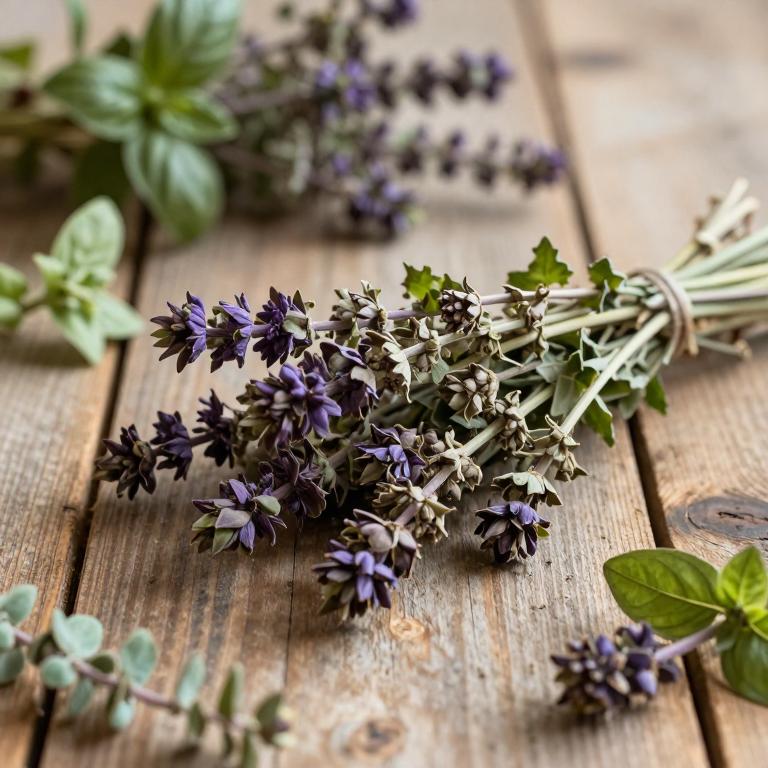
Musk basil, scientifically known as Basilicum polystachyon, is a rare medicinal herb revered for its potent aromatic properties. Renowned for its intense, musky scent, this plant offers significant therapeutic benefits, including anti-inflammatory and antimicrobial effects. It serves as a vital resource in traditional healing and natural wellness practices.
- Family
- Lamiaceae
- Native range
- Africa
- Parts used
- Not available
- Common names
- Musk-Basil · Musk Basil
- Scientific synonyms
- Ocimum Polystachyon · Lehmannia Ocymoidea · 11 more
Names and Synonyms
Common Names
- musk-basil
- Musk Basil
Scientific Names
Accepted name
Basilicum polystachyonSynonyms
- Ocimum polystachyon
- Lehmannia ocymoidea
- Perxo polystachyon
- Lumnitzera moschata
- Lumnitzera polystachyon
- Basilicum polystachyon var. stereocladum
- Plectranthus moschatus
- Moschosma dimidiatum
- Moschosma moschatum
- Plectranthus micranthus
- Moschosma polystachyon
- Ocimum tashiroi
- Ocimum dimidiatum
Regional and Traditional Names
French:
- basilic musqué
Sources: Wikidata, Catalogue of Life
Taxonomical Classification
This plant, scientifically known as Basilicum polystachyon, belongs to the kingdom Plantae and the phylum Streptophyta. Within the class Equisetopsida and subclass Magnoliidae, it is categorized under the order Lamiales and the family Lamiaceae. It is ultimately classified under the genus Basilicum.
| Rank | Classification |
|---|---|
| Kingdom | Plantae |
| Phylum | Streptophyta |
| Class | Equisetopsida |
| Subclass | Magnoliidae |
| Order | Lamiales |
| Family | Lamiaceae |
| Genus | Basilicum |
Sources: The World Checklist of Vascular Plants (WCVP)
Distribution
This plant is primarily located within the diverse landscapes of West Tropical Africa. Its presence is specifically documented across several key nations in this region. In the eastern reaches of this zone, it can be found in Benin, Burkina, and Ghana. The species also extends its range further south into the Ivory Coast. Finally, its geographical distribution concludes with significant occurrences throughout Nigeria.
| Region | Area |
|---|---|
| West Tropical Africa | Benin |
| West Tropical Africa | Burkina |
| West Tropical Africa | Ghana |
| West Tropical Africa | Ivory Coast |
| West Tropical Africa | Nigeria |
| West Tropical Africa | Niger |
| West Tropical Africa | Togo |
| West-Central Tropical Africa | Burundi |
| West-Central Tropical Africa | Central African Republic |
| West-Central Tropical Africa | Cameroon |
Sources: The World Checklist of Vascular Plants (WCVP)
Botanical Identification
Ecology
The ecology of Basilicum polystachyon is defined by its specific altitudinal distribution within its native landscape. This medicinal plant thrives within a distinct elevational range, establishing itself at altitudes starting from a minimum of 136 m AMSL and reaching up to a maximum of 303 m AMSL. While specific data regarding its primary habitat types remains undocumented or unspecified, its presence is strictly constrained to these low-to-mid elevation zones, suggesting a niche dependency on the environmental conditions present within this narrow vertical bracket.
- Elevational range max:
- 303 m AMSL
- Elevational range min:
- 136 m AMSL
- Habitat :
- -
Life history
The life history of Basilicum polystachyon is characterized by its classification as an annual species, meaning it completes its entire developmental cycle—from germination and vegetative growth to flowering and seed production—within a single growing season. In terms of its structural survival strategy, the plant exhibits the traits of both a therophyte and a chamaephyte. As a therophyte, it survives unfavorable environmental periods primarily in the form of seeds, which remain dormant until conditions become optimal for rapid seasonal growth. Concurrently, its life form as a chamaephyte indicates that its perennating buds are located close to or just above the soil surface, allowing it to utilize minimal protective cover while maintaining a compact growth habit during its active phase.
- Life form :
- chamaephyte
- Life form :
- therophyte
- Lifecycle :
- annual
Morphology
The morphology of Basilicum polystachyon is characterized by its growth form as a non-woody herb, existing as a self-supporting plant that does not require climbing structures. It is a terrestrial species, functioning as an independent organism rather than a parasite or an epiphyte. In terms of stature, the plant exhibits moderate height variability, with a minimum height of 0.3 m, a mean height of 0.7 m, and a maximum height reaching up to 1.2 m.
- Aquatic :
- terrestrial
- Climber :
- self-supporting
- Epiphyte :
- terrestrial
- Growth form :
- herb
- Parasite :
- independent
- Plant height max:
- 1.2 m
- Plant height mean:
- 0.7 m
- Plant height min:
- 0.3 m
- Woodiness :
- non-woody
Physiology
The physiology of Basilicon polystachyon is characterized by complex metabolic pathways that prioritize efficient nutrient acquisition and energy conversion within its specific ecological niche. A critical aspect of its nutrient cycling is its relationship with soil nitrogen; specifically, the plant is not a nitrogen fixer, meaning it lacks the specialized symbiotic relationship with diazotrophic bacteria required to convert atmospheric nitrogen into ammonia. Instead, its physiological processes rely heavily on the uptake of nitrates and ammonium directly from the soil through an extensive root system. This dependency necessitates a highly regulated nitrogen assimilation pathway to support the synthesis of amino acids and chlorophyll. Furthermore, its metabolic rate is closely tied to light interception and photosynthetic efficiency, utilizing specialized enzymatic reactions to manage carbon fixation and maintain osmotic balance during varying environmental stressors.
- Nitrogen fixer :
- no
Reproduction
The reproduction of Basilicum polystachyon is characterized by the production of minute seeds that exhibit specific variations in weight. The seed mass for this species shows a mean value of 8.2e-05 g, indicating a highly lightweight reproductive unit. Within the population, there is measurable phenotypic plasticity regarding seed size, with the maximum recorded seed mass reaching 0.00014 g and the minimum recorded seed mass dropping to 4e-05 g. These data suggest that while the seeds are consistently small, there is a significant range of mass distribution that may influence their dispersal capabilities and initial germination success.
- Seed mass max:
- 0.00014 g
- Seed mass mean:
- 8.2e-05 g
- Seed mass min:
- 4e-05 g
Sources: Global Inventory of Floras and Traits (GIFT)
Chemicals
Basilicum polystachyon has 8 reported phytochemicals identified across 0 scientific publications and several other databases. The most consistently reported chemicals include Gallic acid, TRANS-CINNAMIC ACID, Vanillic acid, caffeic acid, ellagic acid.
| Chemical | Supporting sources | Consensus |
|---|---|---|
| Gallic acid | 1 supporting sources | ★☆☆☆☆ |
| TRANS-CINNAMIC ACID | 1 supporting sources | ★☆☆☆☆ |
| Vanillic acid | 1 supporting sources | ★☆☆☆☆ |
| caffeic acid | 1 supporting sources | ★☆☆☆☆ |
| ellagic acid | 1 supporting sources | ★☆☆☆☆ |
| mercury (II) | 1 supporting sources | ★☆☆☆☆ |
| p-coumaric acid | 1 supporting sources | ★☆☆☆☆ |
| rosmarinic acid | 1 supporting sources | ★☆☆☆☆ |
Gallic acid
- Plants (Basel, Switzerland)
TRANS-CINNAMIC ACID
- Plants (Basel, Switzerland)
Vanillic acid
- Plants (Basel, Switzerland)
caffeic acid
- Plants (Basel, Switzerland)
ellagic acid
- Plants (Basel, Switzerland)
mercury (II)
- Plants (Basel, Switzerland)
p-coumaric acid
- Plants (Basel, Switzerland)
rosmarinic acid
- Plants (Basel, Switzerland)
Conditions
Basilicum polystachyon has 1 reported investigations on conditions identified across 0 scientific publications and several other databases. The most consistently reported conditions include oxidative stress.
| Condition | Supporting sources | Consensus |
|---|---|---|
| Oxidative stress | 1 supporting sources | ★☆☆☆☆ |
Oxidative stress
- Plants (Basel, Switzerland)