Atractylodes
Atractylodes · Accepted scientific name
Scientific literature: Very Sparse (16 studies) · ★☆☆☆☆
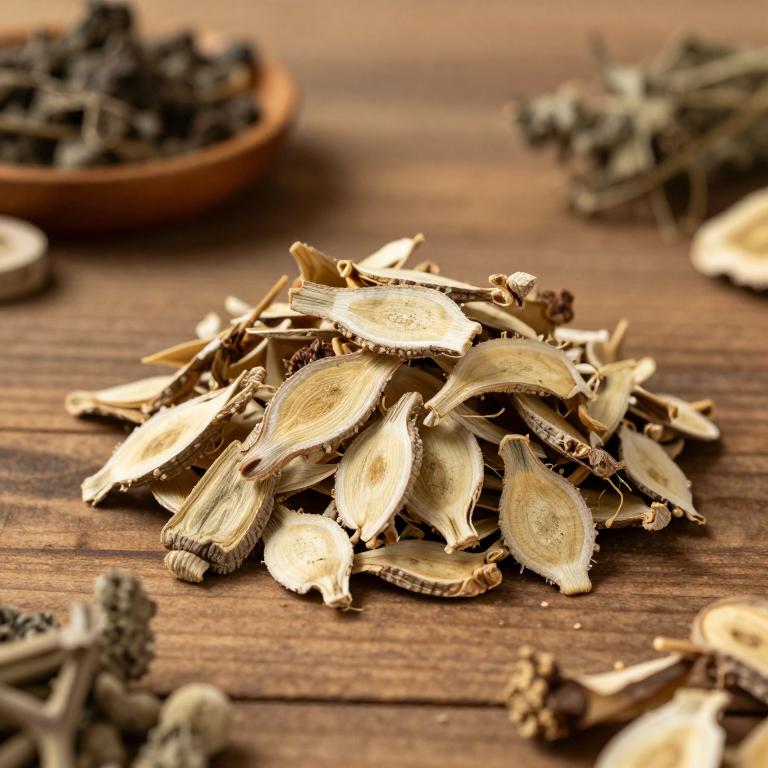
scientifically known as Atractylodes, is a versatile medicinal herb deeply rooted in traditional Eastern medicine. Renowned for its powerful rhizomes, it is primarily utilized to support digestive health, reduce inflammation, and strengthen the body's energy. This resilient plant offers significant therapeutic potential for managing various gastrointestinal and metabolic conditions.
- Family
- Asteraceae
- Native range
- Asia-Temperate
- Parts used
- Rhizome
- Common names
- Not available
- Scientific synonyms
- Giraldia
Names and Synonyms
Scientific Names
Accepted name
AtractylodesSynonyms
- Giraldia
Sources: Wikidata, Catalogue of Life
Taxonomical Classification
This plant belongs to the kingdom Plantae and the phylum Streptophyta. Within the class Equisetopsida and subclass Magnoliidae, it is classified under the order Asterales and the family Asteraceae. Finally, it is identified by the genus Atractylodes.
| Rank | Classification |
|---|---|
| Kingdom | Plantae |
| Phylum | Streptophyta |
| Class | Equisetopsida |
| Subclass | Magnoliidae |
| Order | Asterales |
| Family | Asteraceae |
| Genus | Atractylodes |
Sources: The World Checklist of Vascular Plants (WCVP)
Distribution
This plant exhibits a broad geographical distribution across several key regions in East Asia. In the Russian Far East, it can be found inhabiting the Amur, Khabarovsk, and Primorye territories. Its range extends significantly into China, where it is present in the South-Central regions. Additionally, the species is documented within the Inner Mongolia area of China. Together, these locations define the specific natural habitats where Atractylodes thrives.
| Region | Area |
|---|---|
| Russian Far East | Amur |
| Russian Far East | Khabarovsk |
| Russian Far East | Primorye |
| China | China South-Central |
| China | Inner Mongolia |
| China | Manchuria |
| China | China North-Central |
| China | China Southeast |
| Eastern Asia | Japan |
| Eastern Asia | Korea |
Sources: The World Checklist of Vascular Plants (WCVP)
Plant Parts
Atractylodes has 1 reported plant parts identified across 4 scientific publications and several other databases that are studied for medicinal purposes. The most consistently reported plant part include rhizome.
| Plant part | Supporting sources | Consensus |
|---|---|---|
| Rhizome | 4 supporting sources | ★★☆☆☆ |
Rhizome
- Journal of separation science
- Chemistry & biodiversity
- Zhong yao cai = Zhongyaocai = Journal of Chinese medicinal materials
- Archives of toxicology
Chemicals
Atractylodes has 5 reported phytochemicals identified across 4 scientific publications and several other databases. The most consistently reported chemicals include Atractylon, Atractylodin, Hinesol, Sesquiterpenes, beta-Eudesmol.
| Chemical | Supporting sources | Consensus |
|---|---|---|
| Atractylon | 2 supporting sources | ★☆☆☆☆ |
| Atractylodin | 1 supporting sources | ★☆☆☆☆ |
| Hinesol | 1 supporting sources | ★☆☆☆☆ |
| Sesquiterpenes | 1 supporting sources | ★☆☆☆☆ |
| beta-Eudesmol | 1 supporting sources | ★☆☆☆☆ |
Atractylon
- Biological & pharmaceutical bulletin
- Yakugaku zasshi : Journal of the Pharmaceutical Society of Japan
Atractylodin
- Biological & pharmaceutical bulletin
Hinesol
- Biological & pharmaceutical bulletin
Sesquiterpenes
- Molecules (Basel, Switzerland)
beta-Eudesmol
- Biological & pharmaceutical bulletin
Activities
Atractylodes has 3 reported activities identified across 4 scientific publications and several other databases. The most consistently reported activities include Antibacterial, Anticancer, Antiviral.
| Activity | Supporting sources | Consensus |
|---|---|---|
| Antibacterial | 1 supporting sources | ★☆☆☆☆ |
| Anticancer | 1 supporting sources | ★☆☆☆☆ |
| Antiviral | 1 supporting sources | ★☆☆☆☆ |
Antibacterial
- Molecules (Basel, Switzerland)
Anticancer
- Molecules (Basel, Switzerland)
Antiviral
- Molecules (Basel, Switzerland)
Conditions
Atractylodes has 1 reported investigations on conditions identified across 4 scientific publications and several other databases. The most consistently reported conditions include antiviral.
| Condition | Supporting sources | Consensus |
|---|---|---|
| Antiviral | 1 supporting sources | ★☆☆☆☆ |
Antiviral
- Molecules (Basel, Switzerland)
Preparations
Atractylodes has 1 reported preparations identified across 4 scientific publications and several other databases. The most consistently reported preparations include herbal medicine.
| Preparation | Supporting sources | Consensus |
|---|---|---|
| Herbal medicine | 1 supporting sources | ★☆☆☆☆ |
Herbal medicine
- Scientific reports