Bushman's tea
Athrixia phylicoides · Accepted scientific name
Scientific literature: Very Sparse (19 studies) · ★☆☆☆☆
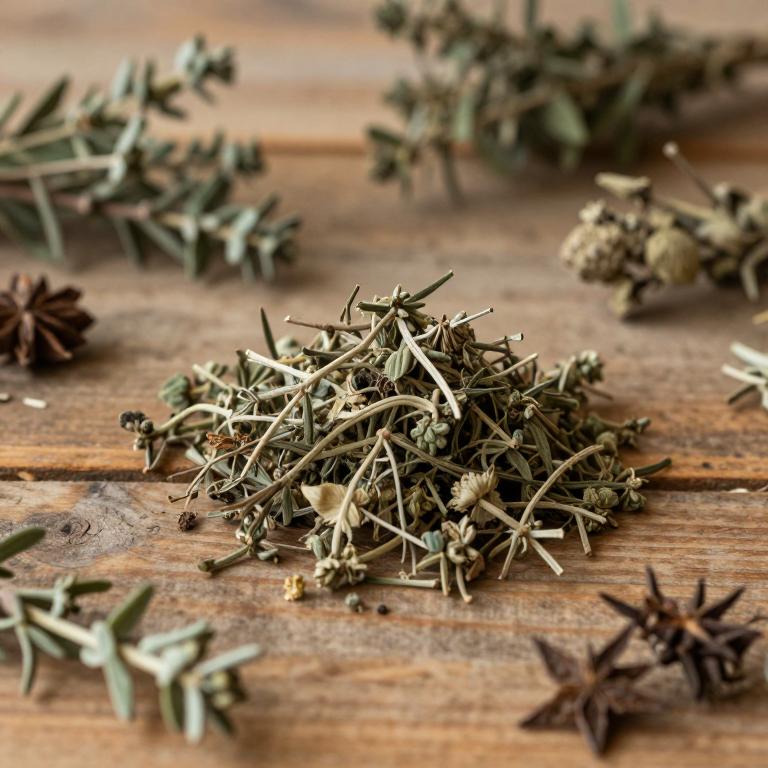
Bushman's tea, scientifically known as Athrixia phylicoides, is a resilient shrub native to Southern Africa. Renowned for its traditional medicinal properties, this plant is frequently brewed into a restorative infusion. It is widely utilized in indigenous healing practices to alleviate digestive discomfort and support overall wellness through its bioactive compounds.
- Family
- Asteraceae
- Native range
- Africa
- Parts used
- Not available
- Common names
- Bush Tea · Bushman Tea · 2 more
- Scientific synonyms
- Not available
Names and Synonyms
Common Names
- Bush Tea
- Bushman Tea
- Kaffir Tea
- Bushman's tea
Scientific Names
Accepted name
Athrixia phylicoidesSources: Wikidata, Catalogue of Life
Taxonomical Classification
This plant belongs to the kingdom Plantae and the phylum Streptophyta, falling under the class Equisetopsida and subclass Magnoliidae. Within the order Asterales, it is classified under the family Asteraceae. Its specific taxonomic designation is within the genus Athrixia, where it is known as Athrixia phylicoides.
| Rank | Classification |
|---|---|
| Kingdom | Plantae |
| Phylum | Streptophyta |
| Class | Equisetopsida |
| Subclass | Magnoliidae |
| Order | Asterales |
| Family | Asteraceae |
| Genus | Athrixia |
Sources: The World Checklist of Vascular Plants (WCVP)
Distribution
This plant exhibits a diverse geographical distribution across several key regions of the continent. Within South Tropical Africa, it can be found growing in both Mozambique and Zimbabwe. Its range also extends significantly into the Southern African region. Specifically, it is documented in the Cape Provinces, KwaZulu-Natal, and the Free State. Together, these locations highlight the wide ecological presence of Athrixia phylicoides.
| Region | Area |
|---|---|
| South Tropical Africa | Mozambique |
| South Tropical Africa | Zimbabwe |
| Southern Africa | Cape Provinces |
| Southern Africa | KwaZulu-Natal |
| Southern Africa | Free State |
| Southern Africa | Eswatini |
| Southern Africa | Northern Provinces |
Sources: The World Checklist of Vascular Plants (WCVP)
Botanical Identification
Ecology
The ecology of Athrixia phylicoides is characterized by a broad altitudinal distribution, allowing it to occupy diverse topographical niches across its habitat. This species demonstrates significant ecological plasticity, inhabiting environments ranging from low-lying areas starting at an elevation of 15 m AMSL to high-altitude terrains reaching up to 2000 m AMSL. This wide elevational range suggests an ability to adapt to varying temperature gradients, atmospheric pressures, and moisture regimes associated with different montane and lowland ecosystems.
- Elevational range max:
- 2000 m AMSL
- Elevational range min:
- 15 m AMSL
Life history
The life history of Athrixia phylicoides is characterized by its status as a perennial plant, allowing it to persist in its environment over many growing seasons rather than completing its life cycle in a single year. Throughout its existence, the species maintains an evergreen habit, ensuring that its foliage remains functional and present year-round without the seasonal shedding of leaves typical of deciduous species.
- Deciduousness :
- evergreen
- Lifecycle :
- perennial
Morphology
The morphology of Athrixia phylicoides is characterized by its growth form as a woody shrub. This self-supporting plant typically attains a height ranging from a minimum of 0.3 m to a maximum of 2 m, with an average plant height of approximately 1 m. It functions as an independent organism rather than a parasite or an epiphyte, maintaining a strictly terrestrial existence.
- Aquatic :
- terrestrial
- Climber :
- self-supporting
- Epiphyte :
- terrestrial
- Growth form :
- shrub
- Parasite :
- independent
- Plant height max:
- 2 m
- Plant height mean:
- 1 m
- Plant height min:
- 0.3 m
- Woodiness :
- woody
Physiology
The physiology of Athrixia phylicoides is characterized by its specialized metabolic processes adapted to the nutrient-poor environments typical of its native habitats. As a member of the Proteaceae family, its physiological framework is heavily oriented toward efficient nutrient acquisition, particularly through a specialized root system designed to maximize phosphorus uptake in acidic soils. In terms of its nitrogen metabolism, the plant does not function as a nitrogen fixer; it lacks the symbiotic relationship with diazotrophic bacteria, such as Rhizobium, required to convert atmospheric nitrogen into bioavailable forms. Consequently, its nitrogen acquisition is entirely dependent on the uptake of nitrates or ammonium from the soil through its root architecture. This reliance on external nitrogen sources, coupled with its non-fixing status, necessitates highly efficient internal nitrogen recycling and conservation mechanisms to support its growth and structural development.
- Nitrogen fixer :
- no
Sources: Global Inventory of Floras and Traits (GIFT)
Chemicals
Athrixia phylicoides has 6 reported phytochemicals identified across 0 scientific publications and several other databases. The most consistently reported chemicals include polyphenols, CHLOROGENIC ACID, Flavonoids, caffeine, coumarin.
| Chemical | Supporting sources | Consensus |
|---|---|---|
| polyphenols | 3 supporting sources | ★★☆☆☆ |
| CHLOROGENIC ACID | 1 supporting sources | ★☆☆☆☆ |
| Flavonoids | 1 supporting sources | ★☆☆☆☆ |
| caffeine | 1 supporting sources | ★☆☆☆☆ |
| coumarin | 1 supporting sources | ★☆☆☆☆ |
| protocatechuic acid | 1 supporting sources | ★☆☆☆☆ |
polyphenols
- BMC complementary medicine and therapies
- Phytomedicine : international journal of phytotherapy and phytopharmacology
- F1000Research
CHLOROGENIC ACID
- Phytomedicine : international journal of phytotherapy and phytopharmacology
Flavonoids
- F1000Research
caffeine
- Journal of ethnopharmacology
coumarin
- F1000Research
protocatechuic acid
- Phytomedicine : international journal of phytotherapy and phytopharmacology
Activities
Athrixia phylicoides has 1 reported activities identified across 0 scientific publications and several other databases. The most consistently reported activities include Purgative.
| Activity | Supporting sources | Consensus |
|---|---|---|
| Purgative | 1 supporting sources | ★☆☆☆☆ |
Purgative
- Journal of ethnopharmacology
Conditions
Athrixia phylicoides has 10 reported investigations on conditions identified across 0 scientific publications and several other databases. The most consistently reported conditions include acne, boils, cough, insulin resistance, metabolic syndrome.
| Condition | Supporting sources | Consensus |
|---|---|---|
| Acne | 1 supporting sources | ★☆☆☆☆ |
| Boils | 1 supporting sources | ★☆☆☆☆ |
| Cough | 1 supporting sources | ★☆☆☆☆ |
| Insulin resistance | 1 supporting sources | ★☆☆☆☆ |
| Metabolic syndrome | 1 supporting sources | ★☆☆☆☆ |
| Obesity | 1 supporting sources | ★☆☆☆☆ |
| Purgative | 1 supporting sources | ★☆☆☆☆ |
| Type 2 diabetes | 1 supporting sources | ★☆☆☆☆ |
| Visceral fat | 1 supporting sources | ★☆☆☆☆ |
| Weight gain | 1 supporting sources | ★☆☆☆☆ |
Acne
- Journal of ethnopharmacology
Boils
- Journal of ethnopharmacology
Cough
- Journal of ethnopharmacology
Insulin resistance
- BMC complementary medicine and therapies
Metabolic syndrome
- BMC complementary medicine and therapies
Obesity
- BMC complementary medicine and therapies
Purgative
- Journal of ethnopharmacology
Type 2 diabetes
- BMC complementary medicine and therapies
Visceral fat
- BMC complementary medicine and therapies
Weight gain
- BMC complementary medicine and therapies
Preparations
Athrixia phylicoides has 1 reported preparations identified across 0 scientific publications and several other databases. The most consistently reported preparations include tea infusion.
| Preparation | Supporting sources | Consensus |
|---|---|---|
| Tea infusion | 1 supporting sources | ★☆☆☆☆ |
Tea infusion
- BMC complementary medicine and therapies