asparagus genus
Asparagus · Accepted scientific name
Scientific literature: Very Sparse (24 studies) · ★☆☆☆☆
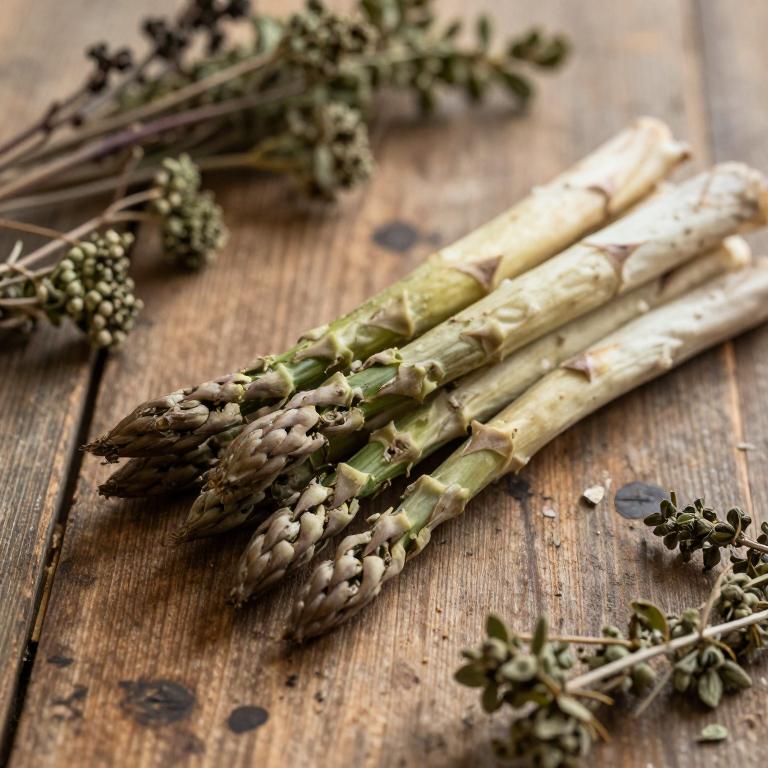
Asparagus genus, scientifically known as Asparagus, is a diverse group of herbaceous perennials valued globally. Beyond its culinary fame, various species offer significant medicinal potential. Rich in antioxidants and essential nutrients, these plants are traditionally used to support kidney health, reduce inflammation, and provide restorative tonic properties in herbalism.
- Family
- Asparagaceae
- Native range
- Europe
- Parts used
- Root
- Common names
- Asparagus Fern · Sparrowgrass
- Scientific synonyms
- Elachanthera · Elide · 4 more
Names and Synonyms
Common Names
- Asparagus fern
- sparrowgrass
Scientific Names
Accepted name
AsparagusSynonyms
- Elachanthera
- Elide
- Myrsiphyllum
- Hecatris
- Protasparagus
- Asparagopsis
Regional and Traditional Names
Spanish:
- Espárragos y falsos helechos
German:
- Spargel
- Spargel
French:
- Asperges
Sources: Wikidata, Catalogue of Life
Taxonomical Classification
This plant belongs to the kingdom Plantae within the phylum Streptophyta and the class Equisetopsida. Under the subclass Magnoliidae, it is classified under the order Asparagales and the family Asparagaceae. Finally, its specific taxonomic identity is defined by the genus Asparagus.
| Rank | Classification |
|---|---|
| Kingdom | Plantae |
| Phylum | Streptophyta |
| Class | Equisetopsida |
| Subclass | Magnoliidae |
| Order | Asparagales |
| Family | Asparagaceae |
| Genus | Asparagus |
Sources: The World Checklist of Vascular Plants (WCVP)
Distribution
This plant exhibits a specific distribution pattern across the northern regions of Europe. It can be found growing within the borders of Denmark. Furthermore, its presence is noted in the landscapes of Finland and Norway. The species also extends its range to include Great Britain. Finally, this medicinal plant is documented to occur in Ireland.
| Region | Area |
|---|---|
| Northern Europe | Denmark |
| Northern Europe | Finland |
| Northern Europe | Great Britain |
| Northern Europe | Ireland |
| Northern Europe | Norway |
| Northern Europe | Sweden |
| Middle Europe | Austria |
| Middle Europe | Belgium |
| Middle Europe | Czechia-Slovakia |
| Middle Europe | Germany |
Sources: The World Checklist of Vascular Plants (WCVP)
Plant Parts
Asparagus has 1 reported plant parts identified across 2 scientific publications and several other databases that are studied for medicinal purposes. The most consistently reported plant part include root.
| Plant part | Supporting sources | Consensus |
|---|---|---|
| Root | 2 supporting sources | ★☆☆☆☆ |
Root
- Phytochemical analysis : PCA
- Phytotherapy research : PTR
Chemicals
Asparagus has 2 reported phytochemicals identified across 2 scientific publications and several other databases. The most consistently reported chemicals include Immunoside, Saponins.
| Chemical | Supporting sources | Consensus |
|---|---|---|
| Immunoside | 1 supporting sources | ★☆☆☆☆ |
| Saponins | 1 supporting sources | ★☆☆☆☆ |
Immunoside
- Chemistry & biodiversity
Saponins
- Critical reviews in food science and nutrition
Activities
Asparagus has 8 reported activities identified across 2 scientific publications and several other databases. The most consistently reported activities include Antibacterial, Antihepatotoxic, Antioxidant, Antioxytocic, Adaptogenic.
| Activity | Supporting sources | Consensus |
|---|---|---|
| Antibacterial | 2 supporting sources | ★☆☆☆☆ |
| Antihepatotoxic | 2 supporting sources | ★☆☆☆☆ |
| Antioxidant | 2 supporting sources | ★☆☆☆☆ |
| Antioxytocic | 2 supporting sources | ★☆☆☆☆ |
| Adaptogenic | 1 supporting sources | ★☆☆☆☆ |
| Antiproliferative | 1 supporting sources | ★☆☆☆☆ |
| Hypoglycemic | 1 supporting sources | ★☆☆☆☆ |
| Tonic | 1 supporting sources | ★☆☆☆☆ |
Antibacterial
- Chemistry & biodiversity
- Pharmacognosy reviews
Antihepatotoxic
- Chemistry & biodiversity
- Pharmacognosy reviews
Antioxidant
- Chemistry & biodiversity
- Critical reviews in food science and nutrition
Antioxytocic
- Chemistry & biodiversity
- Pharmacognosy reviews
Adaptogenic
- Chemistry & biodiversity
Antiproliferative
- Chemistry & biodiversity
Hypoglycemic
- Critical reviews in food science and nutrition
Tonic
- Evidence-based complementary and alternative medicine : eCAM
Conditions
Asparagus has 4 reported investigations on conditions identified across 2 scientific publications and several other databases. The most consistently reported conditions include antioxidant, anxiety, anxiety disorder, hypoglycemic.
| Condition | Supporting sources | Consensus |
|---|---|---|
| Antioxidant | 1 supporting sources | ★☆☆☆☆ |
| Anxiety | 1 supporting sources | ★☆☆☆☆ |
| Anxiety disorder | 1 supporting sources | ★☆☆☆☆ |
| Hypoglycemic | 1 supporting sources | ★☆☆☆☆ |
Antioxidant
- Critical reviews in food science and nutrition
Anxiety
- Evidence-based complementary and alternative medicine : eCAM
Anxiety disorder
- Evidence-based complementary and alternative medicine : eCAM
Hypoglycemic
- Critical reviews in food science and nutrition
Preparations
Asparagus has 5 reported preparations identified across 2 scientific publications and several other databases. The most consistently reported preparations include callus, extracts, powders, spears, suspension cell line.
| Preparation | Supporting sources | Consensus |
|---|---|---|
| Callus | 1 supporting sources | ★☆☆☆☆ |
| Extracts | 1 supporting sources | ★☆☆☆☆ |
| Powders | 1 supporting sources | ★☆☆☆☆ |
| Spears | 1 supporting sources | ★☆☆☆☆ |
| Suspension cell line | 1 supporting sources | ★☆☆☆☆ |
Callus
- Plant biotechnology (Tokyo, Japan)
Extracts
- Journal of dietary supplements
Powders
- Food chemistry
Spears
- Plant biotechnology (Tokyo, Japan)
Suspension cell line
- Plant biotechnology (Tokyo, Japan)