Asparagus curillus
Asparagus curillus · Accepted scientific name
Scientific literature: Very Sparse (5 studies) · ★☆☆☆☆
Asparagus curillus, scientifically known as Asparagus curillus, is a resilient medicinal plant valued for its diverse therapeutic properties. Often found in tropical regions, this species is traditionally utilized in herbal medicine to support digestive health, reduce inflammation, and promote overall vitality through its unique bioactive compounds and nutrients.
- Family
- Asparagaceae
- Native range
- Asia-Tropical
- Parts used
- Leaf
- Common names
- Not available
- Scientific synonyms
- Asparagopsis Curilla · Protasparagus Curillus · 1 more
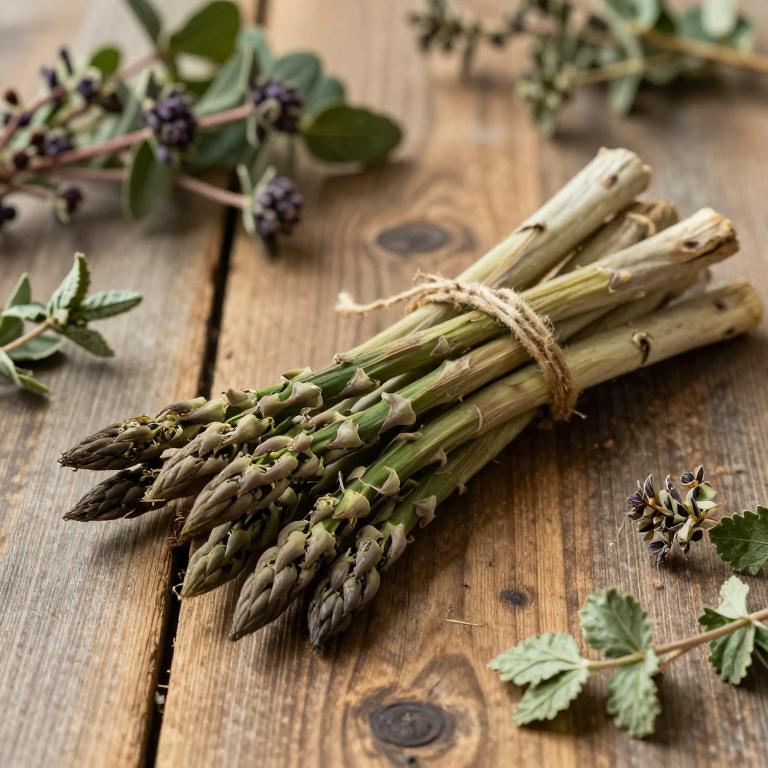
Names and Synonyms
Scientific Names
Accepted name
Asparagus curillusSynonyms
- Asparagopsis curilla
- Protasparagus curillus
- Asparagus nepalensis
Sources: Wikidata, Catalogue of Life
Taxonomical Classification
This plant belongs to the kingdom Plantae and is classified under the phylum Streptophyta and the class Equisetopsida. Within the subclass Magnoliidae, it is further organized into the order Asparagales and the family Asparagaceae. Ultimately, its taxonomic identity is defined by the genus Asparagus.
| Rank | Classification |
|---|---|
| Kingdom | Plantae |
| Phylum | Streptophyta |
| Class | Equisetopsida |
| Subclass | Magnoliidae |
| Order | Asparagales |
| Family | Asparagaceae |
| Genus | Asparagus |
Sources: The World Checklist of Vascular Plants (WCVP)
Distribution
This plant, Asparagus racemosus (often referred to as Asparagus curillus), maintains a specific presence across the Indian Subcontinent. Its natural habitat primarily includes various regions throughout India. Additionally, the species can be found growing within the borders of Nepal. It is also notably distributed across the West Himalaya mountain range. These specific locations define the core geographical range where the plant thrives.
| Region | Area |
|---|---|
| Indian Subcontinent | India |
| Indian Subcontinent | Nepal |
| Indian Subcontinent | West Himalaya |
Sources: The World Checklist of Vascular Plants (WCVP)
Botanical Identification
Life history
The life history of Asparagus curillus is characterized by a perennial growth pattern where its survival strategy is defined by its specific life form. Categorized as a hemicryptophyte, the plant ensures its persistence through seasonal cycles by protecting its perennating buds at or just below the soil surface. This physiological trait allows it to endure varying environmental conditions, effectively functioning as a hemicryptophyte within its ecological niche. By maintaining these buds near the ground level, the species can regenerate its above-ground structures following periods of dormancy or unfavorable climatic shifts, ensuring a continuous life cycle.
- Life form :
- hemicryptophyte
Morphology
The morphology of Asparagus curillus is characterized by its growth habit as a self-supporting climber, which allows it to navigate its environment through its structural development. As a non-parasitic organism, the plant is entirely independent, lacking any parasitic relationship with host plants for its nutritional requirements. Furthermore, it is strictly terrestrial in its ecological positioning, growing within the soil substrate rather than functioning as an epiphyte.
- Climber :
- self-supporting
- Epiphyte :
- terrestrial
- Parasite :
- independent
Sources: Global Inventory of Floras and Traits (GIFT)
Plant Parts
Asparagus curillus has 1 reported plant parts identified across 1 scientific publications and several other databases that are studied for medicinal purposes. The most consistently reported plant part include leaf.
| Plant part | Supporting sources | Consensus |
|---|---|---|
| Leaf | 1 supporting sources | ★☆☆☆☆ |
Leaf
- Phytochemistry
Chemicals
Asparagus curillus has 4 reported phytochemicals identified across 1 scientific publications and several other databases. The most consistently reported chemicals include Curillin G, Curillin H, Curilloside G, Curilloside H.
| Chemical | Supporting sources | Consensus |
|---|---|---|
| Curillin G | 1 supporting sources | ★☆☆☆☆ |
| Curillin H | 1 supporting sources | ★☆☆☆☆ |
| Curilloside G | 1 supporting sources | ★☆☆☆☆ |
| Curilloside H | 1 supporting sources | ★☆☆☆☆ |
Curillin G
- Phytochemistry
Curillin H
- Phytochemistry
Curilloside G
- Phytochemistry
Curilloside H
- Phytochemistry