mugwort
Artemisia · Accepted scientific name
Scientific literature: Extensive (160 studies) · ★★★★☆
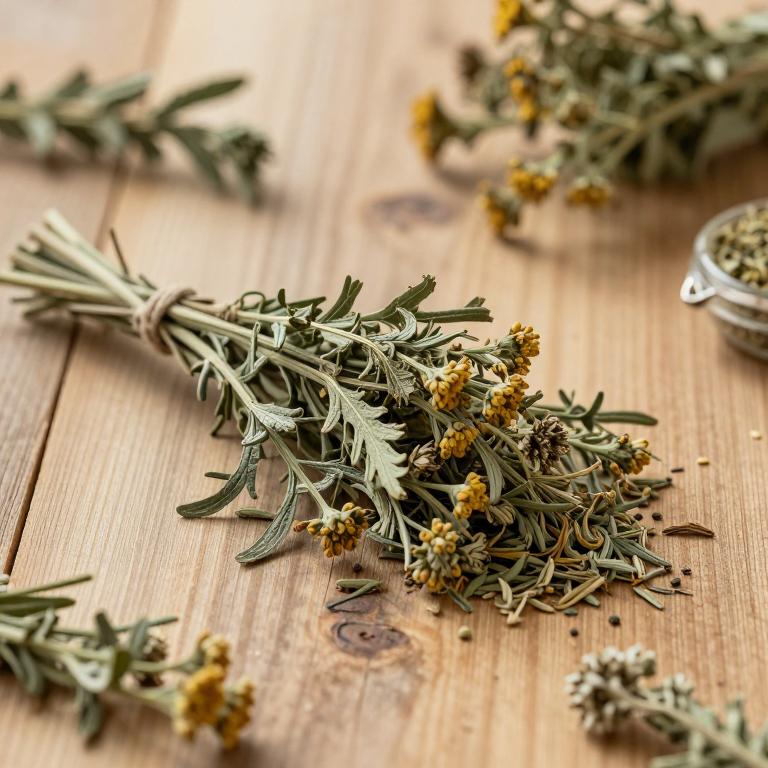
Mugwort, scientifically known as Artemisia, is a versatile perennial herb renowned for its diverse therapeutic properties. Long utilized in traditional medicine, this aromatic plant offers digestive support, promotes sleep, and aids menstrual regulation. Its potent essential oils and antioxidant compounds make it a cornerstone of herbal wellness and holistic healing.
Names and Synonyms
Common Names
- sagebrush
- sagewort
- wormwood
- Mugworts
- Mugworts and Wormwoods
- wormwoods and sagebrushes
Scientific Names
Accepted name
ArtemisiaSynonyms
- Neopallasia
- Seriphidium
- Crossostephium
- Filifolium
- Kaschgaria
- Artanacetum
- Artemisiastrum
- Artemisiella
- Chamartemisia
- Draconia
- Picrothamnus
- Oligosporus
- Sphaeromeria
- Turaniphytum
- Vesicarpa
- Mausolea
- Abrotanum
- Absinthium
Regional and Traditional Names
Spanish:
- Chamartemisia
- Hydrophytum
- Artemisa
- Absinthium
- Oligosporus
- Picrothamnus
- Artemisas y parientes
German:
- Wurmholz
- Beifuß
French:
- armoise
- armoises
Sources: Wikidata, Catalogue of Life
Taxonomical Classification
This plant belongs to the kingdom Plantae and the phylum Streptophyta within the class Equisetopsida. Classified under the subclass Magnoliidae and the order Asterales, it is a member of the Asteraceae family. Specifically, it is categorized under the genus Artemisia.
| Rank | Classification |
|---|---|
| Kingdom | Plantae |
| Phylum | Streptophyta |
| Class | Equisetopsida |
| Subclass | Magnoliidae |
| Order | Asterales |
| Family | Asteraceae |
| Genus | Artemisia |
Sources: The World Checklist of Vascular Plants (WCVP)
Distribution
This plant exhibits a distinct presence across several regions within Northern Europe. It can be found growing in the landscapes of Denmark and Finland. Its distribution also extends to the island of Iceland and the archipelago of Føroyaar. Furthermore, the species is documented throughout Great Britain. Together, these locations highlight its specific range across the northern territories.
| Region | Area |
|---|---|
| Northern Europe | Denmark |
| Northern Europe | Finland |
| Northern Europe | Føroyar |
| Northern Europe | Great Britain |
| Northern Europe | Iceland |
| Northern Europe | Ireland |
| Northern Europe | Norway |
| Northern Europe | Sweden |
| Middle Europe | Austria |
| Middle Europe | Belgium |
Sources: The World Checklist of Vascular Plants (WCVP)
Plant Parts
Artemisia has 2 reported plant parts identified across 5 scientific publications and several other databases that are studied for medicinal purposes. The most consistently reported plant part include leaf, stem.
| Plant part | Supporting sources | Consensus |
|---|---|---|
| Leaf | 4 supporting sources | ★★☆☆☆ |
| Stem | 1 supporting sources | ★☆☆☆☆ |
Leaf
- Yakushigaku zasshi
- Chemical & pharmaceutical bulletin
- Mediators of inflammation
- Evidence-based complementary and alternative medicine : eCAM
Stem
- Yakushigaku zasshi
Chemicals
Artemisia has 35 reported phytochemicals identified across 5 scientific publications and several other databases. The most consistently reported chemicals include artemisinin, Flavonoids, Coumarins, Terpenoids, (+)-Borneol.
| Chemical | Supporting sources | Consensus |
|---|---|---|
| artemisinin | 6 supporting sources | ★★★☆☆ |
| Flavonoids | 3 supporting sources | ★★☆☆☆ |
| Coumarins | 2 supporting sources | ★☆☆☆☆ |
| Terpenoids | 2 supporting sources | ★☆☆☆☆ |
| (+)-Borneol | 1 supporting sources | ★☆☆☆☆ |
| Al | 1 supporting sources | ★☆☆☆☆ |
| Arglabin | 1 supporting sources | ★☆☆☆☆ |
| Artemether | 1 supporting sources | ★☆☆☆☆ |
| Artemisia ketone | 1 supporting sources | ★☆☆☆☆ |
| Artesunate | 1 supporting sources | ★☆☆☆☆ |
artemisinin
- Molecular biology reports
- Current topics in medicinal chemistry
- Medicina (Kaunas, Lithuania)
- Food research international (Ottawa, Ont.)
- Journal of food biochemistry
View 1 additional sources
- Mini reviews in medicinal chemistry
Flavonoids
- Current topics in medicinal chemistry
- Medicina (Kaunas, Lithuania)
- Journal of food biochemistry
Coumarins
- Current topics in medicinal chemistry
- Medicina (Kaunas, Lithuania)
Terpenoids
- Current topics in medicinal chemistry
- Medicina (Kaunas, Lithuania)
(+)-Borneol
- Biochemical and biophysical research communications
Al
- International journal of environmental research and public health
Arglabin
- Current topics in medicinal chemistry
Artemether
- Current topics in medicinal chemistry
Artemisia ketone
- Medicines (Basel, Switzerland)
Artesunate
- Current topics in medicinal chemistry
Activities
Artemisia has 20 reported activities identified across 5 scientific publications and several other databases. The most consistently reported activities include Antimalarial, Antioxidant, Antimicrobial, Anticancer, Antifungal.
| Activity | Supporting sources | Consensus |
|---|---|---|
| Antimalarial | 9 supporting sources | ★★★★☆ |
| Antioxidant | 8 supporting sources | ★★★★☆ |
| Antimicrobial | 7 supporting sources | ★★★★☆ |
| Anticancer | 4 supporting sources | ★★☆☆☆ |
| Antifungal | 4 supporting sources | ★★☆☆☆ |
| Neuroprotective | 3 supporting sources | ★★☆☆☆ |
| Anthelmintic | 2 supporting sources | ★☆☆☆☆ |
| Antidiabetic | 2 supporting sources | ★☆☆☆☆ |
| Antispasmodic | 2 supporting sources | ★☆☆☆☆ |
| Antitumor | 2 supporting sources | ★☆☆☆☆ |
Antimalarial
- Molecules (Basel, Switzerland)
- Frontiers in pharmacology
- Molecular biology reports
- Bioorganic & medicinal chemistry
- Pharmaceutical biology
View 4 additional sources
- Oxidative medicine and cellular longevity
- Current topics in medicinal chemistry
- Research in pharmaceutical sciences
- Mini reviews in medicinal chemistry
Antioxidant
- Frontiers in pharmacology
- Journal of traditional and complementary medicine
- Bioorganic & medicinal chemistry
- Pharmaceutical biology
- Oxidative medicine and cellular longevity
View 3 additional sources
- Research in pharmaceutical sciences
- Medicines (Basel, Switzerland)
- Food science & nutrition
Antimicrobial
- Frontiers in pharmacology
- Bioorganic & medicinal chemistry
- Current topics in medicinal chemistry
- Medicina (Kaunas, Lithuania)
- Research in pharmaceutical sciences
View 2 additional sources
- Medicines (Basel, Switzerland)
- Food science & nutrition
Anticancer
- Molecular biology reports
- Oxidative medicine and cellular longevity
- Current topics in medicinal chemistry
- Phytotherapy research : PTR
Antifungal
- Journal of traditional and complementary medicine
- Pharmaceutical biology
- Planta medica
- Medicina (Kaunas, Lithuania)
Neuroprotective
- Frontiers in pharmacology
- Bioorganic & medicinal chemistry
- Medicina (Kaunas, Lithuania)
Anthelmintic
- Bioorganic & medicinal chemistry
- Current topics in medicinal chemistry
Antidiabetic
- Current topics in medicinal chemistry
- Ancient science of life
Antispasmodic
- Bioorganic & medicinal chemistry
- Current topics in medicinal chemistry
Antitumor
- Molecules (Basel, Switzerland)
- Frontiers in pharmacology
Conditions
Artemisia has 31 reported investigations on conditions identified across 5 scientific publications and several other databases. The most consistently reported conditions include cancer, malaria, hepatitis, inflammation, epilepsy.
| Condition | Supporting sources | Consensus |
|---|---|---|
| Cancer | 5 supporting sources | ★★★☆☆ |
| Malaria | 5 supporting sources | ★★★☆☆ |
| Hepatitis | 4 supporting sources | ★★☆☆☆ |
| Inflammation | 3 supporting sources | ★★☆☆☆ |
| Epilepsy | 2 supporting sources | ★☆☆☆☆ |
| Jaundice | 2 supporting sources | ★☆☆☆☆ |
| Tumor | 2 supporting sources | ★☆☆☆☆ |
| Alzheimer's disease | 1 supporting sources | ★☆☆☆☆ |
| Aspergillus flavus | 1 supporting sources | ★☆☆☆☆ |
| Candida albicans | 1 supporting sources | ★☆☆☆☆ |
Cancer
- Molecular biology reports
- Bioorganic & medicinal chemistry
- Molecules (Basel, Switzerland)
- Planta medica
- Heliyon
Malaria
- Molecules (Basel, Switzerland)
- Critical reviews in biotechnology
- Current topics in medicinal chemistry
- Planta medica
- Archives of pharmacal research
Hepatitis
- Molecules (Basel, Switzerland)
- Planta medica
- Heliyon
- Journal of natural medicines
Inflammation
- Molecules (Basel, Switzerland)
- Medicina (Kaunas, Lithuania)
- Planta medica
Epilepsy
- Frontiers in pharmacology
- Archives of pharmacal research
Jaundice
- Current topics in medicinal chemistry
- Journal of natural medicines
Tumor
- Molecules (Basel, Switzerland)
- Bioorganic & medicinal chemistry
Alzheimer's disease
- Oxidative medicine and cellular longevity
Aspergillus flavus
- Planta medica
Candida albicans
- Planta medica
Preparations
Artemisia has 22 reported preparations identified across 5 scientific publications and several other databases. The most consistently reported preparations include essential oils, extracts, Extracts, Sesquiterpene fractions, alcoholic beverages.
| Preparation | Supporting sources | Consensus |
|---|---|---|
| Essential oils | 2 supporting sources | ★☆☆☆☆ |
| Extracts | 2 supporting sources | ★☆☆☆☆ |
| Extracts | 1 supporting sources | ★☆☆☆☆ |
| Sesquiterpene fractions | 1 supporting sources | ★☆☆☆☆ |
| Alcoholic beverages | 1 supporting sources | ★☆☆☆☆ |
| Amino acids | 1 supporting sources | ★☆☆☆☆ |
| Aqueous and alcoholic extracts | 1 supporting sources | ★☆☆☆☆ |
| Artisanal beers | 1 supporting sources | ★☆☆☆☆ |
| Decoction | 1 supporting sources | ★☆☆☆☆ |
| Decoctions | 1 supporting sources | ★☆☆☆☆ |
Essential oils
- Iranian journal of parasitology
- Bollettino della Societa italiana di biologia sperimentale
Extracts
- Journal of clinical and experimental dentistry
- Journal of ethnopharmacology
Extracts
- Anticancer research
Sesquiterpene fractions
- Iranian journal of basic medical sciences
Alcoholic beverages
- Natural product research
Amino acids
- Recent advances in food, nutrition & agriculture
Aqueous and alcoholic extracts
- Ancient science of life
Artisanal beers
- Plants (Basel, Switzerland)
Decoction
- Zhonghua Minguo xiao er ke yi xue hui za zhi [Journal]. Zhonghua Minguo xiao er ke yi xue hui
Decoctions
- Natural product research