Artemisia chinensis
Artemisia stelleriana · Accepted scientific name
Scientific literature: Very Sparse (2 studies) · ★☆☆☆☆
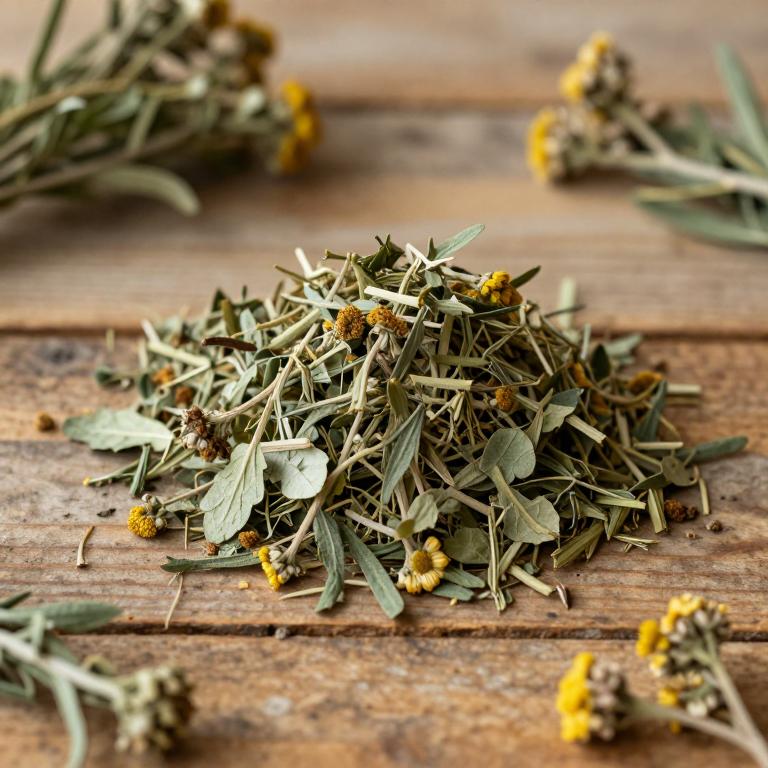
Artemisia chinensis, scientifically known as Artemisia stelleriana, is a perennial herb belonging to the Asteraceae family. Primarily native to East Asia, this plant is valued in traditional medicine for its bioactive compounds. It is frequently utilized for its antimicrobial and anti-inflammatory properties, offering significant potential in pharmacological research.
Names and Synonyms
Common Names
- Artemisia chinensis
- Stellar's wormwood
- beach wormwood
- dusty miller
- Hoary Mugwort
- Hoary Wormwood
- dusty-miller
- old-woman
Scientific Names
Accepted name
Artemisia stellerianaSynonyms
- Artemisia stelleriana var. vesiculosa
- Artemisia stelleriana var. sachalinensis
- Artemisia chinensis
Regional and Traditional Names
Spanish:
- Artemisia chinensis
- Artemisia stelleriana var. sachalinensis
- Artemisia stelleriana var. vesiculosa
- Artemisia chinensis
German:
- Artemisia chinensis
- Silber-Wermut
French:
- Armoise de Steller
- Artemisia chinensis
- armoise de Steller
Sources: Wikidata, Catalogue of Life
Taxonomical Classification
This plant belongs to the kingdom Plantae and is classified within the phylum Streptophyta and the class Equisetopsida. It falls under the subclass Magnoliidae and the order Asterales, specifically being a member of the family Asteraceae. Finally, it is categorized under the genus Artemisia.
| Rank | Classification |
|---|---|
| Kingdom | Plantae |
| Phylum | Streptophyta |
| Class | Equisetopsida |
| Subclass | Magnoliidae |
| Order | Asterales |
| Family | Asteraceae |
| Genus | Artemisia |
Sources: The World Checklist of Vascular Plants (WCVP)
Distribution
This plant exhibits a broad geographical distribution spanning across several distinct regions. In Northern Europe, it can be found growing in Denmark and Great Britain. Its presence extends further north to include the country of Sweden. Additionally, the species is documented in Ireland within the same European region. Beyond Europe, its range reaches the Russian Far East, specifically in the Kamchatka Peninsula.
| Region | Area |
|---|---|
| Northern Europe | Denmark |
| Northern Europe | Great Britain |
| Northern Europe | Ireland |
| Northern Europe | Sweden |
| Russian Far East | Kamchatka |
| Russian Far East | Khabarovsk |
| Russian Far East | Kuril Is. |
| Russian Far East | Primorye |
| Russian Far East | Sakhalin |
| Eastern Asia | Japan |
Sources: The World Checklist of Vascular Plants (WCVP)
Botanical Identification
Ecology
The ecology of Artemisia stelleriana is defined by its ability to colonize a diverse range of demanding and varied environments. It thrives primarily in mountainous regions, where it adapts to the unique climatic pressures of higher elevations. This species exhibits significant ecological flexibility, establishing itself in riparian zones near rivers as well as in more arid or unstable substrates such as sand and shores. Furthermore, its capacity to grow in stony places indicates a high tolerance for poor, well-drained, or rocky soils, allowing it to occupy niches where other vegetation might struggle to persist.
- Habitat :
- mountains, rivers, sand, shores, stony places
Life history
The life history of Artemisia stellerianana is characterized by a perennial lifecycle, allowing the plant to persist across multiple growing seasons. As a perennial species, it establishes a stable presence within its habitat, often relying on robust root systems to survive periods of dormancy and regrow during favorable environmental conditions. This longevity enables the plant to invest energy into structural development and repeated reproductive efforts over several years, rather than completing its entire biological cycle within a single season.
- Lifecycle :
- perennial
Morphology
The morphology of Artemisia stelleriana is characterized by its growth form as a non-woody herb and forb, functioning as a self-supporting plant rather than a climber, liana, or vine. It is an independent species that does not exhibit parasitic or epiphytic behavior, maintaining a terrestrial existence that can transition between aquatic, semiaquatic, and terrestrial habitats. In terms of stature, the plant is relatively low-growing, with a height ranging from a minimum of 0.15 m to a maximum of 0.55 m.
- Aquatic :
- terrestrial
- Climber :
- self-supporting
- Epiphyte :
- terrestrial
- Growth form :
- herb
- Growth form :
- forb
- Parasite :
- independent
- Plant height max:
- 0.55 m
- Plant height min:
- 0.15 m
- Woodiness :
- non-woody
Reproduction
The reproduction of Artemisia stellerianana is characterized by a specific phenological window focused on its flowering period. The plant's reproductive cycle reaches its peak during the month of August, which serves as both the flowering start and the flowering end period. This concentrated seasonal activity indicates a synchronized blooming phase that occurs late in the summer, defining the temporal parameters for its pollination and subsequent seed production.
- Flowering time :
- Aug
Sources: Global Inventory of Floras and Traits (GIFT)
Chemicals
Artemisia stelleriana has 2 reported phytochemicals identified across 0 scientific publications and several other databases. The most consistently reported chemicals include Flavonoids, Terpenoids.
| Chemical | Supporting sources | Consensus |
|---|---|---|
| Flavonoids | 1 supporting sources | ★☆☆☆☆ |
| Terpenoids | 1 supporting sources | ★☆☆☆☆ |
Flavonoids
- Journal of advanced pharmaceutical technology & research
Terpenoids
- Journal of advanced pharmaceutical technology & research