Artemisia santolina
Artemisia santolina · Accepted scientific name
Scientific literature: Very Sparse (6 studies) · ★☆☆☆☆
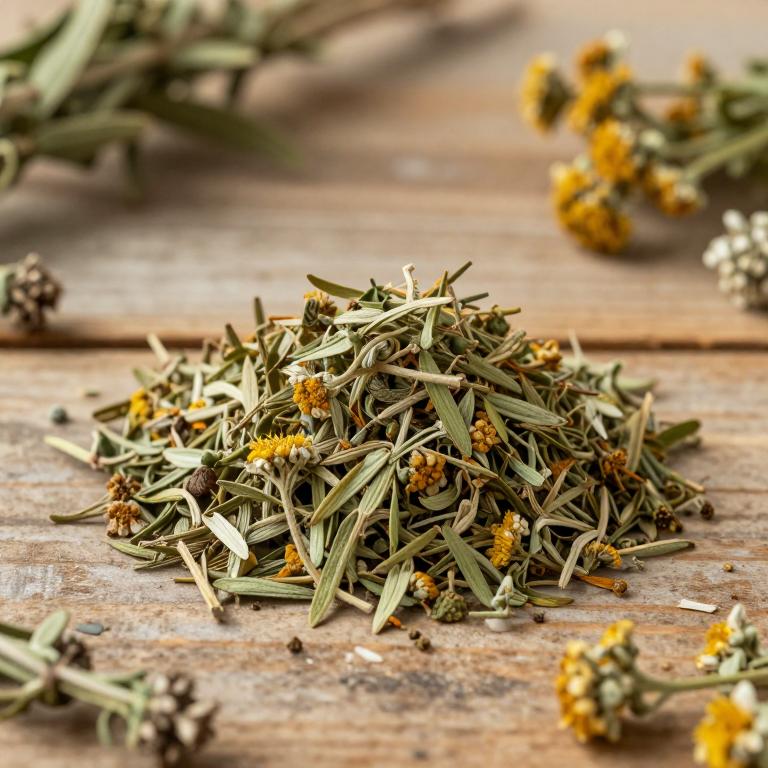
Artemisia santolina, scientifically known as Artemisia santolina, is a distinctive aromatic shrub celebrated in traditional medicine. Renowned for its fragrant, silver-green foliage, this plant offers potent therapeutic properties, including antimicrobial and anti-inflammatory benefits. It remains a vital component in herbal remedies used to support respiratory and digestive health.
- Family
- Asteraceae
- Native range
- Europe
- Parts used
- Flower
- Common names
- Not available
- Scientific synonyms
- Seriphidium Santolinum · Seriphidium Lobulifolium · 3 more
Names and Synonyms
Scientific Names
Accepted name
Artemisia santolinaSynonyms
- Seriphidium santolinum
- Seriphidium lobulifolium
- Artemisia lobulifolia
- Artemisia santolina f. simplicifolia
- Artemisia santolina var. deserta
Sources: Wikidata, Catalogue of Life
Taxonomical Classification
This plant belongs to the kingdom Plantae and is classified under the phylum Streptophyta within the class Equisetopsida. As a member of the subclass Magnoliidae and the order Asterales, it is further categorized into the family Asteraceae. Finally, it is identified under the specific genus Artemisia.
| Rank | Classification |
|---|---|
| Kingdom | Plantae |
| Phylum | Streptophyta |
| Class | Equisetopsida |
| Subclass | Magnoliidae |
| Order | Asterales |
| Family | Asteraceae |
| Genus | Artemisia |
Sources: The World Checklist of Vascular Plants (WCVP)
Distribution
This plant exhibits a widespread geographical distribution across several key regions of Eurasia. In Eastern Europe, its presence is noted within the territories of East European Russia. Moving into Central Asia, it can be found throughout Kazakhstan, Turkmenistan, and Uzbekistan. Additionally, the species extends its range into Western Asia, specifically inhabiting Iran. Collectively, these locations define the natural habitat where Artemisia santolina thrives.
| Region | Area |
|---|---|
| Eastern Europe | East European Russia |
| Central Asia | Kazakhstan |
| Central Asia | Turkmenistan |
| Central Asia | Uzbekistan |
| Western Asia | Iran |
| China | Xinjiang |
Sources: The World Checklist of Vascular Plants (WCVP)
Botanical Identification
Ecology
The ecology of Artemisia santolina is characterized by its specific adaptation to arid environments, typically thriving in desert habitats and sandy substrates. This species occupies a distinct altitudinal niche, with its presence recorded across varying elevations. While specific observations have been noted at lower reaches of approximately 400 m AMSL, the plant is primarily situated within a higher ecological zone, maintaining a minimum elevation of 1400 m AMSL and an average elevational range of approximately 900 m AMSL.
- Elevational range max:
- 400 m AMSL
- Elevational range mean:
- 900 m AMSL
- Elevational range min:
- 1400 m AMSL
- Habitat :
- desert, sand
Life history
The life history of Artemisia santoina is characterized by its status as a perennial plant, allowing it to persist through multiple growing seasons. As a perennial species, it establishes a stable presence in its habitat, typically regenerating through a combination of seed dispersal and vegetative spread. Its developmental cycle involves navigating seasonal shifts, where it maintains its structural integrity over several years, often developing woody bases or robust root systems that facilitate survival during dormant periods. This long-lived lifecycle enables the plant to occupy specific ecological niches consistently, contributing to its stability within its natural environment.
- Lifecycle :
- perennial
Morphology
The morphology of Artemisia santolina is characterized by a growth form consisting of a non-woody herb and a herbaceous structure. As a self-supporting plant, it does not require external support for its development. It typically maintains a relatively low stature, with a plant height ranging from a minimum of 0.25 m to a maximum of 0.45 m.
- Climber :
- self-supporting
- Growth form :
- herb
- Plant height max:
- 0.45 m
- Plant height min:
- 0.25 m
- Woodiness :
- non-woody
Physiology
The physiology of Artemisia santolina is characterized by distinct morphological adaptations in its foliage, which play a crucial role in its metabolic and photosynthetic efficiency. The leaf dimensions exhibit significant variability, reflecting the plant's ability to optimize surface area for gas exchange and light interception. Specifically, the leaf length follows a broad range, with a minimum measurement of 1 cm and a mean length of 4 cm, reaching a maximum of 7 cm. Complementing this longitudinal variation is the leaf width, which fluctuates between a minimum of 0.5 cm and a maximum of 1.5 cm, maintaining a mean width of 1 cm. These specific leaf metrics suggest a specialized growth pattern where the varying aspect ratios of the foliage likely assist in regulating transpiration and managing solar radiation absorption within its physiological framework.
- Leaf length max:
- 7 cm
- Leaf length mean:
- 4 cm
- Leaf length min:
- 1 cm
- Leaf width max:
- 1.5 cm
- Leaf width mean:
- 1 cm
- Leaf width min:
- 0.5 cm
Reproduction
The reproduction of Artemisia santolina is primarily characterized by its specific phenological cycle related to its flowering period. The reproductive phase of this medicinal plant is highly concentrated, with the flowering process both starting and concluding within the month of August. This narrow window of activity suggests a synchronized blooming period that is tightly regulated by seasonal transitions. While the timing of these reproductive stages can be variable depending on environmental conditions, the documented peak for its floral development remains centered in August, marking the critical period for pollen dispersal and subsequent seed production.
- Flowering time :
- Aug
Sources: Global Inventory of Floras and Traits (GIFT)
Plant Parts
Artemisia santolina has 1 reported plant parts identified across 1 scientific publications and several other databases that are studied for medicinal purposes. The most consistently reported plant part include flower.
| Plant part | Supporting sources | Consensus |
|---|---|---|
| Flower | 1 supporting sources | ★☆☆☆☆ |
Flower
- Pharmacognosy research
Chemicals
Artemisia santolina has 2 reported phytochemicals identified across 1 scientific publications and several other databases. The most consistently reported chemicals include Volatile oil, trans-Verbenol.
| Chemical | Supporting sources | Consensus |
|---|---|---|
| Volatile oil | 1 supporting sources | ★☆☆☆☆ |
| trans-Verbenol | 1 supporting sources | ★☆☆☆☆ |
Volatile oil
- Pharmacognosy research
trans-Verbenol
- Pharmacognosy research
Conditions
Artemisia santolina has 3 reported investigations on conditions identified across 1 scientific publications and several other databases. The most consistently reported conditions include cutaneous leishmaniasis, inflammation, leishmaniasis.
| Condition | Supporting sources | Consensus |
|---|---|---|
| Cutaneous leishmaniasis | 1 supporting sources | ★☆☆☆☆ |
| Inflammation | 1 supporting sources | ★☆☆☆☆ |
| Leishmaniasis | 1 supporting sources | ★☆☆☆☆ |
Cutaneous leishmaniasis
- Iranian journal of basic medical sciences
Inflammation
- Iranian journal of basic medical sciences
Leishmaniasis
- Iranian journal of basic medical sciences
Preparations
Artemisia santolina has 2 reported preparations identified across 1 scientific publications and several other databases. The most consistently reported preparations include Sesquiterpene fractions, volatile oil.
| Preparation | Supporting sources | Consensus |
|---|---|---|
| Sesquiterpene fractions | 1 supporting sources | ★☆☆☆☆ |
| Volatile oil | 1 supporting sources | ★☆☆☆☆ |
Sesquiterpene fractions
- Iranian journal of basic medical sciences
Volatile oil
- Pharmacognosy research