Artemisia rutifolia
Artemisia rutifolia · Accepted scientific name
Scientific literature: Very Sparse (1 studies) · ★☆☆☆☆
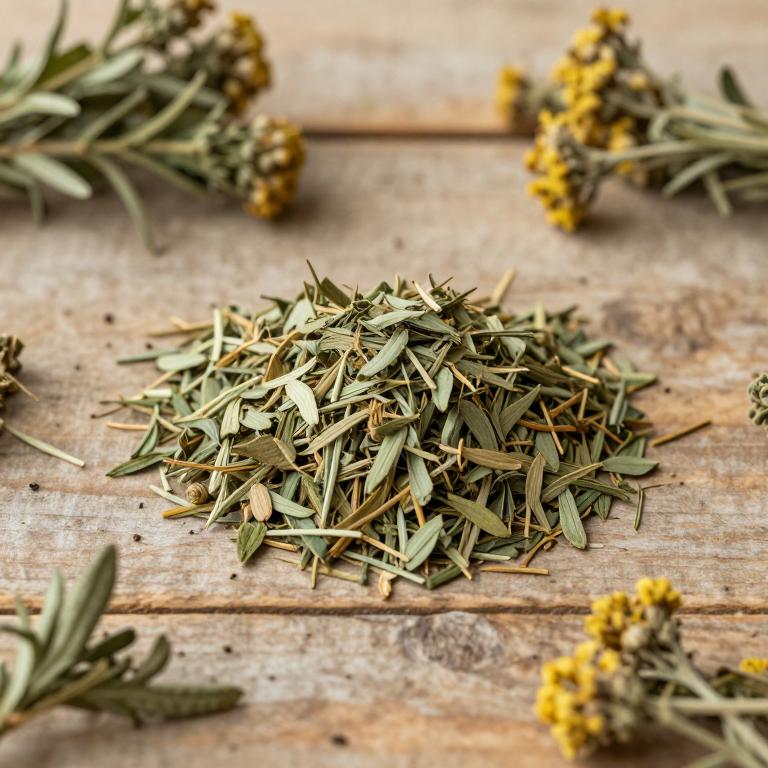
Artemisia rutifolia, scientifically known as Artemisia rutifolia, is a resilient perennial herb native to high-altitude regions. Often found in alpine meadows, this member of the Asteraceae family is recognized for its distinctive aromatic foliage. It holds significant interest in ethnobotany due to its diverse bioactive medicinal properties.
- Family
- Asteraceae
- Native range
- Asia-Temperate
- Parts used
- Not available
- Common names
- Not available
- Scientific synonyms
- Not available
Names and Synonyms
Scientific Names
Accepted name
Artemisia rutifoliaSources: Wikidata, Catalogue of Life
Taxonomical Classification
This plant, known scientifically as Artemisia rutifolia, belongs to the kingdom Plantae and the phylum Streptophyta. Within the class Equisetopsida and subclass Magnoliidae, it is classified under the order Asterales and the family Asteraceae. Finally, it is situated within the genus Artemisia.
| Rank | Classification |
|---|---|
| Kingdom | Plantae |
| Phylum | Streptophyta |
| Class | Equisetopsida |
| Subclass | Magnoliidae |
| Order | Asterales |
| Family | Asteraceae |
| Genus | Artemisia |
Sources: The World Checklist of Vascular Plants (WCVP)
Distribution
This plant exhibits a widespread presence across several key regions of Northern and Central Asia. In the vast territory of Siberia, it can be found growing in the Altay and Buryatiya regions. Its distribution further extends through the Krasnoyarsk area and into the southern reaches of Tuva. Beyond the Siberian borders, the species also occupies significant habitats within Central Asia. Specifically, the plant is documented to thrive within the country of Kazakhstan.
| Region | Area |
|---|---|
| Siberia | Altay |
| Siberia | Buryatiya |
| Siberia | Krasnoyarsk |
| Siberia | Tuva |
| Central Asia | Kazakhstan |
| Central Asia | Kirgizstan |
| Central Asia | Turkmenistan |
| Central Asia | Tadzhikistan |
| Central Asia | Uzbekistan |
| Western Asia | Afghanistan |
Sources: The World Checklist of Vascular Plants (WCVP)
Botanical Identification
Ecology
The ecology of Artemisia rutifolia is characterized by its preference for high-altitude environments, specifically occupying rugged terrains such as mountains, steppes, and stony places. This species demonstrates a significant vertical distribution, ranging from a minimum elevation of 2,100 m AMSL to a maximum peak of 5,300 m AMSL. With a mean elevational range centered around 4,450 m AMSL, the plant is highly adapted to the specialized climatic conditions found in alpine and subalpine zones, thriving in the exposed and often nutrient-poor substrates of rocky slopes and open steppe landscapes.
- Elevational range max:
- 5300 m AMSL
- Elevational range mean:
- 4450 m AMSL
- Elevational range min:
- 2100 m AMSL
- Habitat :
- mountains, steppe, stony places
Life history
The life history of Artemisia rutifolia is characterized by its status as a perennial species, allowing it to persist in its environment through multiple growing seasons. As a perennial, the plant establishes a robust presence, often relying on established root systems to survive periods of dormancy and regrowth. Its developmental cycle is geared toward long-term survival within its specific ecological niche, utilizing its perennial nature to endure varying seasonal shifts. This lifecycle ensures that the plant can maintain population stability by regenerating from its existing structures rather than relying solely on the success of a single seasonal seed set.
- Lifecycle :
- perennial
Morphology
The morphology of Artemisia rutifolia is characterized by its growth form as a non-woody herb, specifically categorized as a forb. The plant is self-supporting rather than being a climber or a liana, and it functions as an independent organism without parasitic tendencies. It is a terrestrial species, lacking aquatic or epiphytic habits. In terms of stature, it maintains a relatively low profile, with a plant height ranging from a minimum of 0.25 meters to a maximum of 0.8 meters.
- Aquatic :
- terrestrial
- Climber :
- self-supporting
- Epiphyte :
- terrestrial
- Growth form :
- herb
- Parasite :
- independent
- Plant height max:
- 0.8 m
- Plant height min:
- 0.25 m
- Woodiness :
- non-woody
Physiology
The physiology of Artemisia rutifolia is characterized by a C3 photosynthetic pathway, which dictates its metabolic processes and carbon fixation strategies. The morphological dimensions of its foliage are tightly regulated, with leaves exhibiting a mean length of 2 cm, ranging from a minimum of 1.5 cm to a maximum of 2.5 cm. Complementing these longitudinal measurements, the leaf width demonstrates significant variability, maintaining a mean width of 1.3 cm, with values fluctuating between a minimum of 0.8 cm and a maximum of 1.8 cm. These specific leaf dimensions and its C3 metabolic framework underpin the plant's structural and functional responses to its environment.
- Leaf length max:
- 2.5 cm
- Leaf length mean:
- 2 cm
- Leaf length min:
- 1.5 cm
- Leaf width max:
- 1.8 cm
- Leaf width mean:
- 1.3 cm
- Leaf width min:
- 0.8 cm
- Photosynthetic pathway :
- C3
Reproduction
The reproduction of Artemisia rutifolia is characterized by a specific seasonal flowering window and a specialized method of seed distribution. The flowering period for this species is concentrated in the month of August, with both the onset and the conclusion of the flowering stage occurring during this time. Following fertilization, the plant utilizes an anemochorous dispersal syndrome, relying on wind currents to transport its seeds to new locations. This anemochorous mechanism is consistent across its dispersal strategies, ensuring that the plant can effectively colonize suitable habitats through wind-driven movement.
- Dispersal syndrome :
- anemochorous
- Flowering time :
- Aug
Sources: Global Inventory of Floras and Traits (GIFT)
Chemicals
Artemisia rutifolia has 1 reported phytochemicals identified across 0 scientific publications and several other databases. The most consistently reported chemicals include Flavonoid.
| Chemical | Supporting sources | Consensus |
|---|---|---|
| Flavonoid | 1 supporting sources | ★☆☆☆☆ |
Flavonoid
- Plants (Basel, Switzerland)