Pontic wormwood
Artemisia pontica · Accepted scientific name
Scientific literature: Very Sparse (3 studies) · ★☆☆☆☆
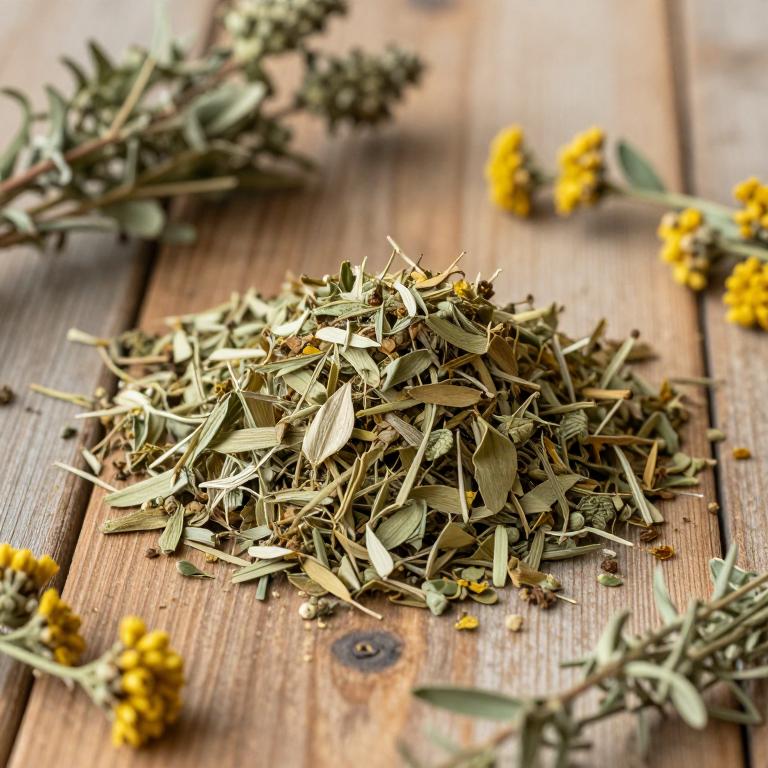
Pontic wormwood, scientifically known as Artemisia pontica, is a perennial aromatic herb native to the Mediterranean and Caspian regions. Renowned for its bitter essence and silver-green foliage, it has been utilized in traditional medicine for centuries to treat digestive ailments, skin conditions, and various inflammatory disorders through its potent compounds.
Names and Synonyms
Common Names
- Hungarian wormwood
- Roman wormwood
- green-ginger
- petite wormwood
Scientific Names
Accepted name
Artemisia ponticaSynonyms
- Artemisia pontica var. calyculata
- Artemisia pontica var. sericea
- Absinthium ponticum
- Artemisia pontica var. discolor
- Absinthium tenuifolium
- Artemisia altaica
- Artemisia balsamita
Regional and Traditional Names
German:
- Pontischer Beifuß
- Pontischer Wermut
- Römischer Wermut
- pontischer Beifuß
- Pontischer Wermut
French:
- armoise romaine
- Armoise Romaine
- armoise de la mer Noire
- armoise du Pont
- armoise pontique
- petite absinthe
- petite armoise
- plante de beauté
- absinthe romaine
Sources: Wikidata, Catalogue of Life
Taxonomical Classification
This plant, known as Artemisia pontica, belongs to the kingdom Plantae and the phylum Streptophyta. Within the class Equisetopsida and subclass Magnoliidae, it is classified under the order Asterales and the family Asteraceae. Ultimately, it is placed within the genus Artemisia.
| Rank | Classification |
|---|---|
| Kingdom | Plantae |
| Phylum | Streptophyta |
| Class | Equisetopsida |
| Subclass | Magnoliidae |
| Order | Asterales |
| Family | Asteraceae |
| Genus | Artemisia |
Sources: The World Checklist of Vascular Plants (WCVP)
Distribution
This plant exhibits a wide-ranging presence across several different regions of the continent. In Northern Europe, its distribution includes Denmark, Great Britain, and Norway. Moving toward the center of the continent, it can also be found within Middle Europe. Specifically, the species is documented in both Austria and Belgium. Consequently, its geographical reach spans from the northern coasts to the heart of Europe.
| Region | Area |
|---|---|
| Northern Europe | Denmark |
| Northern Europe | Great Britain |
| Northern Europe | Norway |
| Middle Europe | Austria |
| Middle Europe | Belgium |
| Middle Europe | Czechia-Slovakia |
| Middle Europe | Germany |
| Middle Europe | Hungary |
| Middle Europe | Poland |
| Middle Europe | Switzerland |
Sources: The World Checklist of Vascular Plants (WCVP)
Botanical Identification
Ecology
The ecology of Artemisia pontica is characterized by its remarkable adaptability to diverse and often challenging landscapes. This species demonstrates a broad ecological amplitude, thriving across a variety of environments including forests, open meadows, and riparian zones near rivers. It is frequently found colonizing shrubberies and expansive steppe ecosystems, where it can compete effectively with other perennial vegetation. Furthermore, Artemisia pontica exhibits significant tolerance to soil chemistry, as evidenced by its ability to inhabit saline places, allowing it to persist in mineral-rich or salt-affected terrains where many other plant species might struggle to survive.
- Habitat :
- forest, meadows, rivers, saline places, shrubberies, steppe
Life history
The life history of Artemisia pontica is characterized by its existence as a perennial species, allowing it to persist across multiple growing seasons. It functions biologically as a hemicryptophyte, a life form where the perennating buds are located at the soil surface, protected by leaf litter or minimal soil cover. This plant exhibits a deciduous nature, shedding its foliage as it enters dormancy to survive unfavorable environmental conditions. Through its perennial lifecycle and hemicryptophytic growth habit, it maintains a consistent presence in its ecological niche, cycling through periods of vegetative growth and seasonal senescence.
- Deciduousness :
- deciduous
- Life form :
- hemicryptophyte
- Lifecycle :
- perennial
Morphology
The morphology of Artemisia pontica is characterized by its growth form as a non-woody subshrub or herb. As a self-supporting plant, it does not function as a climber or a liana, and it operates as an independent organism rather than a parasite. It is a terrestrial species, lacking any aquatic or epiphytic tendencies. In terms of stature, the plant typically reaches a height ranging from a minimum of 0.4 m to a maximum of 1 m, with a mean height of approximately 0.6 m.
- Aquatic :
- terrestrial
- Climber :
- self-supporting
- Epiphyte :
- terrestrial
- Growth form :
- herb
- Growth form :
- subshrub
- Parasite :
- independent
- Plant height max:
- 1 m
- Plant height mean:
- 0.6 m
- Plant height min:
- 0.4 m
- Woodiness :
- non-woody
Physiology
The physiology of Artemisia pontica is characterized by a C3 photosynthetic pathway, which dictates its carbon fixation processes and metabolic efficiency. The plant's vegetative morphology is defined by specific leaf dimensions that support its physiological functions, with leaf lengths typically ranging from a minimum of 2 cm to a mean of 3.5 cm, reaching a maximum of 5 cm. Complementing this, the leaf width exhibits significant variation, with a minimum width of 1.5 cm, a mean width of 2.25 cm, and a maximum width of 3 cm. These structural parameters of the foliage facilitate the gas exchange and light interception necessary for its C3 metabolic operations.
- Leaf length max:
- 5 cm
- Leaf length mean:
- 3.5 cm
- Leaf length min:
- 2 cm
- Leaf width max:
- 3 cm
- Leaf width mean:
- 2.25 cm
- Leaf width min:
- 1.5 cm
- Photosynthetic pathway :
- C3
Reproduction
The reproduction of Artemisia pontica is characterized by a specific seasonal cycle and biological mechanisms designed for successful propagation. The flowering period is relatively concentrated, with both the onset and the conclusion of flowering occurring in August. During this stage, the plant utilizes a biotic pollination syndrome, specifically relying on insects to facilitate the transfer of pollen. Furthermore, the species is capable of self-fertilization, ensuring reproductive success even in the absence of external pollinators. Once fertilization is complete, the dispersal of seeds follows a zoochorous syndrome, meaning the plant relies on animals for the movement of its progeny through various zoochorous mechanisms.
- Dispersal syndrome :
- zoochorous
- Flowering time :
- Aug
- Pollination syndrome :
- insect
- Pollination syndrome :
- biotic
- Self fertilization :
- present
Sources: Global Inventory of Floras and Traits (GIFT)
Activities
Artemisia pontica has 2 reported activities identified across 0 scientific publications and several other databases. The most consistently reported activities include Antibacterial, Antioxidant.
| Activity | Supporting sources | Consensus |
|---|---|---|
| Antibacterial | 1 supporting sources | ★☆☆☆☆ |
| Antioxidant | 1 supporting sources | ★☆☆☆☆ |
Antibacterial
- Antioxidants (Basel, Switzerland)
Antioxidant
- Antioxidants (Basel, Switzerland)
Conditions
Artemisia pontica has 1 reported investigations on conditions identified across 0 scientific publications and several other databases. The most consistently reported conditions include antioxidant.
| Condition | Supporting sources | Consensus |
|---|---|---|
| Antioxidant | 1 supporting sources | ★☆☆☆☆ |
Antioxidant
- Antioxidants (Basel, Switzerland)
Preparations
Artemisia pontica has 1 reported preparations identified across 0 scientific publications and several other databases. The most consistently reported preparations include extracts.
| Preparation | Supporting sources | Consensus |
|---|---|---|
| Extracts | 1 supporting sources | ★☆☆☆☆ |
Extracts
- Journal of applied microbiology