white wormwood
Artemisia herba-alba · Accepted scientific name
Scientific literature: Very Extensive (559 studies) · ★★★★★
White wormwood, scientifically known as Artemisia herba-alba, is a resilient perennial shrub native to North Africa and the Middle East. Renowned for its aromatic foliage, this medicinal plant is deeply embedded in traditional folk medicine, frequently utilized for its potent antioxidant, antimicrobial, and anti-inflammatory properties to treat various ailments.
- Family
- Asteraceae
- Native range
- Europe
- Parts used
- Flower · Leaf
- Common names
- White Wormwood · Pyrenean Wormwood
- Scientific synonyms
- Seriphidium Herba-Alba
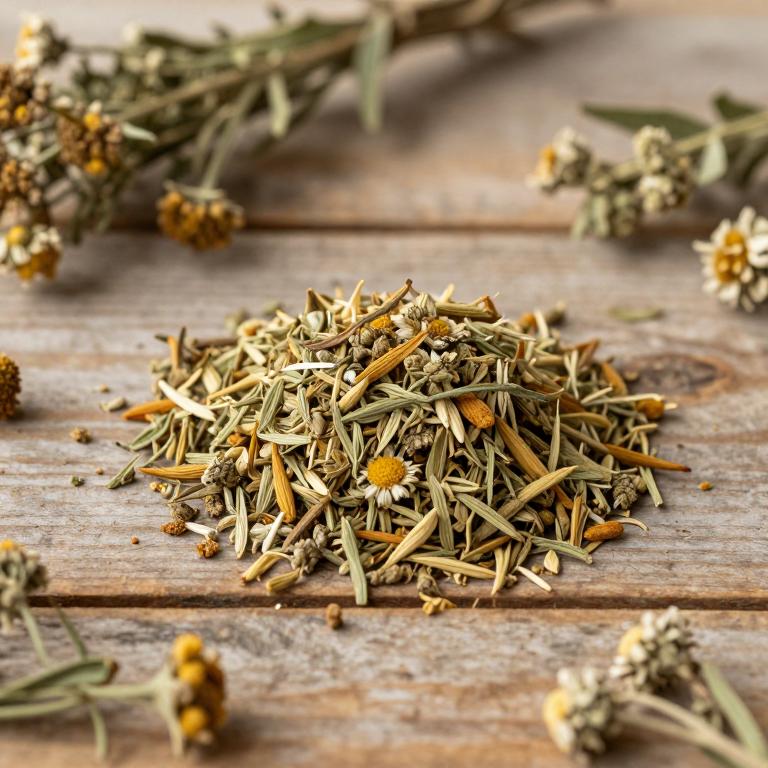
Names and Synonyms
Common Names
- white wormwood
- Pyrenean Wormwood
Scientific Names
Accepted name
Artemisia herba-albaSynonyms
- Seriphidium herba-alba
Regional and Traditional Names
Spanish:
- Artemisia valentina
- Seriphidium herba-alba
- Artemisia aragonensis
- Artemisia aethiopica
- Artemisia lippii
- Artemisia ontina
- Ontina
French:
- Armoise herbe blanche
- Armoise blanche
- armoise herbe blanche
- Armoise Herbe-blanche
Sources: Wikidata, Catalogue of Life
Taxonomical Classification
This plant belongs to the kingdom Plantae and the phylum Streptophyta, falling under the class Equisetopsida and subclass Magnoliidae. Within the order Asterales, it is classified under the family Asteraceae. Finally, it is identified by the genus Artemisia, specifically as the species Artemisia herba-alba.
| Rank | Classification |
|---|---|
| Kingdom | Plantae |
| Phylum | Streptophyta |
| Class | Equisetopsida |
| Subclass | Magnoliidae |
| Order | Asterales |
| Family | Asteraceae |
| Genus | Artemisia |
Sources: The World Checklist of Vascular Plants (WCVP)
Distribution
This plant exhibits a diverse geographical distribution spanning across several distinct regions. In Northern Europe, its presence can be observed within the borders of Great Britain. Moving toward Southwestern Europe, the species is also found growing in Spain. The plant has a significant reach in Northern Africa, where it inhabits Algeria. Finally, its range extends across the North African landscape to include Morocco and Tunisia.
| Region | Area |
|---|---|
| Northern Europe | Great Britain |
| Southwestern Europe | Spain |
| Northern Africa | Algeria |
| Northern Africa | Morocco |
| Northern Africa | Tunisia |
| Macaronesia | Canary Is. |
Sources: The World Checklist of Vascular Plants (WCVP)
Botanical Identification
Life history
The life history of Artemisia herba-alba is characterized by its status as a perennial plant, allowing it to persist through multiple growing seasons within its native habitats. In terms of its structural growth strategy, the species is classified as a chamaephyte, a life form where the majority of the photosynthetic organs are located close to the soil surface, often protected by seasonal litter or the ground itself. This chamaephyte designation is consistent across its morphological categorization, defining its survival mechanism and its ability to endure environmental stressors by maintaining its vital structures near the earth's surface.
- Life form :
- chamaephyte
- Lifecycle :
- perennial
Morphology
The morphology of Artemisia herbacea-alba is characterized by its growth form as a woody subshrub, typically exhibiting a self-supporting structure. As a terrestrial species, it does not function as an aquatic or semiaquatic plant, nor does it act as an epiphyte, remaining firmly rooted in soil environments. It is a non-climbing, self-supporting organism rather than a liana or vine, and it functions as an independent plant without parasitic tendencies. The plant's physical habit is defined by its woody nature, which supports its development as a perennial subshrub.
- Aquatic :
- terrestrial
- Climber :
- self-supporting
- Epiphyte :
- terrestrial
- Growth form :
- shrub
- Growth form :
- subshrub
- Parasite :
- independent
- Woodiness :
- woody
Physiology
The physiology of Artemisia herba-alba is characterized by specialized adaptations to arid and semi-arid environments, primarily driven by its C3 photosynthetic pathway. As a C3 plant, its carbon fixation process occurs directly through the Calvin cycle within the mesophyll cells, which necessitates efficient water management to prevent photorespiration and excessive transpiration under high thermal stress. To mitigate the physiological challenges of drought, the plant exhibits significant xerophytic adaptations, including the production of volatile secondary metabolites and essential oils stored in glandular trichomes. These secretions serve a dual physiological role: they reduce water loss by creating a boundary layer of humidity around the leaf surface and act as chemical deterrents against herbivory. Furthermore, the plant maintains osmotic adjustment capabilities, allowing it to regulate turgor pressure and sustain metabolic functions even when soil moisture is limited.
- Photosynthetic pathway :
- C3
Reproduction
The reproduction of Artemisia herba-alba is characterized by the production of specialized reproductive structures that facilitate the dispersal of its progeny. The plant produces fruit that is notably dry in texture, rather than fleshy, ensuring that the seeds are released in a manner suitable for its environmental conditions. The seeds themselves are quite minute, exhibiting a mean seed mass of approximately 0.000215 g. Within the population, the seed mass shows slight variations, ranging from a minimum value of 0.0002 g to a maximum value of 0.00023 g, a range that reflects the specific energetic investment per individual unit of dispersal.
- Fruit dryness :
- dry
- Seed mass max:
- 0.00023 g
- Seed mass mean:
- 0.000215 g
- Seed mass min:
- 2e-04 g
Sources: Global Inventory of Floras and Traits (GIFT)
Plant Parts
Artemisia herba-alba has 2 reported plant parts identified across 2 scientific publications and several other databases that are studied for medicinal purposes. The most consistently reported plant part include flower, leaf.
| Plant part | Supporting sources | Consensus |
|---|---|---|
| Flower | 1 supporting sources | ★☆☆☆☆ |
| Leaf | 1 supporting sources | ★☆☆☆☆ |
Flower
- Journal of parasitology research
Leaf
- Chemistry & biodiversity
Chemicals
Artemisia herba-alba has 136 reported phytochemicals identified across 2 scientific publications and several other databases. The most consistently reported chemicals include camphor, Isoschaftoside, Santolina alcohol, Schaftoside, 1,8-Cineole.
| Chemical | Supporting sources | Consensus |
|---|---|---|
| camphor | 6 supporting sources | ★★★☆☆ |
| Isoschaftoside | 3 supporting sources | ★★☆☆☆ |
| Santolina alcohol | 3 supporting sources | ★★☆☆☆ |
| Schaftoside | 3 supporting sources | ★★☆☆☆ |
| 1,8-Cineole | 2 supporting sources | ★☆☆☆☆ |
| 4,5-Di-O-caffeoylquinic acid | 2 supporting sources | ★☆☆☆☆ |
| Eucalyptol | 2 supporting sources | ★☆☆☆☆ |
| Flavonoids | 2 supporting sources | ★☆☆☆☆ |
| Hispidulin | 2 supporting sources | ★☆☆☆☆ |
| Isovitexin | 2 supporting sources | ★☆☆☆☆ |
camphor
- Dr. Duke
- Experimental & applied acarology
- Journal of toxicology and environmental health. Part A
- Phytochemistry
- Frontiers in chemistry
View 1 additional sources
- Journal of ethnopharmacology
Isoschaftoside
- Dr. Duke
- Food research international (Ottawa, Ont.)
- Journal of toxicology and environmental health. Part A
Santolina alcohol
- Dr. Duke
- Journal of pharmaceutical sciences
- PloS one
Schaftoside
- Dr. Duke
- Molecules (Basel, Switzerland)
- Journal of toxicology and environmental health. Part A
1,8-Cineole
- Dr. Duke
- Journal of ethnopharmacology
4,5-Di-O-caffeoylquinic acid
- Molecules (Basel, Switzerland)
- Journal of toxicology and environmental health. Part A
Eucalyptol
- Journal of toxicology and environmental health. Part A
- Frontiers in chemistry
Flavonoids
- Preparative biochemistry & biotechnology
- Planta medica
Hispidulin
- Journal of ethnopharmacology
- Journal of toxicology and environmental health. Part A
Isovitexin
- Dr. Duke
- Journal of toxicology and environmental health. Part A
Activities
Artemisia herba-alba has 327 reported activities identified across 2 scientific publications and several other databases. The most consistently reported activities include Antioxidant, Antimicrobial, Antibacterial, Analgesic, Anthelmintic.
| Activity | Supporting sources | Consensus |
|---|---|---|
| Antioxidant | 8 supporting sources | ★★★★☆ |
| Antimicrobial | 6 supporting sources | ★★★☆☆ |
| Antibacterial | 3 supporting sources | ★★☆☆☆ |
| Analgesic | 2 supporting sources | ★☆☆☆☆ |
| Anthelmintic | 2 supporting sources | ★☆☆☆☆ |
| Antidiabetic | 2 supporting sources | ★☆☆☆☆ |
| Antifungal | 2 supporting sources | ★☆☆☆☆ |
| Antiplaque | 2 supporting sources | ★☆☆☆☆ |
| Antiseptic | 2 supporting sources | ★☆☆☆☆ |
| Cytotoxic | 2 supporting sources | ★☆☆☆☆ |
Antioxidant
- Dr. Duke
- Molecules (Basel, Switzerland)
- Chemistry & biodiversity
- Preparative biochemistry & biotechnology
- Plants (Basel, Switzerland)
View 3 additional sources
- Natural product research
- Food research international (Ottawa, Ont.)
- Frontiers in chemistry
Antimicrobial
- Plants (Basel, Switzerland)
- Food research international (Ottawa, Ont.)
- RSC advances
- Saudi pharmaceutical journal : SPJ : the official publication of the Saudi Pharmaceutical Society
- Molecules (Basel, Switzerland)
View 1 additional sources
- Natural product research
Antibacterial
- Dr. Duke
- Foods (Basel, Switzerland)
- Frontiers in chemistry
Analgesic
- Dr. Duke
- Molecules (Basel, Switzerland)
Anthelmintic
- Dr. Duke
- Journal of parasitology research
Antidiabetic
- Dr. Duke
- Planta medica
Antifungal
- Frontiers in chemistry
- Journal of ethnopharmacology
Antiplaque
- Dr. Duke
- Saudi pharmaceutical journal : SPJ : the official publication of the Saudi Pharmaceutical Society
Antiseptic
- Dr. Duke
- Journal of ethnopharmacology
Cytotoxic
- Molecules (Basel, Switzerland)
- Food research international (Ottawa, Ont.)
Conditions
Artemisia herba-alba has 28 reported investigations on conditions identified across 2 scientific publications and several other databases. The most consistently reported conditions include cancer, COVID-19, diabetes mellitus, inflammation, Babesia.
| Condition | Supporting sources | Consensus |
|---|---|---|
| Cancer | 3 supporting sources | ★★☆☆☆ |
| Covid-19 | 2 supporting sources | ★☆☆☆☆ |
| Diabetes mellitus | 2 supporting sources | ★☆☆☆☆ |
| Inflammation | 2 supporting sources | ★☆☆☆☆ |
| Babesia | 1 supporting sources | ★☆☆☆☆ |
| Babesia bovis | 1 supporting sources | ★☆☆☆☆ |
| Enterobacter cloacae | 1 supporting sources | ★☆☆☆☆ |
| Pain | 1 supporting sources | ★☆☆☆☆ |
| Anemia | 1 supporting sources | ★☆☆☆☆ |
| Breast cancer | 1 supporting sources | ★☆☆☆☆ |
Cancer
- Saudi pharmaceutical journal : SPJ : the official publication of the Saudi Pharmaceutical Society
- Journal of ethnopharmacology
- Frontiers in pharmacology
Covid-19
- Molecules (Basel, Switzerland)
- Evidence-based complementary and alternative medicine : eCAM
Diabetes mellitus
- Clinical and experimental pharmacology & physiology
- Journal of ethnopharmacology
Inflammation
- Food research international (Ottawa, Ont.)
- Molecules (Basel, Switzerland)
Babesia
- Journal of advanced veterinary and animal research
Babesia bovis
- Journal of advanced veterinary and animal research
Enterobacter cloacae
- Frontiers in chemistry
Pain
- Healthcare (Basel, Switzerland)
Anemia
- Healthcare (Basel, Switzerland)
Breast cancer
- Food research international (Ottawa, Ont.)
Preparations
Artemisia herba-alba has 18 reported preparations identified across 2 scientific publications and several other databases. The most consistently reported preparations include essential oils, Essential Oils, An ethanolic extract, Ethyl acetate extracts, Methanolic extracts.
| Preparation | Supporting sources | Consensus |
|---|---|---|
| Essential oils | 5 supporting sources | ★★★☆☆ |
| Essential oils | 2 supporting sources | ★☆☆☆☆ |
| An ethanolic extract | 1 supporting sources | ★☆☆☆☆ |
| Ethyl acetate extracts | 1 supporting sources | ★☆☆☆☆ |
| Methanolic extracts | 1 supporting sources | ★☆☆☆☆ |
| Aerial parts organic extract | 1 supporting sources | ★☆☆☆☆ |
| Aqueous extracts | 1 supporting sources | ★☆☆☆☆ |
| Aqueous leaf extract | 1 supporting sources | ★☆☆☆☆ |
| Crude methanolic extracts | 1 supporting sources | ★☆☆☆☆ |
| Crude organic extract | 1 supporting sources | ★☆☆☆☆ |
Essential oils
- Natural product communications
- Evidence-based complementary and alternative medicine : eCAM
- Foods (Basel, Switzerland)
- International journal of environmental health research
- Plants (Basel, Switzerland)
Essential oils
- Evidence-based complementary and alternative medicine : eCAM
- Molecules (Basel, Switzerland)
An ethanolic extract
- Journal of ethnopharmacology
Ethyl acetate extracts
- Journal of ethnopharmacology
Methanolic extracts
- Pakistan journal of biological sciences : PJBS
Aerial parts organic extract
- Natural product research
Aqueous extracts
- Natural product research
Aqueous leaf extract
- Chemistry & biodiversity
Crude methanolic extracts
- Journal of parasitology research
Crude organic extract
- Saudi pharmaceutical journal : SPJ : the official publication of the Saudi Pharmaceutical Society