Douglas' sagewort
Artemisia douglasiana · Accepted scientific name
Scientific literature: Very Sparse (14 studies) · ★☆☆☆☆
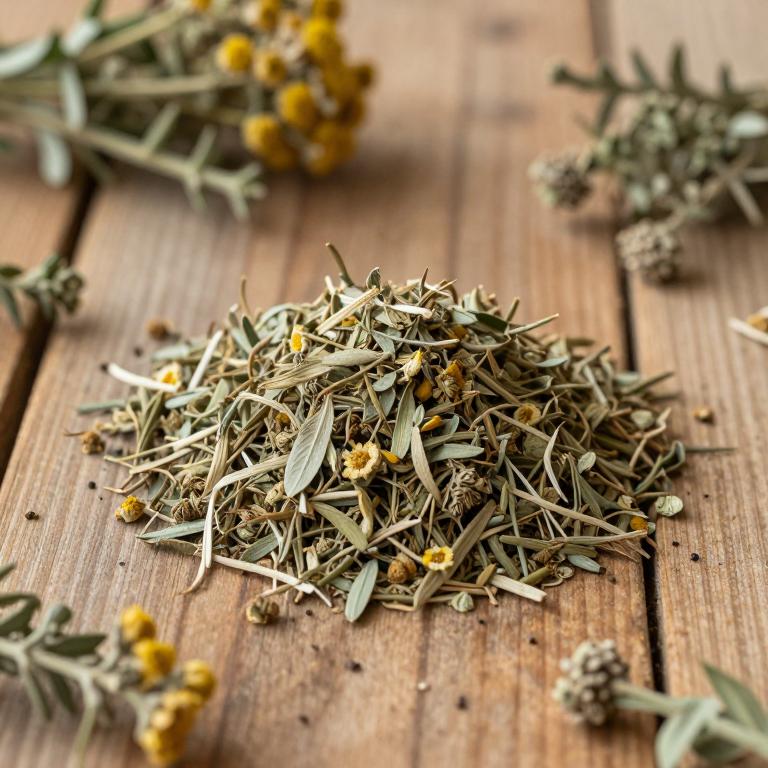
Douglas' sagewort, scientifically known as Artemisia douglasiana, is a versatile perennial shrub native to the coastal regions of western North America. Renowned for its aromatic, silver-green foliage, this plant has long been utilized in traditional herbal medicine for its antimicrobial properties and its ability to support digestive health.
Names and Synonyms
Common Names
- Douglas' sagewort
- Douglas' wormwood
- western mugwort
- California mugwort
- Douglas's sagewort
- dream plant
- mugwort
Scientific Names
Accepted name
Artemisia douglasianaSynonyms
- Artemisia caudata var. douglasiana
- Artemisia commutata var. douglasiana
- Artemisia ludoviciana var. douglasiana
- Artemisia vulgaris subsp. douglasiana
- Artemisia desertorum var. douglasiana
- Artemisia campestris var. douglasiana
Regional and Traditional Names
Spanish:
- Artemisia campestris var. douglasiana
- Artemisia heterophylla
- Artemisia vulgaris var. douglasiana
- Artemisia vulgaris subsp. heterophylla
German:
- Amerikanisches Moxakraut
French:
- armoise de Douglas
Sources: Wikidata, Catalogue of Life
Taxonomical Classification
This plant belongs to the kingdom Plantae and the phylum Streptophyta, falling under the class Equisetopsida and subclass Magnoliidae. Within the order Asterales, it is a member of the Asteraceae family. Specifically, it is classified under the genus Artemisia.
| Rank | Classification |
|---|---|
| Kingdom | Plantae |
| Phylum | Streptophyta |
| Class | Equisetopsida |
| Subclass | Magnoliidae |
| Order | Asterales |
| Family | Asteraceae |
| Genus | Artemisia |
Sources: The World Checklist of Vascular Plants (WCVP)
Distribution
This plant is widely distributed across several distinct regions of Western North America. In the Northwestern United States, its range extends through the states of Oregon and Washington. Moving toward the Southwestern United States, it is commonly found throughout California and Nevada. The distribution also reaches southward into the international territory of Mexico. Specifically, within that country, the species is located in the Northwest region of Mexico.
| Region | Area |
|---|---|
| Northwestern U.S.A. | Oregon |
| Northwestern U.S.A. | Washington |
| Southwestern U.S.A. | California |
| Southwestern U.S.A. | Nevada |
| Mexico | Mexico Northwest |
Sources: The World Checklist of Vascular Plants (WCVP)
Botanical Identification
Ecology
The ecology of Artemisia douglasiana is characterized by its adaptability to diverse Mediterranean-type ecosystems, where it frequently populates coastal sage scrub, chaparral, and open woodland habitats. This species thrives in well-drained soils and is often found in transitional zones between scrubland and more densely forested areas. Its vertical distribution is specifically constrained by topographic gradients, as it typically occupies a mid-elevation niche. Specifically, the plant is found within an elevational range spanning from a minimum of 500 m AMSL to a maximum of 1000 m AMSL. Within this altitudinal belt, the species plays a vital role in local biodiversity, providing structural complexity to its habitat and responding to seasonal moisture shifts characteristic of its native range.
- Elevational range max:
- 1000 m AMSL
- Elevational range min:
- 500 m AMSL
Life history
The life history of Artemisia douglasiana is characterized by its status as a perennial species, allowing it to establish a long-term presence within its native ecosystems. Throughout its life cycle, the plant focuses on building a robust root system that enables it to persist through varying seasonal conditions and compete effectively for resources. As a perennial, it does not rely on a single reproductive event to ensure survival but instead undergoes repeated cycles of vegetative growth and flowering over multiple years. This longevity is supported by its ability to spread and colonize habitats, often utilizing both seed production and vegetative methods to maintain population stability. While its life cycle is fundamentally perennial, it exhibits a degree of resilience that allows it to adapt to the shifting environmental pressures of its Mediterranean-climate habitats.
- Lifecycle :
- perennial
Morphology
The morphology of Artemisia douglasiana is characterized by a growth form as a non-woody herb and forb, typically manifesting as a self-supporting plant. It is a terrestrial species, existing as an independent organism rather than acting as a parasite or an epiphyte. In terms of its structural habit, the plant is self-supporting and does not exhibit climbing behaviors such as liana or vine growth. Its physical composition is defined by its non-woody nature, lacking the significant lignification found in woody shrubs or trees.
- Aquatic :
- terrestrial
- Climber :
- self-supporting
- Epiphyte :
- terrestrial
- Growth form :
- herb
- Growth form :
- forb
- Parasite :
- independent
- Woodiness :
- non-woody
Reproduction
Reproduction in Artemisia douglasiana is primarily driven by the production of small, lightweight seeds that facilitate dispersal across its natural habitat. The seed characteristics exhibit significant variability, with individual seed masses ranging from a minimum of 0.000121 g to a maximum of 0.00055 g. On average, the seed mass for this species is approximately 0.000280333 g, a trait that supports the plant's ability to colonize new areas through wind or environmental movement.
- Seed mass max:
- 0.00055 g
- Seed mass mean:
- 0.000280333 g
- Seed mass min:
- 0.000121 g
Sources: Global Inventory of Floras and Traits (GIFT)
Chemicals
Artemisia douglasiana has 1 reported phytochemicals identified across 0 scientific publications and several other databases. The most consistently reported chemicals include Dehydroleucodine.
| Chemical | Supporting sources | Consensus |
|---|---|---|
| Dehydroleucodine | 4 supporting sources | ★★☆☆☆ |
Dehydroleucodine
- Journal of natural products
- Microscopia electronica y biologia celular : organo oficial de las Sociedades Latinoamericana de Microscopia Electronica e Iberoamericana de Biologia Celular
- PloS one
- Mini reviews in medicinal chemistry
Conditions
Artemisia douglasiana has 3 reported investigations on conditions identified across 0 scientific publications and several other databases. The most consistently reported conditions include peptic ulcer, cancer, oxidative damage.
| Condition | Supporting sources | Consensus |
|---|---|---|
| Peptic ulcer | 2 supporting sources | ★☆☆☆☆ |
| Cancer | 1 supporting sources | ★☆☆☆☆ |
| Oxidative damage | 1 supporting sources | ★☆☆☆☆ |
Peptic ulcer
- Journal of natural products
- Microscopia electronica y biologia celular : organo oficial de las Sociedades Latinoamericana de Microscopia Electronica e Iberoamericana de Biologia Celular
Cancer
- PloS one
Oxidative damage
- Mini reviews in medicinal chemistry
Preparations
Artemisia douglasiana has 3 reported preparations identified across 0 scientific publications and several other databases. The most consistently reported preparations include aerial part, aerial parts, essential oils.
| Preparation | Supporting sources | Consensus |
|---|---|---|
| Aerial part | 1 supporting sources | ★☆☆☆☆ |
| Aerial parts | 1 supporting sources | ★☆☆☆☆ |
| Essential oils | 1 supporting sources | ★☆☆☆☆ |
Aerial part
- Journal of natural products
Aerial parts
- Journal of natural products
Essential oils
- Phytotherapy research : PTR