Artemisia ciniformis
Artemisia ciniformis · Accepted scientific name
Scientific literature: Very Sparse (9 studies) · ★☆☆☆☆
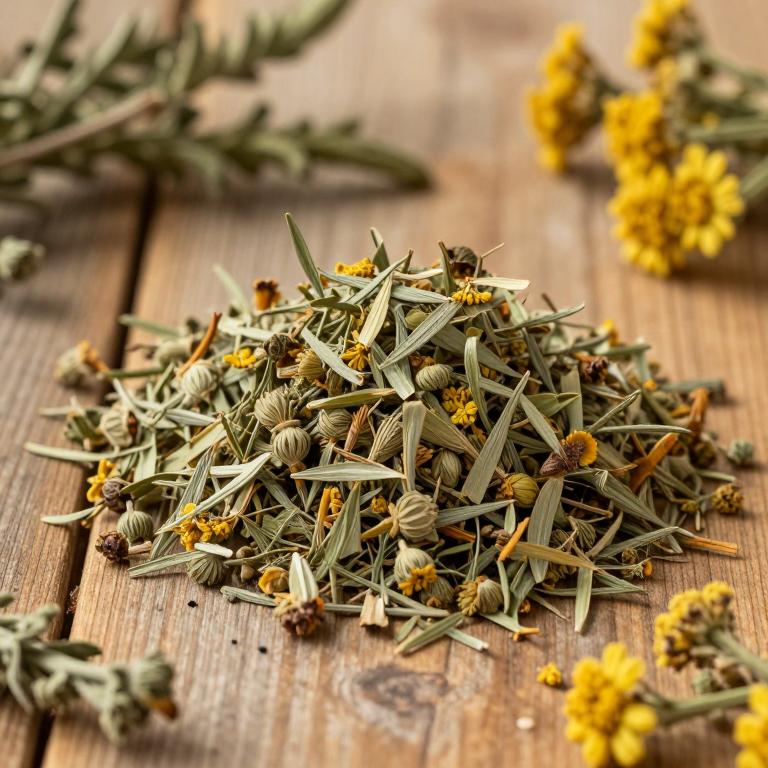
Artemisia ciniformis, scientifically known as Artemisia ciniformis, is a versatile medicinal herb prized in traditional Eastern medicine. Characterized by its aromatic foliage, this plant is widely utilized for its anti-inflammatory, antimicrobial, and analgesic properties, offering therapeutic benefits in treating various ailments ranging from skin conditions to digestive issues.
- Family
- Asteraceae
- Native range
- Asia-Temperate
- Parts used
- Not available
- Common names
- Not available
- Scientific synonyms
- Seriphidium Ciniforme
Names and Synonyms
Scientific Names
Accepted name
Artemisia ciniformisSynonyms
- Seriphidium ciniforme
Sources: Wikidata
Taxonomical Classification
This plant belongs to the kingdom Plantae and the phylum Streptophyta, falling under the class Equisetopsida and subclass Magnoliidae. Within the order Asterales, it is classified under the family Asteraceae. Finally, it is identified by its genus, Artemisia.
| Rank | Classification |
|---|---|
| Kingdom | Plantae |
| Phylum | Streptophyta |
| Class | Equisetopsida |
| Subclass | Magnoliidae |
| Order | Asterales |
| Family | Asteraceae |
| Genus | Artemisia |
Sources: The World Checklist of Vascular Plants (WCVP)
Distribution
This plant, known scientifically as Artemisia ciniformis, exhibits a specific distribution across several regions of Asia. Its presence can be found within the landscapes of Central Asia, specifically in Turkmenistan. Furthermore, the species extends into the territory of Western Asia. Within this western region, it is documented to grow in Afghanistan. Finally, its geographical range also includes the country of Iran.
| Region | Area |
|---|---|
| Central Asia | Turkmenistan |
| Western Asia | Afghanistan |
| Western Asia | Iran |
Sources: The World Checklist of Vascular Plants (WCVP)
Botanical Identification
Ecology
The ecology of Artemisia ciniformis is characterized by its preference for rugged, high-altitude terrains, specifically thriving within the hilly and mountainous regions. This species is commonly found colonizing stony places, where it adapts to the unique microclimates provided by rocky substrates. Its distribution is strictly defined by a specific altitudinal gradient, with an elevational range spanning from a minimum of 700 m AMSL to a maximum of 1500 m AMSL.
- Elevational range max:
- 1500 m AMSL
- Elevational range min:
- 700 m AMSL
- Habitat :
- hills, mountains, stony places
Life history
The life history of Artemisia ciniformis is characterized by its status as a perennial plant, allowing it to persist through multiple growing seasons. In terms of its structural growth habit and survival strategy, it is classified as a chamaephyte, meaning its perennating buds are located close to the soil surface, protected by a layer of leaf litter or ground cover. This life form, categorized under both the chamaephyte and chamamephyte classifications, enables the species to endure varying environmental conditions while maintaining its ability to regenerate annually from its protected buds.
- Life form :
- chamaephyte
- Lifecycle :
- perennial
Morphology
The morphology of Artemisia ciniformis is characterized by a woody, subshrub growth form that typically functions as a terrestrial plant. It maintains a relatively low stature, with a plant height ranging from a minimum of 0.3 m to a maximum of 0.45 m. As an independent species, it does not exhibit parasitic behavior and grows directly in the soil rather than as an epiphyte.
- Epiphyte :
- terrestrial
- Growth form :
- shrub
- Growth form :
- subshrub
- Parasite :
- independent
- Plant height max:
- 0.45 m
- Plant height min:
- 0.3 m
- Woodiness :
- woody
Reproduction
The reproduction of Artemisia ciniformis is characterized by a specific seasonal flowering cycle that occurs during the late summer months. The flowering period begins in August and continues through September, marking the peak window for its reproductive activities. This temporal pattern ensures that the plant's reproductive processes are synchronized with the environmental conditions of late summer, facilitating its life cycle within its natural habitat.
- Flowering time :
- Aug
- Flowering time :
- Sep
Sources: Global Inventory of Floras and Traits (GIFT)
Chemicals
Artemisia ciniformis has 2 reported phytochemicals identified across 0 scientific publications and several other databases. The most consistently reported chemicals include Steroids, Terpenoids.
| Chemical | Supporting sources | Consensus |
|---|---|---|
| Steroids | 1 supporting sources | ★☆☆☆☆ |
| Terpenoids | 1 supporting sources | ★☆☆☆☆ |
Steroids
- Research in pharmaceutical sciences
Terpenoids
- Research in pharmaceutical sciences
Activities
Artemisia ciniformis has 2 reported activities identified across 0 scientific publications and several other databases. The most consistently reported activities include Antiproliferative, Cytotoxic.
| Activity | Supporting sources | Consensus |
|---|---|---|
| Antiproliferative | 1 supporting sources | ★☆☆☆☆ |
| Cytotoxic | 1 supporting sources | ★☆☆☆☆ |
Antiproliferative
- Research in pharmaceutical sciences
Cytotoxic
- Research in pharmaceutical sciences
Conditions
Artemisia ciniformis has 5 reported investigations on conditions identified across 0 scientific publications and several other databases. The most consistently reported conditions include antimalarial, antioxidant, cutaneous leishmaniasis, inflammation, leishmaniasis.
| Condition | Supporting sources | Consensus |
|---|---|---|
| Antimalarial | 1 supporting sources | ★☆☆☆☆ |
| Antioxidant | 1 supporting sources | ★☆☆☆☆ |
| Cutaneous leishmaniasis | 1 supporting sources | ★☆☆☆☆ |
| Inflammation | 1 supporting sources | ★☆☆☆☆ |
| Leishmaniasis | 1 supporting sources | ★☆☆☆☆ |
Antimalarial
- Research in pharmaceutical sciences
Antioxidant
- Research in pharmaceutical sciences
Cutaneous leishmaniasis
- Iranian journal of basic medical sciences
Inflammation
- Iranian journal of basic medical sciences
Leishmaniasis
- Iranian journal of basic medical sciences
Preparations
Artemisia ciniformis has 1 reported preparations identified across 0 scientific publications and several other databases. The most consistently reported preparations include Fractions.
| Preparation | Supporting sources | Consensus |
|---|---|---|
| Fractions | 1 supporting sources | ★☆☆☆☆ |
Fractions
- Iranian journal of basic medical sciences