biennial sagewort
Artemisia biennis · Accepted scientific name
Scientific literature: Very Sparse (7 studies) · ★☆☆☆☆
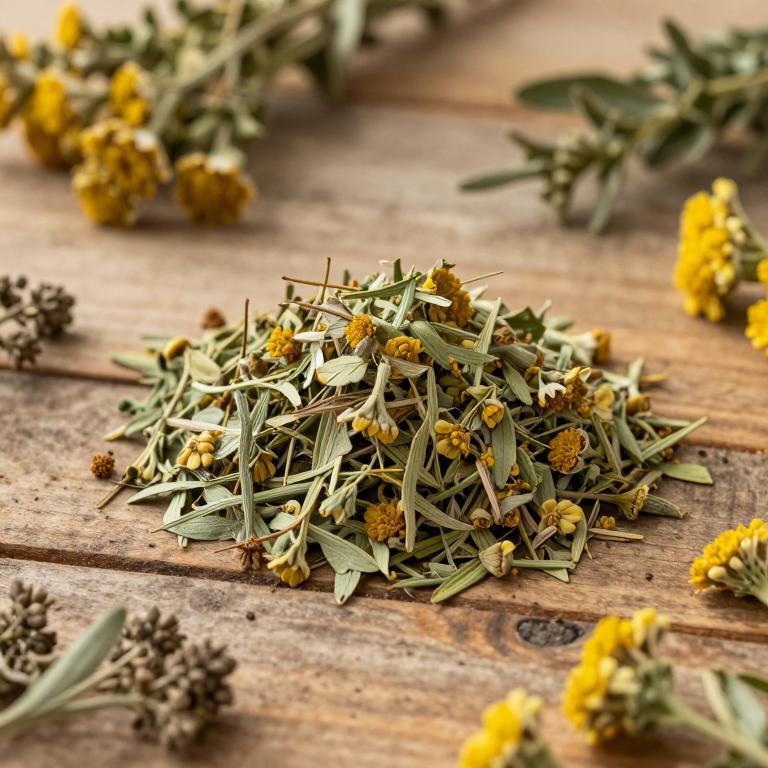
Biennial sagewort, scientifically known as Artemisia biennis, is a perennial herb prized for its potent medicinal properties. Belonging to the Asteraceae family, this plant is traditionally used to treat respiratory ailments, digestive issues, and skin inflammations. Its aromatic leaves contain bioactive compounds essential in various holistic healing practices.
Names and Synonyms
Common Names
- biennial sagewort
- biennial wormwood
- Slender Mugwort
Scientific Names
Accepted name
Artemisia biennisSynonyms
- Artemisia inconspicua
- Artemisia jacquinii
- Artemisia biennis var. diffusa
- Artemisia pinnatifida
Regional and Traditional Names
Spanish:
- Artemisia biennis var. biennis
- Artemisia cernuiflora
- Artemisia ramosa
- Artemisia biennis var. diffusa
- Artemisia inconspicua
- Artemisia jacquinii
- Artemisia pyromacha
- Artemisia australis
- Artemisia eschscholtziana
German:
- Zweijähriger Beifuss
- Zweijähriger Beifuß
- zweijähriger Beifuß
- Zweijaehriger Beifuss
French:
- armoise bisannuelle
- armoise bisanuelle
Sources: Wikidata, Catalogue of Life
Taxonomical Classification
This plant belongs to the kingdom Plantae within the phylum Streptophyta and the class Equisetopsida. It is further classified under the subclass Magnoliidae and the order Asterales. Finally, it is a member of the family Asteraceae and falls under the genus Artemisia.
| Rank | Classification |
|---|---|
| Kingdom | Plantae |
| Phylum | Streptophyta |
| Class | Equisetopsida |
| Subclass | Magnoliidae |
| Order | Asterales |
| Family | Asteraceae |
| Genus | Artemisia |
Sources: The World Checklist of Vascular Plants (WCVP)
Distribution
This plant, known as Artemisia biennis, exhibits a specific geographical range across Northern Europe. Its presence can be documented throughout the coastal and inland regions of Denmark. It also thrives within the northern territories of Finland. Furthermore, the species is widely distributed across the islands of Great Britain and Ireland. Finally, its natural habitat extends into the rugged landscapes of Norway.
| Region | Area |
|---|---|
| Northern Europe | Denmark |
| Northern Europe | Finland |
| Northern Europe | Great Britain |
| Northern Europe | Ireland |
| Northern Europe | Norway |
| Middle Europe | Belgium |
| Middle Europe | Czechia-Slovakia |
| Middle Europe | Germany |
| Middle Europe | Netherlands |
| Middle Europe | Poland |
Sources: The World Checklist of Vascular Plants (WCVP)
Botanical Identification
Life history
The life history of Artemisia biennis is characterized by a lifecycle that is classified as annual, meaning the plant completes its entire biological development from germination to seed production within a single growing season. In terms of its structural growth strategy, it functions as a therophyte, a life form defined by the plant completing its life cycle via seeds and surviving unfavorable environmental conditions in a dormant seed state. This classification as a therophyte applies to both its primary and secondary life form designations, indicating that the plant lacks persistent above-ground or below-ground vegetative structures, such as woody stems or perennial rhizomes, opting instead to rely on a rapid reproductive phase to ensure the continuation of the species.
- Life form :
- therophyte
- Lifecycle :
- annual
Morphology
The morphology of Artemisia biennis is characterized by its growth form as a non-woody herb and forb. It is a self-supporting plant that does not exhibit climbing behavior, such as being a liana or vine, and functions as an independent organism rather than a parasite. As a terrestrial species, it does not possess aquatic or epiphytic habits. In terms of stature, the plant typically reaches a minimum height of 0.3 m, with a mean height of approximately 0.65 m, and can reach a maximum height of up to 1.2 m.
- Aquatic :
- terrestrial
- Climber :
- self-supporting
- Epiphyte :
- terrestrial
- Growth form :
- herb
- Growth form :
- forb
- Parasite :
- independent
- Plant height max:
- 1.2 m
- Plant height mean:
- 0.65 m
- Plant height min:
- 0.3 m
- Woodiness :
- non-woody
Physiology
The physiology of Artemisia biennis is characterized by a C3 photosynthetic pathway, which dictates its carbon fixation processes and metabolic efficiency. The plant exhibits a non-carnivorous nutritional strategy, relying entirely on autotrophic processes through soil nutrient uptake and light absorption. Morphologically, its foliage is defined by an average leaf size of 7.77 cm², contributing to a Specific Leaf Area (SLA) with a mean value of 133.4 cm²/g, reflecting its leaf mass per area and its strategy for balancing light interception with resource conservation.
- Carnivory :
- non-carnivorous
- Leaf size mean:
- 7.77 cm²
- Photosynthetic pathway :
- C3
- Specific Leaf Area (SLA) mean:
- 133.4 cm²/g
Reproduction
The reproduction of Artemisia biennis is driven by a sexual process, as asexual reproduction is notably absent in this species. The flowering period typically begins in August, though the exact flowering end time remains variable. The plant utilizes a biotic pollination syndrome, specifically relying on insect pollination to facilitate fertilization, although self-fertilization is present within the species. Following successful pollination, the plant produces fruit in the form of an achene. These fruits are indehiscent, meaning they do not split open at maturity to release seeds. Finally, the dispersal of the seeds follows an anemochorous syndrome, where they are primarily spread by the action of the wind.
- Dehiscence :
- indehiscent
- Dispersal syndrome :
- anemochorous
- Flowering time :
- Aug
- Flowering time :
- variable
- Fruit type :
- achene
- Pollination syndrome :
- insect
- Pollination syndrome :
- biotic
- Reproduction asexual :
- absent
- Self fertilization :
- present
Sources: Global Inventory of Floras and Traits (GIFT)
Chemicals
Artemisia biennis has 3 reported phytochemicals identified across 0 scientific publications and several other databases. The most consistently reported chemicals include Steroids, Terpenoids, artemisinin.
| Chemical | Supporting sources | Consensus |
|---|---|---|
| Steroids | 1 supporting sources | ★☆☆☆☆ |
| Terpenoids | 1 supporting sources | ★☆☆☆☆ |
| artemisinin | 1 supporting sources | ★☆☆☆☆ |
Steroids
- Research in pharmaceutical sciences
Terpenoids
- Research in pharmaceutical sciences
artemisinin
- Heliyon
Activities
Artemisia biennis has 2 reported activities identified across 0 scientific publications and several other databases. The most consistently reported activities include Antiproliferative, Cytotoxic.
| Activity | Supporting sources | Consensus |
|---|---|---|
| Antiproliferative | 1 supporting sources | ★☆☆☆☆ |
| Cytotoxic | 1 supporting sources | ★☆☆☆☆ |
Antiproliferative
- Research in pharmaceutical sciences
Cytotoxic
- Research in pharmaceutical sciences
Conditions
Artemisia biennis has 2 reported investigations on conditions identified across 0 scientific publications and several other databases. The most consistently reported conditions include antimalarial, antioxidant.
| Condition | Supporting sources | Consensus |
|---|---|---|
| Antimalarial | 1 supporting sources | ★☆☆☆☆ |
| Antioxidant | 1 supporting sources | ★☆☆☆☆ |
Antimalarial
- Research in pharmaceutical sciences
Antioxidant
- Research in pharmaceutical sciences
Preparations
Artemisia biennis has 1 reported preparations identified across 0 scientific publications and several other databases. The most consistently reported preparations include dichloromethane extracts.
| Preparation | Supporting sources | Consensus |
|---|---|---|
| Dichloromethane extracts | 1 supporting sources | ★☆☆☆☆ |
Dichloromethane extracts
- Research in pharmaceutical sciences