Austrian Mugwort
Artemisia austriaca · Accepted scientific name
Scientific literature: Very Sparse (9 studies) · ★☆☆☆☆
Austrian Mugwort, scientifically known as Artemisia austriaca, is a perennial herb belonging to the Asteraceae family. Native to central and southern Europe, this aromatic plant is characterized by its silver-green foliage. Historically valued in traditional medicine, it is studied for its diverse bioactive compounds and potential therapeutic properties.
- Family
- Asteraceae
- Native range
- Europe
- Parts used
- Not available
- Common names
- Austrian Mugwort
- Scientific synonyms
- Absinthium Trifidum
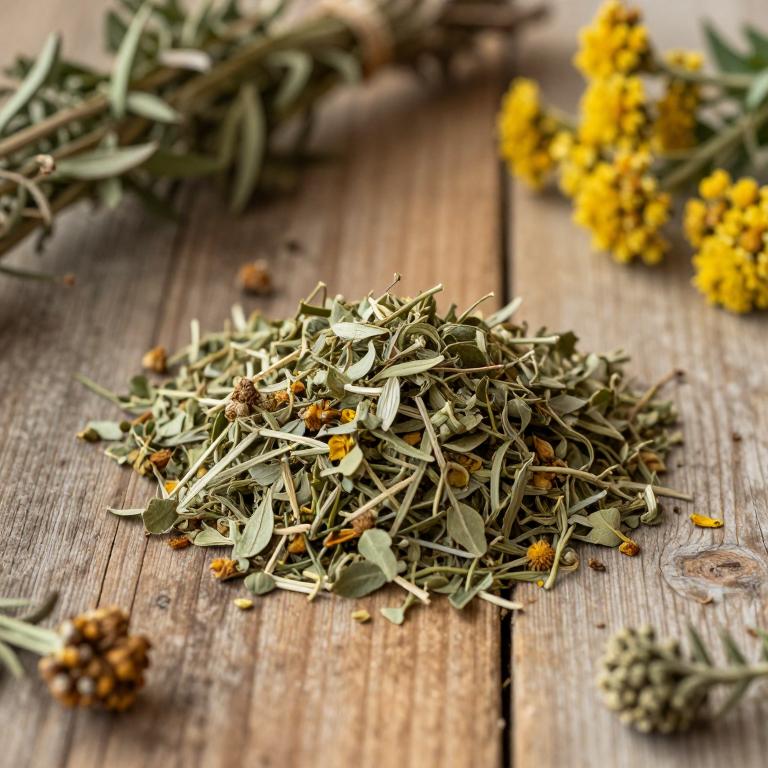
Names and Synonyms
Common Names
- Austrian Mugwort
Scientific Names
Accepted name
Artemisia austriacaSynonyms
- Absinthium trifidum
Regional and Traditional Names
German:
- Österreich-Wermut
- Österreichischer Beifuß
- Österreichischer Beifuß
French:
- Armoise d'Autriche
Sources: Wikidata, Catalogue of Life
Taxonomical Classification
This plant belongs to the kingdom Plantae and the phylum Streptophyta, falling under the class Equisetopsida and subclass Magnoliidae. Within the order Asterales, it is classified under the family Asteraceae. Finally, it is identified by the genus Artemisia, specifically as the species Artemisia austriaca.
| Rank | Classification |
|---|---|
| Kingdom | Plantae |
| Phylum | Streptophyta |
| Class | Equisetopsida |
| Subclass | Magnoliidae |
| Order | Asterales |
| Family | Asteraceae |
| Genus | Artemisia |
Sources: The World Checklist of Vascular Plants (WCVP)
Distribution
This plant is primarily distributed across several regions within Middle Europe. It can be found growing throughout the nation of Austria. Furthermore, its range extends through the territories of Czechia and Slovakia. The species is also present within the borders of Hungary. Finally, its distribution reaches into Southeastern Europe, specifically covering the Northwestern Balkan Peninsula.
| Region | Area |
|---|---|
| Middle Europe | Austria |
| Middle Europe | Czechia-Slovakia |
| Middle Europe | Hungary |
| Southeastern Europe | NW. Balkan Pen. |
Sources: The World Checklist of Vascular Plants (WCVP)
Botanical Identification
Ecology
The ecology of Artemisia austriaca is characterized by its adaptability to a variety of open and semi-open environments, allowing it to thrive across diverse landscapes. It is frequently found in forest clearings and margins, where it can access sufficient light, as well as in meadows and oldfields that provide the necessary space for its growth. Additionally, this species demonstrates a notable capacity for colonizing inhabited places, including parks and disturbed urban green spaces, where it integrates into managed landscapes. Its presence in these varied habitats suggests a resilient ecological strategy capable of navigating both natural successional stages and anthropogenic environments.
- Habitat :
- forest,inhabitedplaces,meadows,oldfields,parks
Life history
The life history of Artemisia austriaca is characterized by its status as a perennial plant, allowing it to persist through multiple growing seasons within its natural habitat. Structurally, the species is classified as a chamaephyte, a life form defined by having its perennating buds located close to the soil surface, often just above it, which helps protect the plant during unfavorable environmental conditions. This growth habit, consistent across its morphological classification as a chamaephyte, enables the plant to maintain a stable presence in its ecosystem by regenerating from these low-lying buds each year.
- Life form :
- chamaephyte
- Lifecycle :
- perennial
Morphology
The morphology of Artemisia austriaca is characterized by its growth form as a non-woody herb. As a self-supporting plant, it does not exhibit climbing behavior and functions as an independent organism, neither acting as a parasite nor an epiphyte, maintaining a terrestrial lifestyle. The plant typically reaches a height ranging from a minimum of 0.2 m to a maximum of 0.6 m, with an average plant height of approximately 0.4 m.
- Aquatic :
- terrestrial
- Climber :
- self-supporting
- Epiphyte :
- terrestrial
- Growth form :
- herb
- Parasite :
- independent
- Plant height max:
- 0.6 m
- Plant height mean:
- 0.4 m
- Plant height min:
- 0.2 m
- Woodiness :
- non-woody
Physiology
The physiology of Artemisia austriaca is characterized by a C3 photosynthetic pathway, which dictates its metabolic carbon fixation processes and adaptation to its environmental niche. The morphological aspects of its foliage play a critical role in its physiological performance, specifically regarding light interception and gas exchange. The leaves exhibit significant variability in dimensions, with a mean leaf length of 2.75 cm, ranging from a minimum of 1.5 cm to a maximum of 4 cm. Correspondingly, the leaf width shows a mean value of 1.75 cm, fluctuating between a minimum of 1 cm and a maximum of 2.5 cm. These specific leaf dimensions contribute to the plant's overall surface area, influencing its transpiration rates and its capacity to manage thermal regulation through its C3 metabolic framework.
- Leaf length max:
- 4 cm
- Leaf length mean:
- 2.75 cm
- Leaf length min:
- 1.5 cm
- Leaf width max:
- 2.5 cm
- Leaf width mean:
- 1.75 cm
- Leaf width min:
- 1 cm
- Photosynthetic pathway :
- C3
Reproduction
The reproduction of Artemisia austriaca is characterized by a specific seasonal cycle and biological mechanisms designed for successful propagation. The flowering period is concentrated in the month of August, with both the onset and conclusion of flowering occurring during this time. The pollination process is primarily biotic in nature, utilizing an insect-based pollination syndrome to facilitate fertilization. Furthermore, the plant possesses the capability for self-fertilization, which ensures reproductive success even in varying environmental conditions. Once seeds are developed, the dispersal syndrome is classified as zoochorous, meaning the plant relies on animals for the movement of its reproductive units to new locations.
- Dispersal syndrome :
- zoochorous
- Flowering time :
- Aug
- Pollination syndrome :
- insect
- Pollination syndrome :
- biotic
- Self fertilization :
- present
Sources: Global Inventory of Floras and Traits (GIFT)
Chemicals
Artemisia austriaca has 3 reported phytochemicals identified across 0 scientific publications and several other databases. The most consistently reported chemicals include Coumarins, Flavonoids, Lignan.
| Chemical | Supporting sources | Consensus |
|---|---|---|
| Coumarins | 1 supporting sources | ★☆☆☆☆ |
| Flavonoids | 1 supporting sources | ★☆☆☆☆ |
| Lignan | 1 supporting sources | ★☆☆☆☆ |
Coumarins
- Antioxidants (Basel, Switzerland)
Flavonoids
- Antioxidants (Basel, Switzerland)
Lignan
- Antioxidants (Basel, Switzerland)
Activities
Artemisia austriaca has 2 reported activities identified across 0 scientific publications and several other databases. The most consistently reported activities include Antibacterial, Antioxidant.
| Activity | Supporting sources | Consensus |
|---|---|---|
| Antibacterial | 1 supporting sources | ★☆☆☆☆ |
| Antioxidant | 1 supporting sources | ★☆☆☆☆ |
Antibacterial
- Antioxidants (Basel, Switzerland)
Antioxidant
- Antioxidants (Basel, Switzerland)
Conditions
Artemisia austriaca has 1 reported investigations on conditions identified across 0 scientific publications and several other databases. The most consistently reported conditions include antioxidant.
| Condition | Supporting sources | Consensus |
|---|---|---|
| Antioxidant | 1 supporting sources | ★☆☆☆☆ |
Antioxidant
- Antioxidants (Basel, Switzerland)
Preparations
Artemisia austriaca has 1 reported preparations identified across 0 scientific publications and several other databases. The most consistently reported preparations include extracts.
| Preparation | Supporting sources | Consensus |
|---|---|---|
| Extracts | 1 supporting sources | ★☆☆☆☆ |
Extracts
- Journal of applied microbiology