African wormwood
Artemisia afra · Accepted scientific name
Scientific literature: Moderate (117 studies) · ★★★☆☆
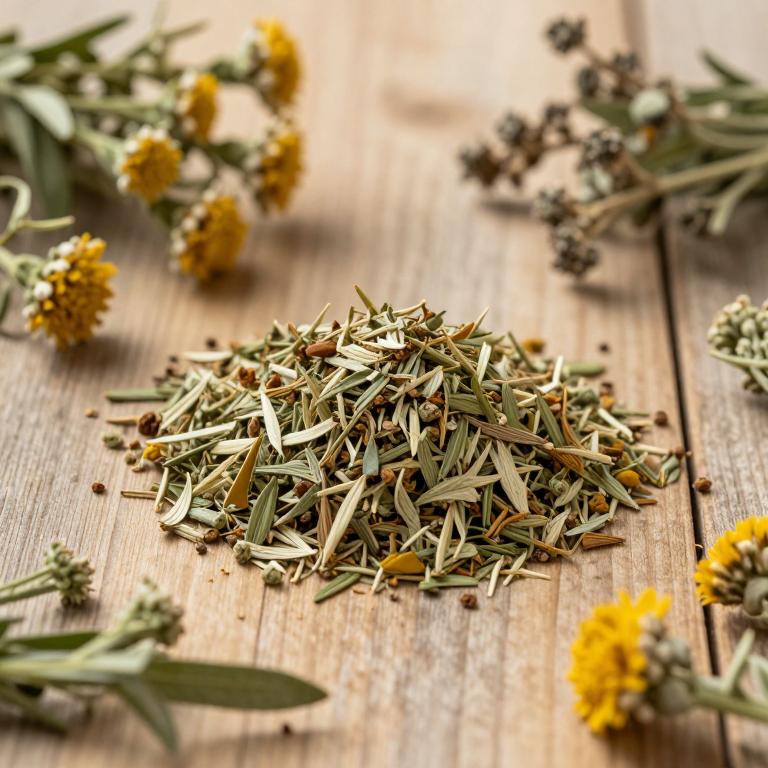
African wormwood, scientifically known as Artemisia afra, is a versatile perennial shrub native to various regions of Africa. Renowned for its aromatic, pungent foliage, this medicinal plant has long been utilized in traditional healing to treat respiratory ailments, digestive issues, and malaria, making it a cornerstone of herbal medicine.
- Family
- Asteraceae
- Native range
- Europe
- Parts used
- Leaf · Stem
- Common names
- African Wormwood · Wild Wormwood
- Scientific synonyms
- Not available
Names and Synonyms
Common Names
- African wormwood
- Wild Wormwood
Scientific Names
Accepted name
Artemisia afraRegional and Traditional Names
Spanish:
- Absinthium tenuifolium
- Artemisia pseudopontica
- Artemisia balsamita
- Artemisia pallida
- Artemisia altaica
- Absinthium ponticum
- Artemisia tenuifolia
Sources: Wikidata, Catalogue of Life
Taxonomical Classification
This plant belongs to the kingdom Plantae and the phylum Streptophyta within the class Equisetopsida. It is further classified under the subclass Magnoliidae and the order Asterales. Finally, Artemisia afra is a member of the family Asteraceae and the genus Artemisia.
| Rank | Classification |
|---|---|
| Kingdom | Plantae |
| Phylum | Streptophyta |
| Class | Equisetopsida |
| Subclass | Magnoliidae |
| Order | Asterales |
| Family | Asteraceae |
| Genus | Artemisia |
Sources: The World Checklist of Vascular Plants (WCVP)
Distribution
This plant exhibits a diverse geographical distribution that spans multiple continents and climatic zones. In Middle Europe, its presence can be identified within the borders of Germany. Moving toward the northeast, it is also found across the tropical landscapes of Ethiopia. The species extends significantly into South Tropical Africa, where it grows in Angola and Zambia. Finally, its range reaches further into the southern regions of the continent within Zimbabwe.
| Region | Area |
|---|---|
| Middle Europe | Germany |
| Northeast Tropical Africa | Ethiopia |
| South Tropical Africa | Angola |
| South Tropical Africa | Zambia |
| South Tropical Africa | Zimbabwe |
| Southern Africa | Botswana |
| Southern Africa | Cape Provinces |
| Southern Africa | Lesotho |
| Southern Africa | Namibia |
| Southern Africa | KwaZulu-Natal |
Sources: The World Checklist of Vascular Plants (WCVP)
Botanical Identification
Ecology
The ecology of Artemisia afra is characterized by its remarkable adaptability to diverse topographic gradients, allowing it to inhabit a broad spectrum of environments. This species demonstrates a significant altitudinal plasticity, thriving across an extensive elevational range that spans from as low as 20 m AMSL to a maximum of 2440 m AMSL. Such a wide vertical distribution suggests that the plant is capable of tolerating varied thermal regimes, atmospheric pressures, and moisture availability, ranging from lowland coastal or subtropical regions to high-altitude montane ecosystems. This ecological breadth enables it to occupy diverse niches within its native landscape, facilitating its survival in both temperate and more extreme highland habitats.
- Elevational range max:
- 2440 m AMSL
- Elevational range min:
- 20 m AMSL
Life history
The life history of Artemisia afra is characterized by its status as a perennial plant, allowing it to persist through multiple growing seasons rather than completing its cycle within a single year. As a long-lived species, it establishes a robust presence in its native habitats, often developing extensive root systems that support its survival through varying environmental conditions. This perennial nature enables the plant to undergo repeated cycles of vegetative growth and seasonal flowering, contributing to its long-term stability within its ecosystem. Throughout its life cycle, the plant exhibits a resilient growth pattern that allows it to endure fluctuations in moisture and temperature, maintaining its biological functions over many years.
- Lifecycle :
- perennial
Morphology
The morphology of Artemisia afra is characterized by a woody growth form, functioning as a self-supporting herb. As a terrestrial plant, it does not exhibit aquatic or epiphytic tendencies and operates as an independent organism rather than a parasite. The plant's stature varies significantly depending on environmental conditions, with a height ranging from a minimum of 0.3 m to a maximum of 2 m, maintaining an average plant height of approximately 1 m.
- Aquatic :
- terrestrial
- Climber :
- self-supporting
- Epiphyte :
- terrestrial
- Growth form :
- herb
- Parasite :
- independent
- Plant height max:
- 2 m
- Plant height mean:
- 1 m
- Plant height min:
- 0.3 m
- Woodiness :
- woody
Physiology
The physiology of Artemisia afra is characterized by specialized metabolic pathways and adaptive mechanisms designed for survival in diverse environmental conditions. As a member of the Asteraceae family, its physiological processes are heavily focused on the synthesis and secretion of diverse secondary metabolites, particularly volatile essential oils such as terpenoids, which serve critical roles in chemical defense and thermoregulation. The plant exhibits robust photosynthetic efficiency, utilizing its leaf structure to optimize light interception while managing transpiration rates in varying humidity levels. Regarding its nutrient acquisition processes, Artemisia afra does not function as a nitrogen fixer, meaning it lacks the symbiotic relationship with nitrogen-fixing bacteria (such as rhizobia) required to convert atmospheric nitrogen into bioavailable forms; instead, it relies on the uptake of nitrates and ammonium from the soil through its root system. Its physiological resilience is further supported by complex osmotic adjustments that allow it to maintain cellular turgor and metabolic functionality during periods of water scarcity.
- Nitrogen fixer :
- no
Reproduction
The reproduction of Artemisia afra is characterized by the production of small seeds that exhibit significant variation in weight. The seed mass within a population shows a mean value of 0.000213333 g, reflecting the typical energetic investment per individual propagule. However, the reproductive output demonstrates a broad spectrum of seed sizes, with a maximum recorded seed mass of 0.00048 g and a minimum mass as low as 0.00005 g. This range in seed mass suggests a diverse strategy in seed development, which may influence dispersal capabilities and initial seedling vigor during the establishment phase.
- Seed mass max:
- 0.00048 g
- Seed mass mean:
- 0.000213333 g
- Seed mass min:
- 5e-05 g
Sources: Global Inventory of Floras and Traits (GIFT)
Plant Parts
Artemisia afra has 2 reported plant parts identified across 9 scientific publications and several other databases that are studied for medicinal purposes. The most consistently reported plant part include leaf, stem.
| Plant part | Supporting sources | Consensus |
|---|---|---|
| Leaf | 8 supporting sources | ★★★★☆ |
| Stem | 1 supporting sources | ★☆☆☆☆ |
Leaf
- Journal of ethnopharmacology
- BMC complementary medicine and therapies
- Ecology and evolution
- Evidence-based complementary and alternative medicine : eCAM
- Molecules (Basel, Switzerland)
View 3 additional sources
- Fitoterapia
- Plants (Basel, Switzerland)
- Ethiopian journal of health sciences
Stem
- Molecules (Basel, Switzerland)
Chemicals
Artemisia afra has 44 reported phytochemicals identified across 9 scientific publications and several other databases. The most consistently reported chemicals include Flavonoids, acacetin, artemisinin, Chrysoeriol, Genkwanin.
| Chemical | Supporting sources | Consensus |
|---|---|---|
| Flavonoids | 4 supporting sources | ★★☆☆☆ |
| acacetin | 4 supporting sources | ★★☆☆☆ |
| artemisinin | 4 supporting sources | ★★☆☆☆ |
| Chrysoeriol | 2 supporting sources | ★☆☆☆☆ |
| Genkwanin | 2 supporting sources | ★☆☆☆☆ |
| 25-hydroxyvitamin d3-26,23-lactone | 1 supporting sources | ★☆☆☆☆ |
| 3,5-Di-O-caffeoylquinic acid | 1 supporting sources | ★☆☆☆☆ |
| 4-Caffeoylquinic acid | 1 supporting sources | ★☆☆☆☆ |
| 5-hydroxy-7-methoxy-2-(4-methoxyphenyl)chromen-4-one | 1 supporting sources | ★☆☆☆☆ |
| AN | 1 supporting sources | ★☆☆☆☆ |
Flavonoids
- Phytotherapy research : PTR
- BMC complementary medicine and therapies
- Journal of AOAC International
- Plants (Basel, Switzerland)
acacetin
- Phytotherapy research : PTR
- Fitoterapia
- Natural product research
- Journal of AOAC International
artemisinin
- Journal of ethnopharmacology
- Molecules (Basel, Switzerland)
- Phytomedicine : international journal of phytotherapy and phytopharmacology
- Natural product reports
Chrysoeriol
- Fitoterapia
- Journal of AOAC International
Genkwanin
- Phytotherapy research : PTR
- Journal of AOAC International
25-hydroxyvitamin d3-26,23-lactone
- Pharmaceuticals (Basel, Switzerland)
3,5-Di-O-caffeoylquinic acid
- Fitoterapia
4-Caffeoylquinic acid
- Fitoterapia
5-hydroxy-7-methoxy-2-(4-methoxyphenyl)chromen-4-one
- Journal of ethnopharmacology
AN
- Journal of ethnopharmacology
Activities
Artemisia afra has 3 reported activities identified across 9 scientific publications and several other databases. The most consistently reported activities include Antioxidant, Antidiabetic, Antimalarial.
| Activity | Supporting sources | Consensus |
|---|---|---|
| Antioxidant | 4 supporting sources | ★★☆☆☆ |
| Antidiabetic | 2 supporting sources | ★☆☆☆☆ |
| Antimalarial | 1 supporting sources | ★☆☆☆☆ |
Antioxidant
- BMC complementary medicine and therapies
- Antibiotics (Basel, Switzerland)
- Natural product research
- BMC complementary and alternative medicine
Antidiabetic
- Natural product research
- Evidence-based complementary and alternative medicine : eCAM
Antimalarial
- Molecules (Basel, Switzerland)
Conditions
Artemisia afra has 25 reported investigations on conditions identified across 9 scientific publications and several other databases. The most consistently reported conditions include malaria, Mycobacterium smegmatis, tuberculosis, Mycobacterium tuberculosis, Plasmodium falciparum.
| Condition | Supporting sources | Consensus |
|---|---|---|
| Malaria | 4 supporting sources | ★★☆☆☆ |
| Mycobacterium smegmatis | 3 supporting sources | ★★☆☆☆ |
| Tuberculosis | 3 supporting sources | ★★☆☆☆ |
| Mycobacterium tuberculosis | 2 supporting sources | ★☆☆☆☆ |
| Plasmodium falciparum | 2 supporting sources | ★☆☆☆☆ |
| Sars-cov-2 | 2 supporting sources | ★☆☆☆☆ |
| Covid-19 | 1 supporting sources | ★☆☆☆☆ |
| Diabetes mellitus | 1 supporting sources | ★☆☆☆☆ |
| Escherichia coli | 1 supporting sources | ★☆☆☆☆ |
| Mycobacterium abscessus | 1 supporting sources | ★☆☆☆☆ |
Malaria
- Journal of ethnopharmacology
- Molecules (Basel, Switzerland)
- Phytomedicine : international journal of phytotherapy and phytopharmacology
- Ethiopian journal of health sciences
Mycobacterium smegmatis
- Antibiotics (Basel, Switzerland)
- Evidence-based complementary and alternative medicine : eCAM
- Phytotherapy research : PTR
Tuberculosis
- Tuberculosis (Edinburgh, Scotland)
- Evidence-based complementary and alternative medicine : eCAM
- Journal of ethnopharmacology
Mycobacterium tuberculosis
- Evidence-based complementary and alternative medicine : eCAM
- Journal of ethnopharmacology
Plasmodium falciparum
- Phytotherapy research : PTR
- Journal of ethnopharmacology
Sars-cov-2
- Experimental biology and medicine (Maywood, N.J.)
- Pharmaceuticals (Basel, Switzerland)
Covid-19
- Rwanda journal of medicine and health sciences
Diabetes mellitus
- Natural product communications
Escherichia coli
- Ethiopian journal of health sciences
Mycobacterium abscessus
- Journal of ethnopharmacology
Preparations
Artemisia afra has 31 reported preparations identified across 9 scientific publications and several other databases. The most consistently reported preparations include extracts, infusions, 80% ethanol, acetone crude extract, aqueous extract.
| Preparation | Supporting sources | Consensus |
|---|---|---|
| Extracts | 3 supporting sources | ★★☆☆☆ |
| Infusions | 2 supporting sources | ★☆☆☆☆ |
| 80% ethanol | 1 supporting sources | ★☆☆☆☆ |
| Acetone crude extract | 1 supporting sources | ★☆☆☆☆ |
| Aqueous extract | 1 supporting sources | ★☆☆☆☆ |
| Aqueous leaf extract | 1 supporting sources | ★☆☆☆☆ |
| Aqueous- extracts | 1 supporting sources | ★☆☆☆☆ |
| Capsules | 1 supporting sources | ★☆☆☆☆ |
| Crude acetone extracts | 1 supporting sources | ★☆☆☆☆ |
| Crude dried leaves | 1 supporting sources | ★☆☆☆☆ |
Extracts
- Experimental biology and medicine (Maywood, N.J.)
- Journal of ethnopharmacology
- Pharmaceuticals (Basel, Switzerland)
Infusions
- Molecules (Basel, Switzerland)
- Phytomedicine : international journal of phytotherapy and phytopharmacology
80% ethanol
- BMC complementary medicine and therapies
Acetone crude extract
- Antibiotics (Basel, Switzerland)
Aqueous extract
- Journal of ethnopharmacology
Aqueous leaf extract
- Journal of ethnopharmacology
Aqueous- extracts
- Tuberculosis (Edinburgh, Scotland)
Capsules
- Phytomedicine : international journal of phytotherapy and phytopharmacology
Crude acetone extracts
- Journal of ethnopharmacology
Crude dried leaves
- Journal of ethnopharmacology